Advertisements
Advertisements
प्रश्न
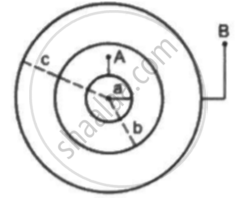
Consider an assembly of three conducting concentric spherical shell of radii a, b and c as shown in figure Find the capacitance of the assembly between the points Aand B.
Advertisements
उत्तर
The spherical shells form two spherical capacitors: one made by A and B and the other made by B and C.
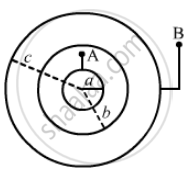
The capacitance of the spherical capacitor made by the shells of radii r1 and r2 is given by
`C = (4pi∈_0)/[[1/r_1 - 1/r^2]] = (4pi∈_0r_1r_2)/(r_2 - r_1)`
The capacitance of the capacitor made by A and B is given by
`C_(AB) = (4pi∈_0ab)/(b-a)`
The capacitance of the capacitor made by B and C is given by
`C_(BC) = (4pi∈_0bc)/(c-b)`
As the capacitors are in series, the net capacitance is given by
`1/C = 1/C_(AB) + 1/C_(BC)`
⇒ `C = (C_(AB)C_(BC))/(C_(AB)+C_(BC)) = (((4pi∈_0)^2 ab^2c)/((b-a)(c-b)))/((4pi∈_0ab)/((b-a))+(4pi∈_0bc)/((c-b))`
⇒ `C = ((4pi∈_0ab^2c)/((b-a)(c-b)))/(((ab(c-b)+bc(b-a))/((b-a)(c-b))))`
⇒ `C = (4pi∈_0ab^2c)/[[ab(c-b)+bc(b-a)]]`
⇒ `C = (4pi∈_0ab^2c)/(b^2(c-a)) = (4pi∈_0ac)/((c-a))`
APPEARS IN
संबंधित प्रश्न
When an AC source is connected to an ideal capacitor, show that the average power supplied by the source over a complete cycle is zero
A capacitor of capacitance C is charged fully by connecting it to a battery of emf E. It is then disconnected from the battery. If the separation between the plates of the capacitor is now doubled, how will the following change?
(i) charge stored by the capacitor.
(ii) Field strength between the plates.
(iii) Energy stored by the capacitor.
Justify your answer in each case.
Define capacitor reactance. Write its S.I units.
As `C = (1/V) Q` , can you say that the capacitance C is proportional to the charge Q?
Two capacitors each having capacitance C and breakdown voltage V are joined in series. The capacitance and the breakdown voltage of the combination will be
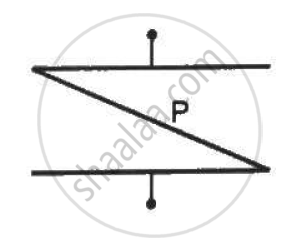
A thin metal plate P is inserted between the plates of a parallel-plate capacitor of capacitance C in such a way that its edges touch the two plates . The capacitance now becomes _________ .
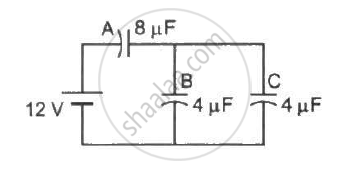
Find the charge appearing on each of the three capacitors shown in figure .
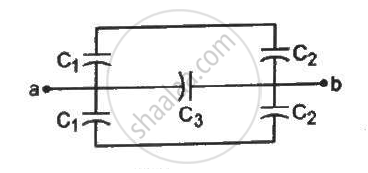
Find the equivalent capacitance of the system shown in figure between the points a and b.
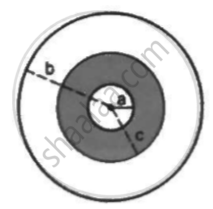
A sphercial capacitor is made of two conducting spherical shells of radii a and b. The space between the shells is filled with a dielectric of dielectric constant K up to a radius c as shown in figure . Calculate the capacitance.
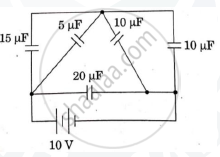
The figure show a network of five capacitors connected to a 10V battery. Calculate the charge acquired by the 5μF capacitor.
A capacitor is charged by a battery. The battery is removed and another identical uncharged capacitor is connected in parallel. The total electrostatic energy of resulting system ______.
Three capacitors 2µF, 3µF, and 6µF are joined in series with each other. The equivalent capacitance is ____________.
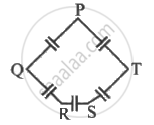
Five capacitor each of capacitance value C are connected as shown in the figure. The ratio of capacitance between P to R, and the capacitance between P and Q is ______.
The radius of a sphere of capacity 1 microfarad in the air is ______
Consider two conducting spheres of radii R1 and R2 with R1 > R2. If the two are at the same potential, the larger sphere has more charge than the smaller sphere. State whether the charge density of the smaller sphere is more or less than that of the larger one.
The displacement current of 4.425 µA is developed in the space between the plates of the parallel plate capacitor when voltage is changing at a rate of 106 Vs-1. The area of each plate of the capacitor is 40 cm2. The distance between each plate of the capacitor is x × 10-3 m. The value of x is ______.
(Permittivity of free space, ε0 = 8.85 × 10⁻¹²C2N-1m-2).
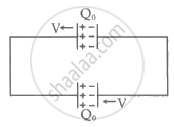
Two identical capacitors are connected as shown and have an initial charge of Q0. The separation between the plates of each capacitor is d0. Suddenly the left plate of the upper capacitor and right plate of the lower capacitor start moving with speed v towards the left while the other plate of each capacitor remains fixed. `("given" (Q_0V)/(2d_0) = 10 A)`. The value of current in the circuit is ______ A.
What is called the capacity of conductor?
For a given capacitor, what fixes its capacitance?
