Advertisements
Advertisements
Question
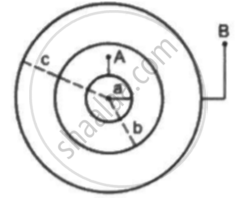
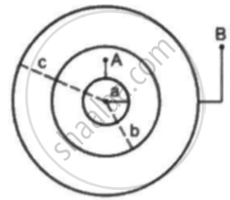
Consider an assembly of three conducting concentric spherical shell of radii a, b and c as shown in figure Find the capacitance of the assembly between the points Aand B.
Advertisements
Solution
The spherical shells form two spherical capacitors: one made by A and B and the other made by B and C.
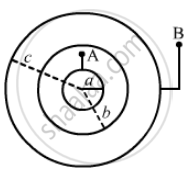
The capacitance of the spherical capacitor made by the shells of radii r1 and r2 is given by
`C = (4pi∈_0)/[[1/r_1 - 1/r^2]] = (4pi∈_0r_1r_2)/(r_2 - r_1)`
The capacitance of the capacitor made by A and B is given by
`C_(AB) = (4pi∈_0ab)/(b-a)`
The capacitance of the capacitor made by B and C is given by
`C_(BC) = (4pi∈_0bc)/(c-b)`
As the capacitors are in series, the net capacitance is given by
`1/C = 1/C_(AB) + 1/C_(BC)`
⇒ `C = (C_(AB)C_(BC))/(C_(AB)+C_(BC)) = (((4pi∈_0)^2 ab^2c)/((b-a)(c-b)))/((4pi∈_0ab)/((b-a))+(4pi∈_0bc)/((c-b))`
⇒ `C = ((4pi∈_0ab^2c)/((b-a)(c-b)))/(((ab(c-b)+bc(b-a))/((b-a)(c-b))))`
⇒ `C = (4pi∈_0ab^2c)/[[ab(c-b)+bc(b-a)]]`
⇒ `C = (4pi∈_0ab^2c)/(b^2(c-a)) = (4pi∈_0ac)/((c-a))`
APPEARS IN
RELATED QUESTIONS
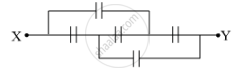
Find the equivalent capacitance of the network shown in the figure, when each capacitor is of 1 μF. When the ends X and Y are connected to a 6 V battery, find out (i) the charge and (ii) the energy stored in the network.
A capacitor of capacitance ‘C’ is being charged by connecting it across a dc source along with an ammeter. Will the ammeter show a momentary deflection during the process of charging? If so, how would you explain this momentary deflection and the resulting continuity of current in the circuit? Write the expression for the current inside the capacitor.
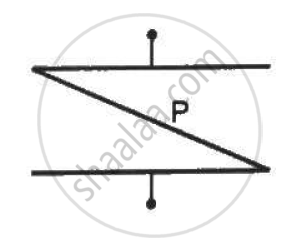
A thin metal plate P is inserted between the plates of a parallel-plate capacitor of capacitance C in such a way that its edges touch the two plates . The capacitance now becomes _________ .
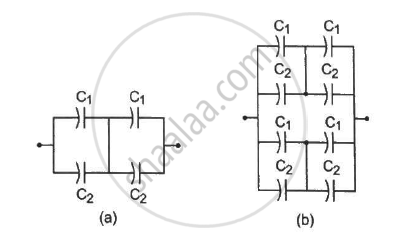
Take `C_1 = 4.0 "uF" and C_2 = 6.0 "uF"` in figure . Calculate the equivalent capacitance of the combination between the points indicated.
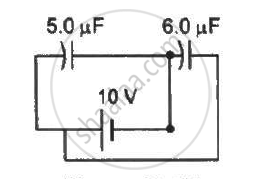
Find the charge supplied by the battery in the arrangement shown in figure.
A cylindrical capacitor is constructed using two coaxial cylinders of the same length 10 cm and of radii 2 mm and 4 mm. (a) Calculate the capacitance. (b) Another capacitor of the same length is constructed with cylinders of radii 4 mm and 8 mm. Calculate the capacitance.
A parallel-plate capacitor of plate area A and plate separation d is charged to a potential difference V and then the battery is disconnected. A slab of dielectric constant K is then inserted between the plates of the capacitor so as to fill the space between the plates. Find the work done on the system in the process of inserting the slab.
Suppose the space between the two inner shells is filled with a dielectric of dielectric constant K. Find the capacitance of the system between A and B.
Three capacitors C1 = 3μF, C2 = 6μF, and C3 = 10μF are connected to a 50 V battery as shown in Figure below:

Calculate:
(i) The equivalent capacitance of the circuit between points A and B.
(ii) The charge on C1.
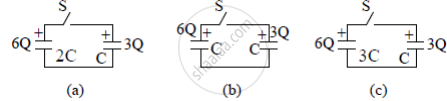
Three circuits, each consisting of a switch 'S' and two capacitors, are initially charged, as shown in the figure. After the switch has been closed, in which circuit will the charge on the left-hand capacitor
(i) increase,
(ii) decrease, and
(iii) remains the same? Give reasons.
Obtain the expression for capacitance for a parallel plate capacitor.
The displacement current of 4.425 µA is developed in the space between the plates of the parallel plate capacitor when voltage is changing at a rate of 106 Vs-1. The area of each plate of the capacitor is 40 cm2. The distance between each plate of the capacitor is x × 10-3 m. The value of x is ______.
(Permittivity of free space, ε0 = 8.85 × 10⁻¹²C2N-1m-2).
A 5µF capacitor is charged fully by a 220 V supply. It is then disconnected from the supply and is connected in series to another uncharged 2.5 µF capacitor If the energy change during the charge redistribution is `"X"/100`J then value of X to the 100 nearest integer is ______.
Current versus time and voltage versus time graphs of a circuit element are shown in figure.
 |
 |
The type of the circuit element is ______.
Calculate equivalent capacitance of the circuit shown in the Figure given below:

Eight drops of mercury of equal radius and possessing equal charge combine to form a big drop. The capacitance of bigger drop as compared to each small drop is ______.
In a parallel combination, which statement describes the charges on the capacitors?
Which statement describes the voltage and use of a parallel combination?
