Advertisements
Advertisements
Question
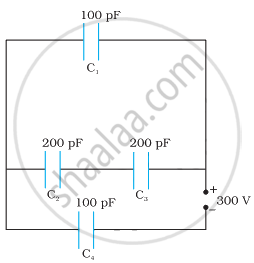
Obtain the equivalent capacitance of the network in Figure. For a 300 V supply, determine the charge and voltage across each capacitor.
Advertisements
Solution
Capacitance of capacitor C1 is 100 pF.
Capacitance of capacitor C2 is 200 pF.
Capacitance of capacitor C3 is 200 pF.
Capacitance of capacitor C4 is 100 pF.
Supply potential, V = 300 V
Capacitors C2 and C3 are connected in series.
Let their equivalent capacitance be C'
∴ `1/"C'" = 1/200 + 1/200 = 2/200`
∴ C' = 100 pF
Capacitors C1 and C' are in parallel. Let their equivalent capacitance be C''.
∴ `"C''" = "C'" + "C"_1`
= 100 + 100
= 200 pF
C'' and C4 are connected in series. Let their equivalent capacitance be C.
∴ `1/C = 1/("C''") + 1/("C"_4)`
= `1/200 + 1/100`
= `(2 + 1)/200`
C = `200/3` pF
Hence, the equivalent capacitance of the circuit is `200/3` pF.
Potential difference across C" = V"
Potential difference across C4 = V4
∴ `"V''" + "V"_4 = "V" = 300 "V"`
Charge on C4 is given by
Q4 = CV
= `200/3 xx 10^-12 xx 300`
= `2 xx 10^-8 "C"`
∴ `"V"_4 = "Q"_4/"C"_4`
= `(2 xx 10^-8)/(100 xx 10^-12)` = 200 V
∴ Voltage across C1 is given by
`"V"_1 = "V" - "V"_4`
= `300 - 200 = 100 "V"`
Hence, potential difference, V1, across C1 is 100 V.
Charge on C1 is given by,
`"Q"_1 = "C"_1"V"_1`
= `100 xx 10^-12 xx 100`
= `10^-8 "C"`
C2 and C3 have the same capacitances have a potential difference of 100 V together. Since C2 and C3 are in series, the potential difference across C2 and C3 is given by,
V2 = V3 = 50 V
Therefore, charge on C2 is given by,
`"Q"_2 = "C"_2"V"_2`
= `200 xx 10^-12 xx 50`
= `10^-8 "C"`
And charge on C3 is given by,
`"Q"_3 = "C"_3"V"_3`
= `200 xx 10^-12 xx 50`
= `10^-8 "C"`
Hence, the equivalent capacitance of the given circuit is `200/3` pF with
Q1 = 10−8 C, V1 = 100 V
Q2 = 10−8 C, V2 = 50 V
Q3 = 10−8 C, V3 = 50 V
Q4 = 2 × 10⁻⁸ C, V4 = 200 V
APPEARS IN
RELATED QUESTIONS
Two identical capacitors of 12 pF each are connected in series across a battery of 50 V. How much electrostatic energy is stored in the combination? If these were connected in parallel across the same battery, how much energy will be stored in the combination now?
Also find the charge drawn from the battery in each case.
As `C = (1/V) Q` , can you say that the capacitance C is proportional to the charge Q?
A capacitor of capacitance C is charged to a potential V. The flux of the electric field through a closed surface enclosing the capacitor is
Three capacitors of capacitances 6 µF each are available. The minimum and maximum capacitances, which may be obtained are
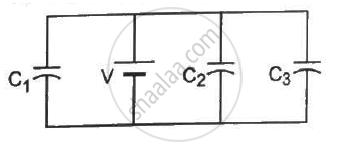
Find the charges on the three capacitors connected to a battery as shown in figure.
Take `C_1 = 2.0 uF , C_2 = 4.0 uF , C_3 = 6.0 uF and V` = 12 volts.
It is required to construct a 10 µF capacitor which can be connected across a 200 V battery. Capacitors of capacitance 10 µF are available but they can withstand only 50 V. Design a combination which can yield the desired result.
Find the equivalent capacitance of the system shown in figure between the points a and b.
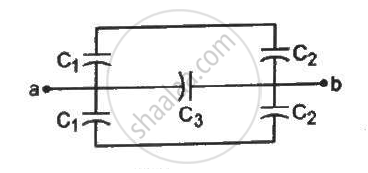
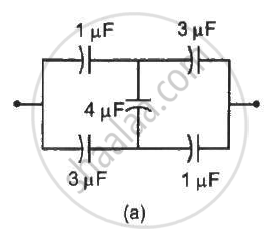
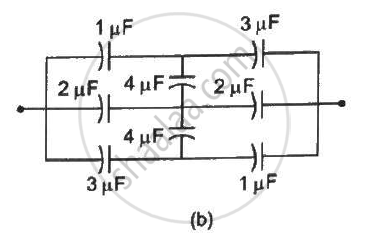
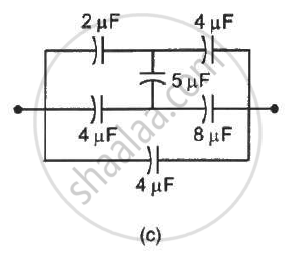
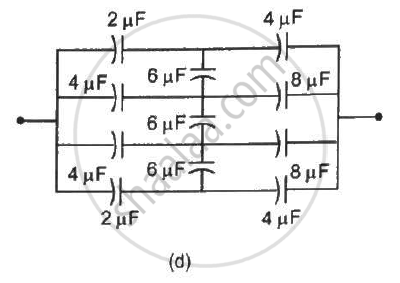
Find the equivalent capacitances of the combinations shown in figure between the indicated points.
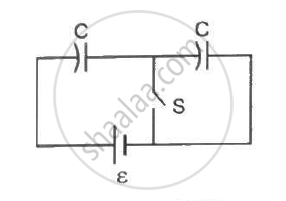
Consider the situation shown in the figure. The switch S is open for a long time and then closed. (a) Find the charge flown through the battery when the switch S is closed. (b) Find the work done by the battery.(c) Find the change in energy stored in the capacitors.(d) Find the heat developed in the system.
A parallel-plate capacitor of capacitance 5 µF is connected to a battery of emf 6 V. The separation between the plates is 2 mm. (a) Find the charge on the positive plate. (b) Find the electric field between the plates. (c) A dielectric slab of thickness 1 mm and dielectric constant 5 is inserted into the gap to occupy the lower half of it. Find the capacitance of the new combination. (d) How much charge has flown through the battery after the slab is inserted?
A parallel plate capacitor stores a charge Q at a voltage V. Suppose the area of the parallel plate capacitor and the distance between the plates are each doubled then which is the quantity that will change?
Obtain the expression for capacitance for a parallel plate capacitor.
A capacitor is charged by a battery. The battery is removed and another identical uncharged capacitor is connected in parallel. The total electrostatic energy of resulting system ______.
- Charge on each capacitor remains same and equals to the main charge supplied by the battery.
- Potential difference and energy distribute in the reverse ratio of capacitance.
- Effective capacitance is even les than the least of teh individual capacitances.
When air is replaced by a dielectric medium of constant K, the maximum force of attraction between two charges separated by a distance ______.
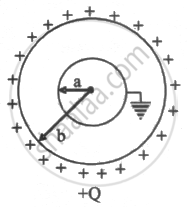
Two spherical conductors A and B of radii a and b(b > a) are placed concentrically in the air. B is given a charge +Q and A is earthed. The equivalent capacitance of the system is ______.
The displacement current of 4.425 µA is developed in the space between the plates of the parallel plate capacitor when voltage is changing at a rate of 106 Vs-1. The area of each plate of the capacitor is 40 cm2. The distance between each plate of the capacitor is x × 10-3 m. The value of x is ______.
(Permittivity of free space, ε0 = 8.85 × 10⁻¹²C2N-1m-2).
Two plates A and B of a parallel plate capacitor are arranged in such a way, that the area of each plate is S = 5 × 10⁻³ m 2 and distance between them is d = 8.85 mm. Plate A has a positive charge q1 = 10-10 C and Plate B has charge q2 = + 2 × 10⁻¹⁰ C. Then the charge induced on the plate B due to the plate A be - (....... × 10-11 )C