Advertisements
Advertisements
Question
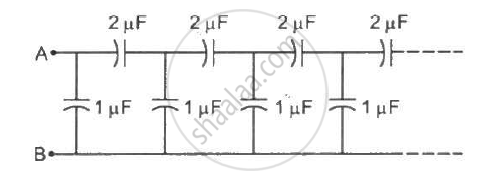
Find the equivalent capacitance of the infinite ladder shown in figure between the points A and B.
Advertisements
Solution
Let the equivalent capacitance of the infinite ladder be C.
Because it is an infinite ladder, the change in the equivalent capacitance will be negligible if we add one more ladder at point AB, as shown in the given figure.

From the given figure, the equivalent capacitance can be calculated as :-
`C_(eq) = (2 xx C)/(2+C)+1 = C`
`⇒ (2+C)C = 3C + 2`
`⇒ 2C + C^2 = 3C + 2`
`⇒ C^2 - C - 2 = 0`
`⇒ (C-2) (C+1) = 0`
`⇒ C =-1 or C = 2`
`⇒ C= -1` (It is not possible)
`therefore C = 2 "uF"`
APPEARS IN
RELATED QUESTIONS
When an AC source is connected to an ideal capacitor, show that the average power supplied by the source over a complete cycle is zero
Define capacitor reactance. Write its S.I units.
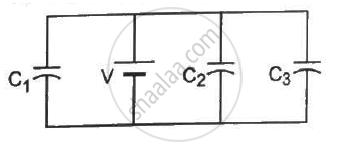
Find the charges on the three capacitors connected to a battery as shown in figure.
Take `C_1 = 2.0 uF , C_2 = 4.0 uF , C_3 = 6.0 uF and V` = 12 volts.
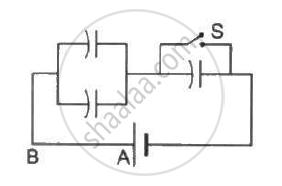
Each capacitor shown in figure has a capacitance of 5⋅0 µF. The emf of the battery is 50 V. How much charge will flow through AB if the switch S is closed?
A 5⋅0 µF capacitor is charged to 12 V. The positive plate of this capacitor is now connected to the negative terminal of a 12 V battery and vice versa. Calculate the heat developed in the connecting wires.
The two square faces of a rectangular dielectric slab (dielectric constant 4⋅0) of dimensions 20 cm × 20 cm × 1⋅0 mm are metal-coated. Find the capacitance between the coated surfaces.
If the voltage applied on a capacitor is increased from V to 2V, choose the correct conclusion.
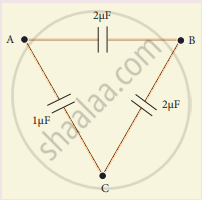
Three capacitors are connected in a triangle as shown in the figure. The equivalent capacitance between points A and C is ______.
Explain in detail the effect of a dielectric placed in a parallel plate capacitor.
Derive the expression for resultant capacitance, when the capacitor is connected in parallel.
For the given capacitor configuration
- Find the charges on each capacitor
- potential difference across them
- energy stored in each capacitor.
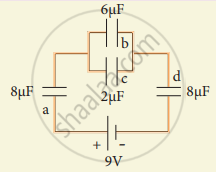
Two similar conducting spheres having charge+ q and -q are placed at 'd' seperation from each other in air. The radius of each ball is r and the separation between their centre is d (d >> r). Calculate the capacitance of the two ball system ______.

The displacement current of 4.425 µA is developed in the space between the plates of the parallel plate capacitor when voltage is changing at a rate of 106 Vs-1. The area of each plate of the capacitor is 40 cm2. The distance between each plate of the capacitor is x × 10-3 m. The value of x is ______.
(Permittivity of free space, ε0 = 8.85 × 10⁻¹²C2N-1m-2).
For changing the capacitance of a given parallel plate capacitor, a dielectric material of dielectric constant K is used, which has the same area as the plates of the capacitor.
The thickness of the dielectric slab is `3/4`d, where 'd' is the separation between the plate of the parallel plate capacitor.
The new capacitance (C') in terms of the original capacitance (C0) is given by the following relation:
Two plates A and B of a parallel plate capacitor are arranged in such a way, that the area of each plate is S = 5 × 10⁻³ m 2 and distance between them is d = 8.85 mm. Plate A has a positive charge q1 = 10-10 C and Plate B has charge q2 = + 2 × 10⁻¹⁰ C. Then the charge induced on the plate B due to the plate A be - (....... × 10-11 )C
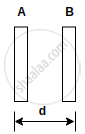
What is called the capacity of conductor?
What is the practical purpose of a series combination of capacitors?
