Advertisements
Advertisements
प्रश्न
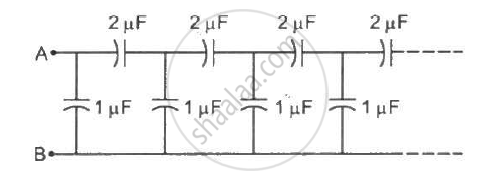
Find the equivalent capacitance of the infinite ladder shown in figure between the points A and B.
Advertisements
उत्तर
Let the equivalent capacitance of the infinite ladder be C.
Because it is an infinite ladder, the change in the equivalent capacitance will be negligible if we add one more ladder at point AB, as shown in the given figure.

From the given figure, the equivalent capacitance can be calculated as :-
`C_(eq) = (2 xx C)/(2+C)+1 = C`
`⇒ (2+C)C = 3C + 2`
`⇒ 2C + C^2 = 3C + 2`
`⇒ C^2 - C - 2 = 0`
`⇒ (C-2) (C+1) = 0`
`⇒ C =-1 or C = 2`
`⇒ C= -1` (It is not possible)
`therefore C = 2 "uF"`
APPEARS IN
संबंधित प्रश्न
A spherical capacitor consists of two concentric spherical conductors, held in position by suitable insulating supports. Show that the capacitance of a spherical capacitor is given by
C = `(4piin_0"r"_1"r"_2)/("r"_1 - "r"_2)`
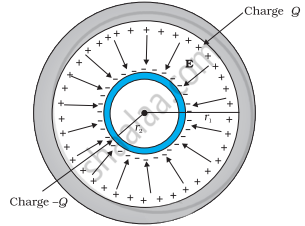
where r1 and r2 are the radii of outer and inner spheres, respectively.
Three capacitors of capacitances 6 µF each are available. The minimum and maximum capacitances, which may be obtained are
When 1⋅0 × 1012 electrons are transferred from one conductor to another, a potential difference of 10 V appears between the conductors. Calculate the capacitance of the two-conductor system.
Suppose, one wishes to construct a 1⋅0 farad capacitor using circular discs. If the separation between the discs be kept at 1⋅0 mm, what would be the radius of the discs?
Three capacitors having capacitances 20 µF, 30 µF and 40 µF are connected in series with a 12 V battery. Find the charge on each of the capacitors. How much work has been done by the battery in charging the capacitors?
Find the charge appearing on each of the three capacitors shown in figure .
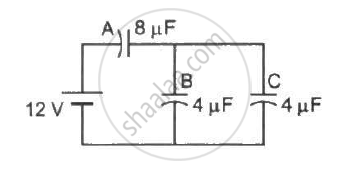
Find the charge supplied by the battery in the arrangement shown in figure.
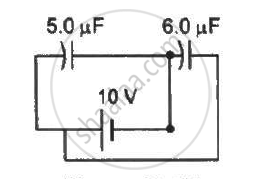
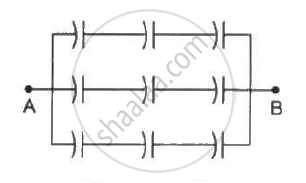
Each of the capacitors shown in figure has a capacitance of 2 µF. find the equivalent capacitance of the assembly between the points A and B. Suppose, a battery of emf 60 volts is connected between A and B. Find the potential difference appearing on the individual capacitors.
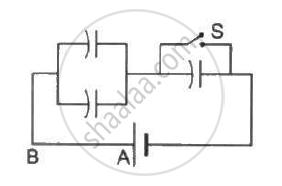
Each capacitor shown in figure has a capacitance of 5⋅0 µF. The emf of the battery is 50 V. How much charge will flow through AB if the switch S is closed?
The two square faces of a rectangular dielectric slab (dielectric constant 4⋅0) of dimensions 20 cm × 20 cm × 1⋅0 mm are metal-coated. Find the capacitance between the coated surfaces.
A parallel-plate capacitor has plate area 100 cm2 and plate separation 1⋅0 cm. A glass plate (dielectric constant 6⋅0) of thickness 6⋅0 mm and an ebonite plate (dielectric constant 4⋅0) are inserted one over the other to fill the space between the plates of the capacitor. Find the new capacitance.
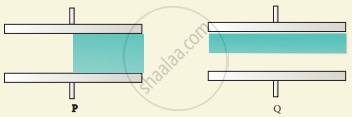
Capacitors P and Q have identical cross-sectional areas A and separation d. The space between the capacitors is filled with a dielectric of dielectric constant Er as shown in the figure. Calculate the capacitance of capacitors P and Q.
When air is replaced by a dielectric medium of constant K, the maximum force of attraction between two charges separated by a distance ______.
The capacitance of a parallel plate capacitor is 60 µF. If the distance between the plates is tripled and area doubled then new capacitance will be ______.
Between the plates of parallel plate condenser there is 1 mm thick medium shoot of dielectric constant 4. It is charged at 100 volt. The electric field in volt/meter between the plates of capacitor is ______.
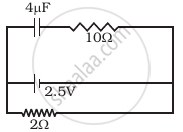
A capacitor of 4 µ F is connected as shown in the circuit (Figure). The internal resistance of the battery is 0.5 Ω. The amount of charge on the capacitor plates will be ______.
A capacitor of capacity 2 µF is charged to a potential difference of 12 V. It is then connected across an inductor of inductance 0.6 mH. The current in the circuit at a time when the potential difference across the capacitor is 6.0 V is ______ × 10-1A.
Which expression gives the capacitance of a capacitor?
For the same potential difference, what does a larger capacitance mean?
Which statement describes the voltage and use of a parallel combination?
