Advertisements
Advertisements
प्रश्न
A parallel-plate capacitor has plate area 100 cm2 and plate separation 1⋅0 cm. A glass plate (dielectric constant 6⋅0) of thickness 6⋅0 mm and an ebonite plate (dielectric constant 4⋅0) are inserted one over the other to fill the space between the plates of the capacitor. Find the new capacitance.
Advertisements
उत्तर

The given system of the capacitor will behave as two capacitors connected in series.
Let the capacitances be C1 and C2.
Now,
`C_1 = (∈_0Ak_1)/d_1` and `C_2 = (∈_0Ak_2)/d_2`
Thus, the net capacitance is given by
`C = (C_1C_2)/(C_1+C_2)`
= `((∈_0Ak_1)/d_1 xx (∈_0Ak_2)/d_2)/((∈_0Ak_1)/d_1 +(∈_0Ak_2)/d_2)`
= `(∈_0A(k_1+k_2))/(k_1d_2+k_2d_1)`
= `((8.85 xx 10^-12) xx (10^-2) xx 24) / ((6 xx 4 xx 10^-3 + 4 xx 6 xx 10^-3)) = 4.425 xx 10^-11 C`
= 44.25 pF
APPEARS IN
संबंधित प्रश्न
A capacitor of capacitance ‘C’ is charged to ‘V’ volts by a battery. After some time the battery is disconnected and the distance between the plates is doubled. Now a slab of dielectric constant, 1 < k < 2, is introduced to fill the space between the plates. How will the following be affected? (a) The electric field between the plates of the capacitor Justify your answer by writing the necessary expressions.
Define capacitor reactance. Write its S.I units.
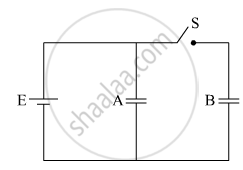
Two identical parallel plate capacitors A and B are connected to a battery of V volts with the switch S closed. The switch is now opened and the free space between the plates of the capacitors is filled with a dielectric of dielectric constant K. Find the ratio of the total electrostatic energy stored in both capacitors before and after the introduction of the dielectric.
As `C = (1/V) Q` , can you say that the capacitance C is proportional to the charge Q?
Three capacitors of capacitances 6 µF each are available. The minimum and maximum capacitances, which may be obtained are
Three capacitors having capacitances 20 µF, 30 µF and 40 µF are connected in series with a 12 V battery. Find the charge on each of the capacitors. How much work has been done by the battery in charging the capacitors?
Two conducting spheres of radii R1 and R2 are kept widely separated from each other. What are their individual capacitances? If the spheres are connected by a metal wire, what will be the capacitance of the combination? Think in terms of series−parallel connections.
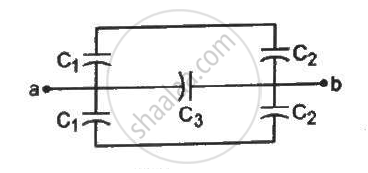
Find the equivalent capacitance of the system shown in figure between the points a and b.
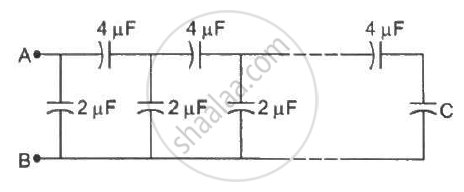
A finite ladder is constructed by connecting several sections of 2 µF, 4 µF capacitor combinations as shown in the figure. It is terminated by a capacitor of capacitance C. What value should be chosen for C, such that the equivalent capacitance of the ladder between the points A and B becomes independent of the number of sections in between?
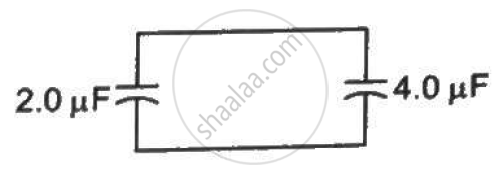
A capacitor of capacitance 2⋅0 µF is charged to a potential difference of 12 V. It is then connected to an uncharged capacitor of capacitance 4⋅0 µF as shown in figure . Find (a) the charge on each of the two capacitors after the connection, (b) the electrostatic energy stored in each of the two capacitors and (c) the heat produced during the charge transfer from one capacitor to the other.
A 5⋅0 µF capacitor is charged to 12 V. The positive plate of this capacitor is now connected to the negative terminal of a 12 V battery and vice versa. Calculate the heat developed in the connecting wires.
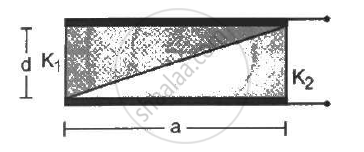
A capacitor is formed by two square metal-plates of edge a, separated by a distance d. Dielectrics of dielectric constant K1 and K2 are filled in the gap as shown in figure . Find the capacitance.
A parallel-plate capacitor with the plate area 100 cm2 and the separation between the plates 1⋅0 cm is connected across a battery of emf 24 volts. Find the force of attraction between the plates.
The variation of inductive reactance (XL) of an inductor with the frequency (f) of the ac source of 100 V and variable frequency is shown in fig.
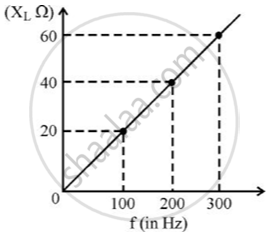
- Calculate the self-inductance of the inductor.
- When this inductor is used in series with a capacitor of unknown value and a resistor of 10 Ω at 300 s–1, maximum power dissipation occurs in the circuit. Calculate the capacitance of the capacitor.
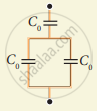
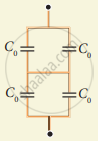
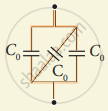
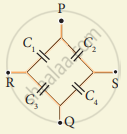
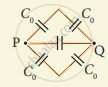
Calculate the resultant capacitances for each of the following combinations of capacitors.
Which system is called a capacitor?
In a series combination, which quantity is the same on each capacitor?
In a series combination, which statement describes the potential difference across each capacitor?
Which combination has charge as its constant quantity and potential difference as its variable quantity?
