Advertisements
Advertisements
प्रश्न
Two conducting spheres of radii R1 and R2 are kept widely separated from each other. What are their individual capacitances? If the spheres are connected by a metal wire, what will be the capacitance of the combination? Think in terms of series−parallel connections.
Advertisements
उत्तर
We need to calculate the capacitance of an isolated charged sphere.
Let us assume that the charge on the sphere is Q and its radius is R.
Capacitance of the charged sphere can be found by imagining a concentric sphere of infinite radius consisting of −Q charge.
Potential difference between the spheres = `1/(4pi∈_0) Q/R` - 0 = `1/(4pi∈_0) Q/R`
Capacitance is the ratio of the magnitude of the charge on each conductor to the potential difference between them.
`C = Q/(1/(4pi∈_0) Q/R` = `4pi∈_0 R`
Therefore, the capacitances of spheres of radii R1 and R2 are C1 and C2, respectively. They are given by
`C_1 = 4pi∈_0 R_1`
`C_2 = 4pi∈_0 R_2`
If the spheres are connected by a metal wire, the charge will flow from one sphere to another till their potentials become the same.
As there potentials become the same, the potential difference between the conductors for both the capacitors also becomes the same. Thus, it can be concluded that the capacitors are connected in parallel.
Thus, the capacitance of the combination is given by `C_(eq) = C_1 + C_2`
= `4pi∈_0(R_1 + R_2)`
APPEARS IN
संबंधित प्रश्न
Define capacitor reactance. Write its S.I units.
Three capacitors of capacitances 6 µF each are available. The minimum and maximum capacitances, which may be obtained are
Suppose, one wishes to construct a 1⋅0 farad capacitor using circular discs. If the separation between the discs be kept at 1⋅0 mm, what would be the radius of the discs?
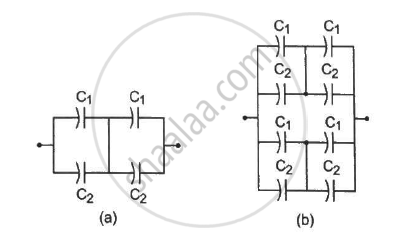
Take `C_1 = 4.0 "uF" and C_2 = 6.0 "uF"` in figure . Calculate the equivalent capacitance of the combination between the points indicated.
It is required to construct a 10 µF capacitor which can be connected across a 200 V battery. Capacitors of capacitance 10 µF are available but they can withstand only 50 V. Design a combination which can yield the desired result.
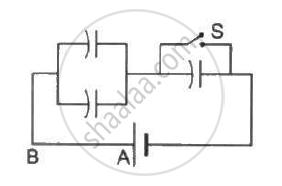
Each capacitor shown in figure has a capacitance of 5⋅0 µF. The emf of the battery is 50 V. How much charge will flow through AB if the switch S is closed?
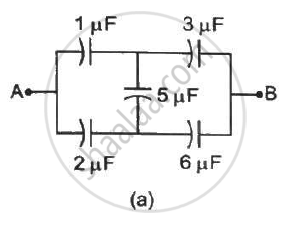
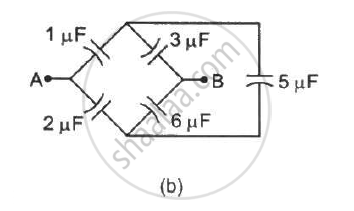
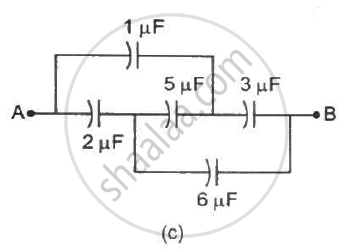
Convince yourself that parts (a), (b) and (c) figure are identical. Find the capacitance between the points A and B of the assembly.
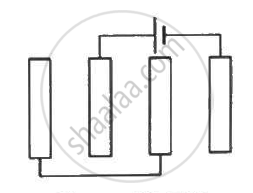
Each of the plates shown in figure has surface area `(96/∈_0) xx 10^-12` Fm on one side and the separation between the consecutive plates is 4⋅0 mm. The emf of the battery connected is 10 volts. Find the magnitude of the charge supplied by the battery to each of the plates connected to it.
The two square faces of a rectangular dielectric slab (dielectric constant 4⋅0) of dimensions 20 cm × 20 cm × 1⋅0 mm are metal-coated. Find the capacitance between the coated surfaces.
A parallel-plate capacitor of capacitance 5 µF is connected to a battery of emf 6 V. The separation between the plates is 2 mm. (a) Find the charge on the positive plate. (b) Find the electric field between the plates. (c) A dielectric slab of thickness 1 mm and dielectric constant 5 is inserted into the gap to occupy the lower half of it. Find the capacitance of the new combination. (d) How much charge has flown through the battery after the slab is inserted?
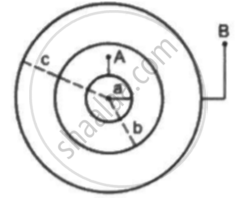
Consider an assembly of three conducting concentric spherical shell of radii a, b and c as shown in figure Find the capacitance of the assembly between the points Aand B.
Three capacitors C1 = 3μF, C2 = 6μF, and C3 = 10μF are connected to a 50 V battery as shown in Figure below:

Calculate:
(i) The equivalent capacitance of the circuit between points A and B.
(ii) The charge on C1.
Obtain an expression for equivalent capacitance when three capacitors C1, C2 and C3 are connected in series.
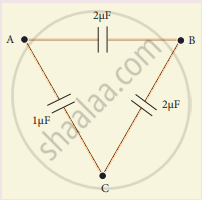
Three capacitors are connected in a triangle as shown in the figure. The equivalent capacitance between points A and C is ______.
Obtain the expression for capacitance for a parallel plate capacitor.
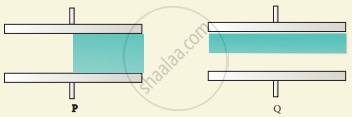
Capacitors P and Q have identical cross-sectional areas A and separation d. The space between the capacitors is filled with a dielectric of dielectric constant Er as shown in the figure. Calculate the capacitance of capacitors P and Q.
Current versus time and voltage versus time graphs of a circuit element are shown in figure.
 |
 |
The type of the circuit element is ______.
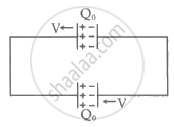
Two identical capacitors are connected as shown and have an initial charge of Q0. The separation between the plates of each capacitor is d0. Suddenly the left plate of the upper capacitor and right plate of the lower capacitor start moving with speed v towards the left while the other plate of each capacitor remains fixed. `("given" (Q_0V)/(2d_0) = 10 A)`. The value of current in the circuit is ______ A.
For a given capacitor, what fixes its capacitance?
