Advertisements
Advertisements
प्रश्न
Following operations can be performed on a capacitor:
X − connect the capacitor to a battery of emf ε.
Y − disconnect the battery.
Z − reconnect the battery with polarity reversed.
W − insert a dielectric slab in the capacitor.
(a) In XYZ (perform X, then Y, then Z) the stored electric energy remains unchanged and no thermal energy is developed.
(b) The charge appearing on the capacitor is greater after the action XWY than after the action XYZ.
(c) The electric energy stored in the capacitor is greater after the action WXY than after the action XYW.
(d) The electric field in the capacitor after the action XW is the same as that after WX.
Advertisements
उत्तर
(b) The charge appearing on the capacitor is greater after the action XWY than after the action XYZ.
(c) The electric energy stored in the capacitor is greater after the action WXY than after the action XYW.
(d) The electric field in the capacitor after the action XW is the same as that after WX.
Justification of option (b)
If the potential is held constant, that is, the battery remains attached to the circuit, then the charge on the capacitor increases by a factor of K on inserting a dielectric of a dielectric constant K between the plates of the capacitor.
Mathematically,
q = Kq0
Here, q0 and q are the charges without dielectric and with dielectric, respectively.
The amount of charge stored does not depend upon the polarity of the plates.
Thus, the charge appearing on the capacitor is greater after the action XWY than after the action XYZ.
Justification of option (c)
Since the battery is disconnected before inserting a dielectric, the amount of charge remains constant, that is,q = q0, because after the battery is disconnected, the capacitor gets no source to store charge from. In other words, the capacitor is now an isolated system where the amount of charge is conserved and so is the energy U as `1/2q∈` . Hence, inserting a dielectric after disconnecting the battery will not bring any change in the amount of charge stored in the capacitor. So, the energy stored in the capacitor will also not change after the action XYW.
However, during the action WXY, the amount of charge that will get stored in the capacitor will get increased by a factor of K, as the battery is disconnected after inserting a dielectric between the plates of the capacitor and the energy stored will also get multiplied by a factor of K.
Thus, the electric energy stored in the capacitor is greater after the action WXY than after the action XYW.
Justification of option (d)
The electric field between the plates E depends on the potential across the capacitor and the distanced between the plates of the capacitor.
Mathematically,
`E = ∈/d`
In either case, that is, during actions XW and WX, the potential remains the same, that is, ∈. Thus, the electric field E remains the same.
Denial of option (a)
During the action XYZ, the battery has to do extra work equivalent to `1/2CV^2` to change the polarity of the plates of the capacitor. In other words, the total work to be done by the battery will be `1/2CV^2+1/2CV^2` . This extra work done will be dissipated as heat energy. Thus, thermal energy is developed. However, the stored electric energy remains unchanged, that is `1/2CV^2` .
APPEARS IN
संबंधित प्रश्न
When an AC source is connected to an ideal capacitor, show that the average power supplied by the source over a complete cycle is zero
A capacitor of unknown capacitance is connected across a battery of V volts. The charge stored in it is 360 μC. When potential across the capacitor is reduced by 120 V, the charge stored in it becomes 120 μC.
Calculate:
(i) The potential V and the unknown capacitance C.
(ii) What will be the charge stored in the capacitor, if the voltage applied had increased by 120 V?
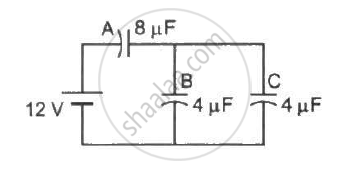
Find the charge appearing on each of the three capacitors shown in figure .
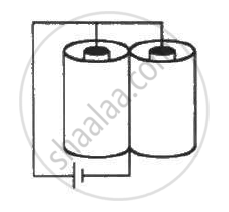
The outer cylinders of two cylindrical capacitors of capacitance 2⋅2 µF each, are kept in contact and the inner cylinders are connected through a wire. A battery of emf 10 V is connected as shown in figure . Find the total charge supplied by the battery to the inner cylinders.
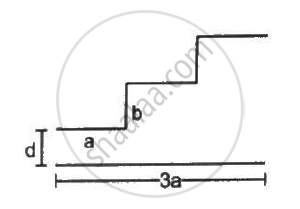
A capacitor is made of a flat plate of area A and a second plate having a stair-like structure as shown in figure . The width of each stair is a and the height is b. Find the capacitance of the assembly.
A parallel-plate capacitor has plate area 100 cm2 and plate separation 1⋅0 cm. A glass plate (dielectric constant 6⋅0) of thickness 6⋅0 mm and an ebonite plate (dielectric constant 4⋅0) are inserted one over the other to fill the space between the plates of the capacitor. Find the new capacitance.
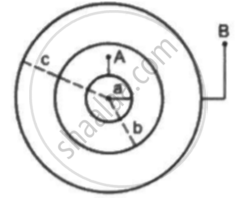
Consider an assembly of three conducting concentric spherical shell of radii a, b and c as shown in figure Find the capacitance of the assembly between the points Aand B.
An air-filled parallel-plate capacitor is to be constructed which can store 12 µC of charge when operated at 1200 V. What can be the minimum plate area of the capacitor? The dielectric strength of air is `3 xx 10^6 "Vm"^-1`
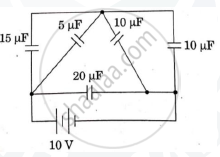
The figure show a network of five capacitors connected to a 10V battery. Calculate the charge acquired by the 5μF capacitor.
Obtain the expression for capacitance for a parallel plate capacitor.
Explain in detail the effect of a dielectric placed in a parallel plate capacitor.
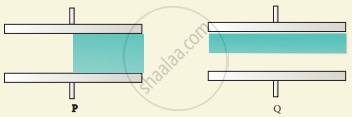
Capacitors P and Q have identical cross-sectional areas A and separation d. The space between the capacitors is filled with a dielectric of dielectric constant Er as shown in the figure. Calculate the capacitance of capacitors P and Q.
A capacitor is charged by a battery. The battery is removed and another identical uncharged capacitor is connected in parallel. The total electrostatic energy of resulting system ______.
Between the plates of parallel plate condenser there is 1 mm thick medium shoot of dielectric constant 4. It is charged at 100 volt. The electric field in volt/meter between the plates of capacitor is ______.
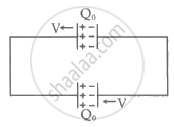
Two identical capacitors are connected as shown and have an initial charge of Q0. The separation between the plates of each capacitor is d0. Suddenly the left plate of the upper capacitor and right plate of the lower capacitor start moving with speed v towards the left while the other plate of each capacitor remains fixed. `("given" (Q_0V)/(2d_0) = 10 A)`. The value of current in the circuit is ______ A.
A parallel plate capacitor (A) of capacitance C is charged by a battery to voltage V. The battery is disconnected and an uncharged capacitor (B) of capacitance 2C is connected across A. Find the ratio of final charges on A and B.
Which expression gives the capacitance of a capacitor?
In a series combination, which quantity is the same on each capacitor?
In a parallel combination, which quantity is the same across each capacitor?
