Advertisements
Advertisements
प्रश्न
During a thunder storm, the movement of water molecules within the clouds creates friction, partially causing the bottom part of the clouds to become negatively charged. This implies that the bottom of the cloud and the ground act as a parallel plate capacitor. If the electric field between the cloud and ground exceeds the dielectric breakdown of the air (3 × 10⁶ Vm–1), lightning will occur.
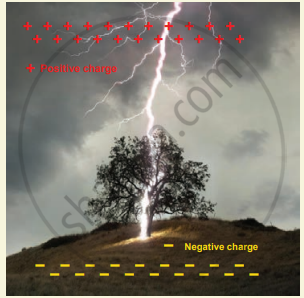
- If the bottom part of the cloud is 1000 m above the ground, determine the electric potential difference that exists between the cloud and ground.
- In a typical lightning phenomenon, around 25 C of electrons are transferred from cloud to ground. How much electrostatic potential energy is transferred to the ground?
Advertisements
उत्तर
- Electric field between the cloud and ground,
V = E.d
V= 3 x 106 x 1000 = 3 x 10⁹V - Electrons transfered from cloud to ground,
q = 25 C
Electron static potential energy,
U = `1/2 "CV"^2`
`["C" = "q"/"V"]`
`= 1/2 "qV" = 1/2 xx 25 xx 3 xx 10^9`
U = 37.5 x 10⁹ J
APPEARS IN
संबंधित प्रश्न
A capacitor of capacitance C is charged to a potential V. The flux of the electric field through a closed surface enclosing the capacitor is
Find the charge appearing on each of the three capacitors shown in figure .
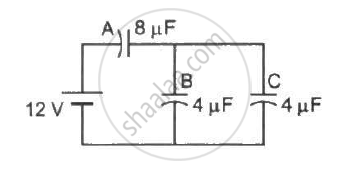
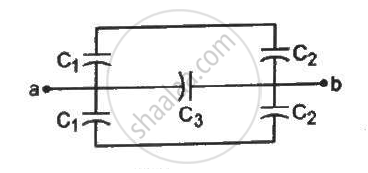
Find the equivalent capacitance of the system shown in figure between the points a and b.
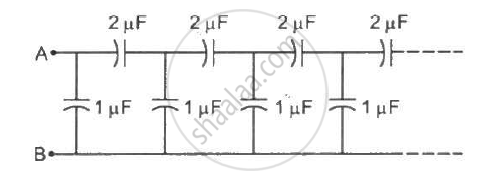
Find the equivalent capacitance of the infinite ladder shown in figure between the points A and B.
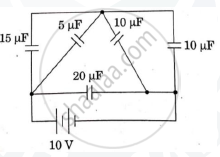
The figure show a network of five capacitors connected to a 10V battery. Calculate the charge acquired by the 5μF capacitor.
Between the plates of parallel plate condenser there is 1 mm thick medium shoot of dielectric constant 4. It is charged at 100 volt. The electric field in volt/meter between the plates of capacitor is ______.
A 5µF capacitor is charged fully by a 220 V supply. It is then disconnected from the supply and is connected in series to another uncharged 2.5 µF capacitor If the energy change during the charge redistribution is `"X"/100`J then value of X to the 100 nearest integer is ______.
If the plates of a parallel plate capacitor connected to a battery are moved close to each other, then:
- the charge stored in it. increases.
- the energy stored in it, decreases.
- its capacitance increases.
- the ratio of charge to its potential remains the same.
- the product of charge and voltage increases.
Choose the most appropriate answer from the options given below:
What does a large capacitance mean in terms of charge storage and potential difference?
