Advertisements
Advertisements
प्रश्न
A 5⋅0 µF capacitor is charged to 12 V. The positive plate of this capacitor is now connected to the negative terminal of a 12 V battery and vice versa. Calculate the heat developed in the connecting wires.
Advertisements
उत्तर
As a capacitor of capacitance C is connected to the battery of voltage V, one of its plates gets charged to Q = CV and the other gets charged to −Q coulomb. When the polarity is reversed, charge −Q appears on the first plate and charge +Q appears on the second plate. So to maintain these charges, charge 2Q passes through the battery from the negative terminal to the positive terminal.
The work done by the battery is given by `W = 2QV = 2CE^2`
In the given process, the capacitor's energy remains the same in both cases. The work done by the battery appears as heat in the connecting wires.
Now,
Heat produced :
`H = 2CE^2`
`H = 2 xx (5 xx 10^-6) xx 144`
`H = 144 xx 10^-5 "J"= 1.44 "mJ"`
APPEARS IN
संबंधित प्रश्न
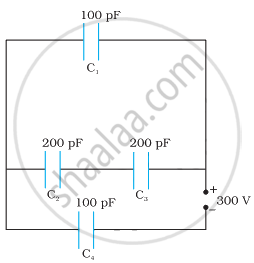
Obtain the equivalent capacitance of the network in Figure. For a 300 V supply, determine the charge and voltage across each capacitor.
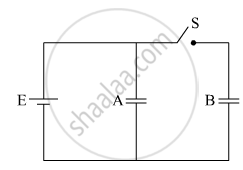
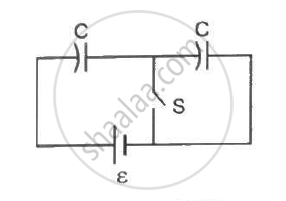
Two identical parallel plate capacitors A and B are connected to a battery of V volts with the switch S closed. The switch is now opened and the free space between the plates of the capacitors is filled with a dielectric of dielectric constant K. Find the ratio of the total electrostatic energy stored in both capacitors before and after the introduction of the dielectric.
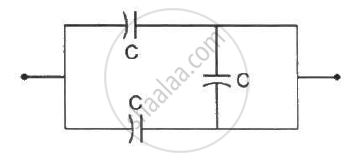
The equivalent capacitance of the combination shown in the figure is _________ .
The plates of a parallel-plate capacitor are made of circular discs of radii 5⋅0 cm each. If the separation between the plates is 1⋅0 mm, what is the capacitance?
Three capacitors having capacitances 20 µF, 30 µF and 40 µF are connected in series with a 12 V battery. Find the charge on each of the capacitors. How much work has been done by the battery in charging the capacitors?
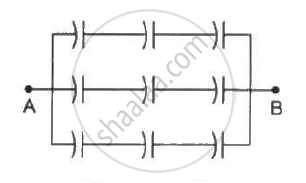
Each of the capacitors shown in figure has a capacitance of 2 µF. find the equivalent capacitance of the assembly between the points A and B. Suppose, a battery of emf 60 volts is connected between A and B. Find the potential difference appearing on the individual capacitors.
Consider the situation shown in the figure. The switch S is open for a long time and then closed. (a) Find the charge flown through the battery when the switch S is closed. (b) Find the work done by the battery.(c) Find the change in energy stored in the capacitors.(d) Find the heat developed in the system.
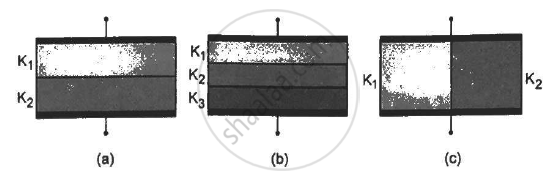
Find the capacitances of the capacitors shown in figure . The plate area is Aand the separation between the plates is d. Different dielectric slabs in a particular part of the figure are of the same thickness and the entire gap between the plates is filled with the dielectric slabs.
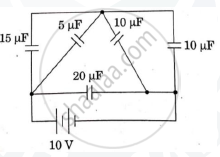
The figure show a network of five capacitors connected to a 10V battery. Calculate the charge acquired by the 5μF capacitor.
Explain in detail the effect of a dielectric placed in a parallel plate capacitor.
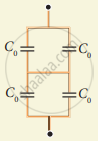
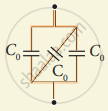
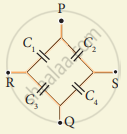
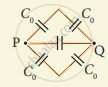
Calculate the resultant capacitances for each of the following combinations of capacitors.
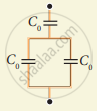
- Charge on each capacitor remains same and equals to the main charge supplied by the battery.
- Potential difference and energy distribute in the reverse ratio of capacitance.
- Effective capacitance is even les than the least of teh individual capacitances.
Can the potential function have a maximum or minimum in free space?
The plates of a parallel plate capacitor are separated by d. Two slabs of different dielectric constant K1 and K2 with thickness `3/8 d and d/2`, respectively, are inserted in the capacitor. Due to this, the capacitance becomes two times larger than when there is nothing between the plates. If K1 = 1.25 K, the value of K1 is:
Eight drops of mercury of equal radius and possessing equal charge combine to form a big drop. The capacitance of bigger drop as compared to each small drop is ______.
What does a large capacitance mean in terms of charge storage and potential difference?
What is the practical purpose of a parallel combination of capacitors?
