Advertisements
Advertisements
प्रश्न
A parallel-plate capacitor of plate area A and plate separation d is charged to a potential difference V and then the battery is disconnected. A slab of dielectric constant K is then inserted between the plates of the capacitor so as to fill the space between the plates. Find the work done on the system in the process of inserting the slab.
Advertisements
उत्तर
Initial capacitance, `C = (∈_0A)/d`
The energy of the capacitor before the insertion of the dielectric is given by `E_1 = 1/2 CV^2 = 1/2 (∈_0A)/d V^2`
After inserting the dielectric slab, the capacitance becomes
`C_1 = KC = K(∈_0A)/d`
and the final voltage becomes
`V_1 = V/K`
Thus, the final energy stored in the capacitor is given by
`E_2 = 1/2 (K∈_0A)/d xx (V/K)^2`
⇒ `E_2 = 1/2 (∈_0AV^2)/(Kd)`
Now ,
Work done = Change in energy
`therefore W = E_2 - E_1`
⇒ `W = 1/2 (∈_0AV^2)/(Kd) - 1/2(∈_0AV^2)/(d)`
⇒ `W = 1/2(∈_0AV^2)/(d)(1/K-1)`
APPEARS IN
संबंधित प्रश्न
A capacitor of unknown capacitance is connected across a battery of V volts. The charge stored in it is 360 μC. When potential across the capacitor is reduced by 120 V, the charge stored in it becomes 120 μC.
Calculate:
(i) The potential V and the unknown capacitance C.
(ii) What will be the charge stored in the capacitor, if the voltage applied had increased by 120 V?
The capacitance of a capacitor does not depend on
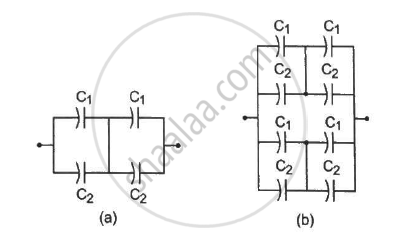
Take `C_1 = 4.0 "uF" and C_2 = 6.0 "uF"` in figure . Calculate the equivalent capacitance of the combination between the points indicated.
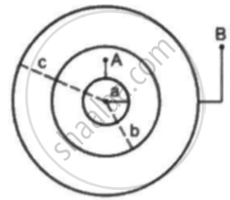
Suppose the space between the two inner shells is filled with a dielectric of dielectric constant K. Find the capacitance of the system between A and B.
Derive the expression for resultant capacitance, when the capacitor is connected in parallel.
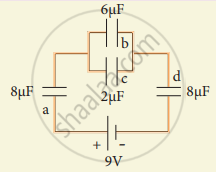
For the given capacitor configuration
- Find the charges on each capacitor
- potential difference across them
- energy stored in each capacitor.
The work done in placing a charge of 8 × 10–18 coulomb on a condenser of capacity 100 micro-farad is ______.
Dielectric constant for a metal is ______.
Two similar conducting spheres having charge+ q and -q are placed at 'd' seperation from each other in air. The radius of each ball is r and the separation between their centre is d (d >> r). Calculate the capacitance of the two ball system ______.

A 5µF capacitor is charged fully by a 220 V supply. It is then disconnected from the supply and is connected in series to another uncharged 2.5 µF capacitor If the energy change during the charge redistribution is `"X"/100`J then value of X to the 100 nearest integer is ______.
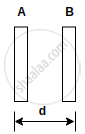
Two plates A and B of a parallel plate capacitor are arranged in such a way, that the area of each plate is S = 5 × 10⁻³ m 2 and distance between them is d = 8.85 mm. Plate A has a positive charge q1 = 10-10 C and Plate B has charge q2 = + 2 × 10⁻¹⁰ C. Then the charge induced on the plate B due to the plate A be - (....... × 10-11 )C
A capacitor has charge 50 µC. When the gap between the plate is filled with glass wool, then 120 µC charge flows through the battery to capacitor. The dielectric constant of glass wool is ______.
Read the following paragraph and answer the questions.
| A capacitor is a system of two conductors separated by an insulator. The two conductors have equal and opposite charges with a potential difference between them. The capacitance of a capacitor depends on the geometrical configuration (shape, size and separation) of the system and also on the nature of the insulator separating the two conductors. They are used to store charges. Like resistors, capacitors can be arranged in series or parallel or a combination of both to obtain the desired value of capacitance. |
- Find the equivalent capacitance between points A and B in the given diagram.

- A dielectric slab is inserted between the plates of the parallel plate capacitor. The electric field between the plates decreases. Explain.
- A capacitor A of capacitance C, having charge Q is connected across another uncharged capacitor B of capacitance 2C. Find an expression for (a) the potential difference across the combination and (b) the charge lost by capacitor A.
OR
Two slabs of dielectric constants 2K and K fill the space between the plates of a parallel plate capacitor of plate area A and plate separation d as shown in the figure. Find an expression for the capacitance of the system.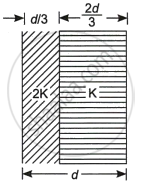
If the plates of a parallel plate capacitor connected to a battery are moved close to each other, then:
- the charge stored in it. increases.
- the energy stored in it, decreases.
- its capacitance increases.
- the ratio of charge to its potential remains the same.
- the product of charge and voltage increases.
Choose the most appropriate answer from the options given below:
Two spherical conductors of capacities 4 µF and 3 µF are charged to same potential having radii 4 cm and 3 cm respectively. If ‘σ1’ and ‘σ2’ represent surface density of charge on respective conductors then ______.
For a given capacitor, what fixes its capacitance?
In a series combination, which statement describes the potential difference across each capacitor?
What is the practical purpose of a series combination of capacitors?
In a parallel combination, which statement describes the charges on the capacitors?
