Advertisements
Advertisements
प्रश्न
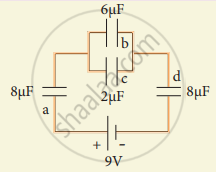
For the given capacitor configuration
- Find the charges on each capacitor
- potential difference across them
- energy stored in each capacitor.
Advertisements
उत्तर
Capacitor b and c in parallel combination
Cp = Cb + Cc = (6 + 2) μF = 8 μF
Capacitor a, cp and d are in series combination, so the resulatant copacitance
`1/"C"_"s" = 1/"C"_"a" + 1/"C"_"cp" + 1/"C"_"d"`
`= 1/8 + 1/8 + 1/8 = 3/8`
`"C"_"s" = 8/3` μF


- Charge on each capacitor,
Charge on capacitor a, Qa = Cs V = `8/3 xx 9`
Qa = 24 μC
Charge on capacitor, d, Qd = Cs V = `8/3 xx 9`
Qd = 24 μC
Capacitor b and c in parallel
Charge on capacitor, b, Qb = `6/3 xx 9` = 18
Qb = 18 μC
Charge on capacitor, c, Qc = `2/3 xx 9` = 6
Qc = 6 μC - Potential difference across each capacitor, V = `"q"/"c"`
Capacitor Ca, Va = `"q"_"a"/"C"_"a" = (24 xx 10^6)/(8 xx 10^6)` = 3 V
Capacitor Cb, Vb = `"q"_"b"/"C"_"b" = (18 xx 10^6)/(6 xx 10^6)` = 3 V
Capacitor Cc, Vc = `"q"_"c"/"C"_"c" = (6 xx 10^6)/(2 xx 10^6)` = 3 V
Capacitor Cd, Vd = `"q"_"d"/"C"_"d" = (24 xx 10^6)/(8 xx 10^6)` = 3 V - Energy stores in a capacitor, U = `1/2` CV2
Energy in capacitor Ca, Ua = `1/2 "C"_"a" "V"_"a"^2 = 1/2 xx 8 xx 10^-6 xx (3)^2`
Ua = 36 μJ
Capacitor Cb, Ub = `1/2 "C"_"b" "V"_"b"^2 = 1/2 xx 6 xx 10^-6 xx (3)^2`
Ua = 27 μJ
Cc, Uc = `1/2 "C"_"c" "V"_"c"^2 = 1/2 xx 2 xx 10^-6 xx (3)^2`
Ua = 9 μJ
Cd, Ud = `1/2 "C"_"d" "V"_"d"^2 = 1/2 xx 8 xx 10^-6 xx (3)^2`
Ua = 36 μJ
APPEARS IN
संबंधित प्रश्न
A capacitor of capacitance C is charged fully by connecting it to a battery of emf E. It is then disconnected from the battery. If the separation between the plates of the capacitor is now doubled, how will the following change?
(i) charge stored by the capacitor.
(ii) Field strength between the plates.
(iii) Energy stored by the capacitor.
Justify your answer in each case.
A capacitor of capacitance ‘C’ is charged to ‘V’ volts by a battery. After some time the battery is disconnected and the distance between the plates is doubled. Now a slab of dielectric constant, 1 < k < 2, is introduced to fill the space between the plates. How will the following be affected? (a) The electric field between the plates of the capacitor Justify your answer by writing the necessary expressions.
A capacitor of unknown capacitance is connected across a battery of V volts. The charge stored in it is 300 μC. When potential across the capacitor is reduced by 100 V, the charge stored in it becomes 100 μC. Calculate The potential V and the unknown capacitance. What will be the charge stored in the capacitor if the voltage applied had increased by 100 V?
A capacitor has capacitance C. Is this information sufficient to know what maximum charge the capacitor can contain? If yes, what is this charges? If no, what other information is needed?
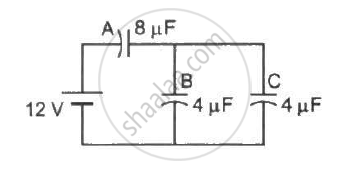
Find the charge appearing on each of the three capacitors shown in figure .
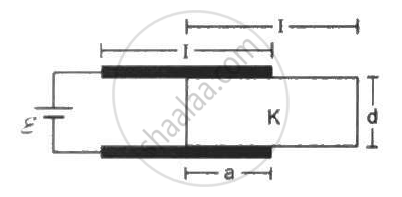
Consider the situation shown in figure. The plates of the capacitor have plate area A and are clamped in the laboratory. The dielectric slab is released from rest with a length a inside the capacitor. Neglecting any effect of friction or gravity, show that the slab will execute periodic motion and find its time period.
The work done in placing a charge of 8 × 10–18 coulomb on a condenser of capacity 100 micro-farad is ______.
Two spherical conductors of capacities 4 µF and 3 µF are charged to same potential having radii 4 cm and 3 cm respectively. If ‘σ1’ and ‘σ2’ represent surface density of charge on respective conductors then ______.
Which statement lists the factors on which capacitance depends?
