Advertisements
Advertisements
प्रश्न
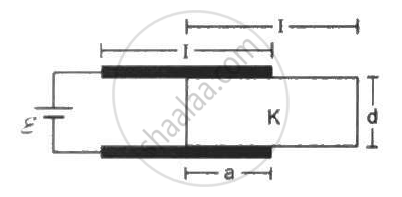
Consider the situation shown in figure. The plates of the capacitor have plate area A and are clamped in the laboratory. The dielectric slab is released from rest with a length a inside the capacitor. Neglecting any effect of friction or gravity, show that the slab will execute periodic motion and find its time period.
Advertisements
उत्तर
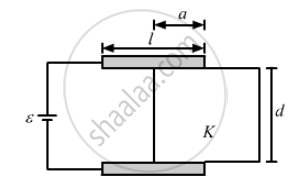
Given that the area of the plates of the capacitors is A.
As ''a'' length of the dielecric slab is inside the capacitor.
Therefore, the area of the plate covered with dielectric is `= A/la`
The capacitance of the portion with dielectric is given by `C_1 = (K∈_0Aa)/(ld)`
The capacitance of the portion without dielectric is given by `C_1 = (∈_0A(l-a))/(ld)`
The two parts can be considered to be in parallel.
Therefore, the net capacitance is given by
`C = C_1 + C_2`
`⇒ C = (∈_0A)/(ld)[Ka + (l-a)]`
`⇒ C = (∈_0A)/(ld)[l + a(K-1)]`
Let us consider a small displacement da of the slab in the inward direction. The capacitance will increase, therefore the energy of the capacitor will also increase. In order to maintain constant voltage, the battery will supply extra charges, therefore the battery will do work.
Work done by the battery = change in energy of capacitor + work done by the force F on the capacitor
`dW_B = dU + dW_F`
Let the charge dq is supplied by the battery, and the change in the capacitor be dC
`dW_B = (dq).V = (dC).V^2`
`dU = 1/2(dC).V^2`
`(dC).V^2 = 1/2(dC).V^2 + F.da`
`1/2(dC).V^2 = F.da`
`⇒ F = 1/2 (dC)/(da)V^2`
`⇒ F = 1/2 d/(da) ((∈_0A)/(ld)[l + a(K-1)])V^2`
`⇒ F = 1/2 (∈_0A)/(ld) (K - 1)`
The acceleration of the dielectric is given by `a_0 = 1/2 (∈_0A)/(ldm)(K-1)`
As, the force is in inward direction, it will tend to make the dielectric to completely fill the space inside the capacitors. As, the dielectric completely fills the space inside the capacitor at this instant its velocity is not zero. The dielectric slab tends to move outside the capacitor. As the slab tends to move out, the direction of the force due to the capacitor will reverse its direction. Thus, the dielectric slab will have a periodic motion.
The time taken to move distance `(l-a)` can be calculated as :-
`(l - a) = 1/2 a_0t^2`
`t = sqrt ((2(l-a))/(a_0))`
`t = sqrt (2(l-a) xx (2ldm)/(∈_0AV^2(K-1))`
`t = sqrt ((4m(l-a)ld)/(∈_0AV^2(K-1))`
For the complete cycle the time period will be four times the time taken for covering distance `(l-a)`.
It is given by :-
`T = 4t = 4 xx 2 sqrt((m(l-a)ld)/(∈_0AV^2(K-1))) = 8 sqrt ((m(l-a)ld)/(∈_0AV^2(K-1))`
APPEARS IN
संबंधित प्रश्न
Define capacitor reactance. Write its S.I units.
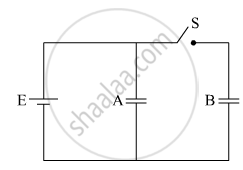
Two identical parallel plate capacitors A and B are connected to a battery of V volts with the switch S closed. The switch is now opened and the free space between the plates of the capacitors is filled with a dielectric of dielectric constant K. Find the ratio of the total electrostatic energy stored in both capacitors before and after the introduction of the dielectric.
A capacitor of unknown capacitance is connected across a battery of V volts. The charge stored in it is 300 μC. When potential across the capacitor is reduced by 100 V, the charge stored in it becomes 100 μC. Calculate The potential V and the unknown capacitance. What will be the charge stored in the capacitor if the voltage applied had increased by 100 V?
A capacitor of capacitance C is charged to a potential V. The flux of the electric field through a closed surface enclosing the capacitor is
The plates of a parallel-plate capacitor are made of circular discs of radii 5⋅0 cm each. If the separation between the plates is 1⋅0 mm, what is the capacitance?
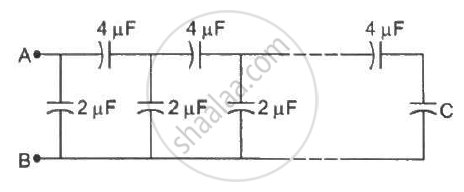
A finite ladder is constructed by connecting several sections of 2 µF, 4 µF capacitor combinations as shown in the figure. It is terminated by a capacitor of capacitance C. What value should be chosen for C, such that the equivalent capacitance of the ladder between the points A and B becomes independent of the number of sections in between?
A 5⋅0 µF capacitor is charged to 12 V. The positive plate of this capacitor is now connected to the negative terminal of a 12 V battery and vice versa. Calculate the heat developed in the connecting wires.
The variation of inductive reactance (XL) of an inductor with the frequency (f) of the ac source of 100 V and variable frequency is shown in fig.
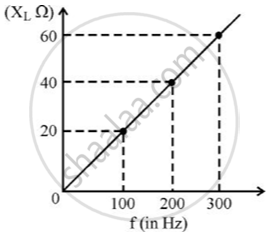
- Calculate the self-inductance of the inductor.
- When this inductor is used in series with a capacitor of unknown value and a resistor of 10 Ω at 300 s–1, maximum power dissipation occurs in the circuit. Calculate the capacitance of the capacitor.
Obtain the expression for energy stored in the parallel plate capacitor.
Explain in detail the effect of a dielectric placed in a parallel plate capacitor.
Derive the expression for resultant capacitance, when the capacitor is connected in parallel.
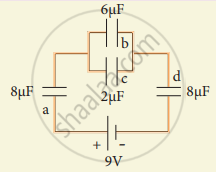
For the given capacitor configuration
- Find the charges on each capacitor
- potential difference across them
- energy stored in each capacitor.
A capacitor is charged by a battery. The battery is removed and another identical uncharged capacitor is connected in parallel. The total electrostatic energy of resulting system ______.
The positive terminal of 12 V battery is connected to the ground. Then the negative terminal will be at ______.
Two similar conducting spheres having charge+ q and -q are placed at 'd' seperation from each other in air. The radius of each ball is r and the separation between their centre is d (d >> r). Calculate the capacitance of the two ball system ______.

A capacitor of 4 µ F is connected as shown in the circuit (Figure). The internal resistance of the battery is 0.5 Ω. The amount of charge on the capacitor plates will be ______.