Advertisements
Advertisements
प्रश्न
Derive the expression for resultant capacitance, when the capacitor is connected in series.
Advertisements
उत्तर
Consider three capacitors of capacitance C1, C2 and C3 connected in series with a battery of voltage V as shown in figure (a).
As soon as the battery is connected to the capacitors in series, the electrons of charge -Q are transferred from negative terminal to the right plate of C3which pushes the electrons of same amount -Q from left plate of C3 to the right plate of C2 due to electrostatic induction. Similarly, the left plate of C2 pushes the charges of Q to the right plate of which induces the positive charge +Q on the left plate of C1 At the same time, electrons of charge -Q are transferred from left plate of C1 to positive terminal of the battery.
(a)
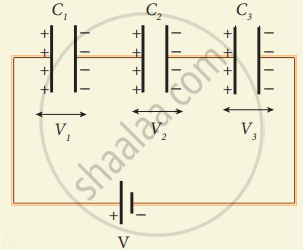
Capacitors connected in series
(b)
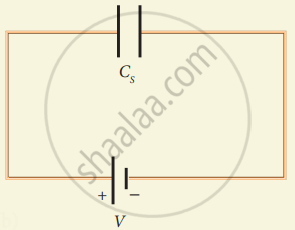
Equivalent capacitors CS
By these processes, each capacitor stores the same amount of charge Q. The capacitances of the capacitors are in general different, so that the voltage across each capacitor is also different and are denoted as V1, V2 and V3 respectively.
The total voltage across each capacitor must be equal to the voltage of the battery.
V = V1 + V2 + V3 ….. (1)
Since Q = CV, we have V = `"Q"/"C"_1 + "Q"/"C"_2 + "Q"/"C"_3`
Q = `(1/"C"_1 + 1/"C"_2 + 1/"C"_3)` .....(2)
If three capacitors in series are considered to form an equivalent single capacitor Cs shown in figure (b), then we have V = `"Q"/"C"_"s"`
Substituting this expression into equation (2) we get
V = `"Q"/"C"_"s" = "Q"(1/"C"_1 + 1/"C"_2 + 1/"C"_3)`
`1/"C"_"s" = 1/"C"_1 + 1/"C"_2 + 1/"C"_3` ...(3)
Thus, the inverse of the equivalent capacitance Cs of three capacitors connected in series is equal to the sum of the inverses of each capacitance. This equivalent capacitance Cs is always less than the smallest individual capacitance in the series.
APPEARS IN
संबंधित प्रश्न
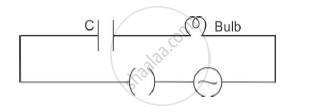
A bulb is connected in series with a variable capacitor and an AC source as shown. What happens to the brightness of the bulb when the key is plugged in and capacitance of the capacitor is gradually reduced?
Following operations can be performed on a capacitor:
X − connect the capacitor to a battery of emf ε.
Y − disconnect the battery.
Z − reconnect the battery with polarity reversed.
W − insert a dielectric slab in the capacitor.
(a) In XYZ (perform X, then Y, then Z) the stored electric energy remains unchanged and no thermal energy is developed.
(b) The charge appearing on the capacitor is greater after the action XWY than after the action XYZ.
(c) The electric energy stored in the capacitor is greater after the action WXY than after the action XYW.
(d) The electric field in the capacitor after the action XW is the same as that after WX.
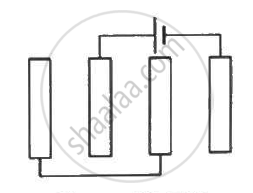
Each of the plates shown in figure has surface area `(96/∈_0) xx 10^-12` Fm on one side and the separation between the consecutive plates is 4⋅0 mm. The emf of the battery connected is 10 volts. Find the magnitude of the charge supplied by the battery to each of the plates connected to it.
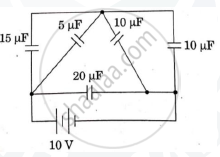
The figure show a network of five capacitors connected to a 10V battery. Calculate the charge acquired by the 5μF capacitor.
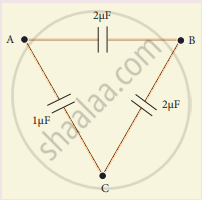
Three capacitors are connected in a triangle as shown in the figure. The equivalent capacitance between points A and C is ______.
Three capacitors 2µF, 3µF, and 6µF are joined in series with each other. The equivalent capacitance is ____________.
A capacitor with capacitance 5µF is charged to 5 µC. If the plates are pulled apart to reduce the capacitance to 2 µF, how much work is done?
Two spherical conductors of capacities 4 µF and 3 µF are charged to same potential having radii 4 cm and 3 cm respectively. If ‘σ1’ and ‘σ2’ represent surface density of charge on respective conductors then ______.
In a series combination, which capacitor gets a larger potential difference?
