Advertisements
Advertisements
प्रश्न
Derive the expression for resultant capacitance, when the capacitor is connected in series.
Advertisements
उत्तर
Consider three capacitors of capacitance C1, C2 and C3 connected in series with a battery of voltage V as shown in figure (a).
As soon as the battery is connected to the capacitors in series, the electrons of charge -Q are transferred from negative terminal to the right plate of C3which pushes the electrons of same amount -Q from left plate of C3 to the right plate of C2 due to electrostatic induction. Similarly, the left plate of C2 pushes the charges of Q to the right plate of which induces the positive charge +Q on the left plate of C1 At the same time, electrons of charge -Q are transferred from left plate of C1 to positive terminal of the battery.
(a)
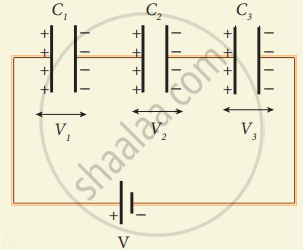
Capacitors connected in series
(b)
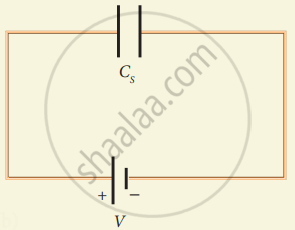
Equivalent capacitors CS
By these processes, each capacitor stores the same amount of charge Q. The capacitances of the capacitors are in general different, so that the voltage across each capacitor is also different and are denoted as V1, V2 and V3 respectively.
The total voltage across each capacitor must be equal to the voltage of the battery.
V = V1 + V2 + V3 ….. (1)
Since Q = CV, we have V = `"Q"/"C"_1 + "Q"/"C"_2 + "Q"/"C"_3`
Q = `(1/"C"_1 + 1/"C"_2 + 1/"C"_3)` .....(2)
If three capacitors in series are considered to form an equivalent single capacitor Cs shown in figure (b), then we have V = `"Q"/"C"_"s"`
Substituting this expression into equation (2) we get
V = `"Q"/"C"_"s" = "Q"(1/"C"_1 + 1/"C"_2 + 1/"C"_3)`
`1/"C"_"s" = 1/"C"_1 + 1/"C"_2 + 1/"C"_3` ...(3)
Thus, the inverse of the equivalent capacitance Cs of three capacitors connected in series is equal to the sum of the inverses of each capacitance. This equivalent capacitance Cs is always less than the smallest individual capacitance in the series.
APPEARS IN
संबंधित प्रश्न
When an AC source is connected to an ideal capacitor, show that the average power supplied by the source over a complete cycle is zero
(i) Find equivalent capacitance between A and B in the combination given below. Each capacitor is of 2 µF capacitance.
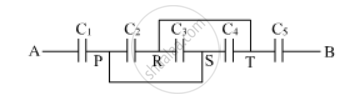
(ii) If a dc source of 7 V is connected across AB, how much charge is drawn from the source and what is the energy stored in the network?
A capacitor of capacitance ‘C’ is being charged by connecting it across a dc source along with an ammeter. Will the ammeter show a momentary deflection during the process of charging? If so, how would you explain this momentary deflection and the resulting continuity of current in the circuit? Write the expression for the current inside the capacitor.
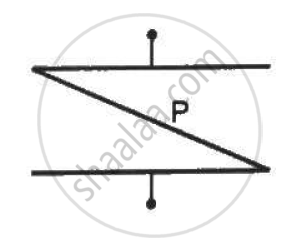
A thin metal plate P is inserted between the plates of a parallel-plate capacitor of capacitance C in such a way that its edges touch the two plates . The capacitance now becomes _________ .
A parallel-plate capacitor has plate area 100 cm2 and plate separation 1⋅0 cm. A glass plate (dielectric constant 6⋅0) of thickness 6⋅0 mm and an ebonite plate (dielectric constant 4⋅0) are inserted one over the other to fill the space between the plates of the capacitor. Find the new capacitance.
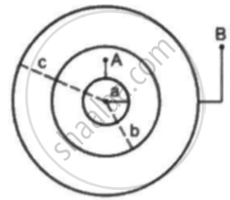
Suppose the space between the two inner shells is filled with a dielectric of dielectric constant K. Find the capacitance of the system between A and B.
Obtain the expression for energy stored in the parallel plate capacitor.
Three capacitors 2µF, 3µF, and 6µF are joined in series with each other. The equivalent capacitance is ____________.
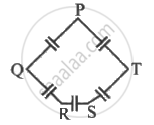
Five capacitor each of capacitance value C are connected as shown in the figure. The ratio of capacitance between P to R, and the capacitance between P and Q is ______.
In a series combination, which quantity is the same on each capacitor?
