Advertisements
Advertisements
प्रश्न
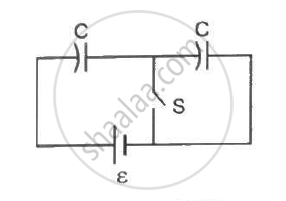
Consider the situation shown in the figure. The switch S is open for a long time and then closed. (a) Find the charge flown through the battery when the switch S is closed. (b) Find the work done by the battery.(c) Find the change in energy stored in the capacitors.(d) Find the heat developed in the system.
Advertisements
उत्तर
Since the switch is opened for a long time, the capacitor is in series.
`therefore C_(eq) = C/2`
When the switch is closed, the charge flown from the battery is given by
`q = C/2 xx ε =( Cε)/2`
(b) Work done, `W = q xx V`
`⇒ q = C_ε/2 xx ε = (Cε^2)/2`
(c) The change in the energy stored in the capacitors is given by
`ΔE = 1/2 C_(eq) xx V_2`
`= 1/2 xx C/2 xx ε^2 = 1/4 Cε^2`
(d) The heat developed in the system is given by
H = ΔE
`⇒ H = 1/4 Cε^2`
APPEARS IN
संबंधित प्रश्न
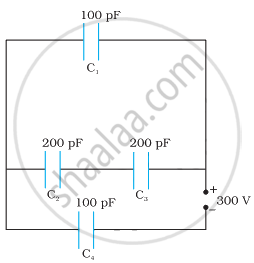
Obtain the equivalent capacitance of the network in Figure. For a 300 V supply, determine the charge and voltage across each capacitor.
A capacitor of unknown capacitance is connected across a battery of V volts. The charge stored in it is 300 μC. When potential across the capacitor is reduced by 100 V, the charge stored in it becomes 100 μC. Calculate The potential V and the unknown capacitance. What will be the charge stored in the capacitor if the voltage applied had increased by 100 V?
When 1⋅0 × 1012 electrons are transferred from one conductor to another, a potential difference of 10 V appears between the conductors. Calculate the capacitance of the two-conductor system.
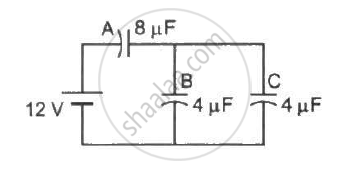
Find the charge appearing on each of the three capacitors shown in figure .
A parallel-plate capacitor of capacitance 5 µF is connected to a battery of emf 6 V. The separation between the plates is 2 mm. (a) Find the charge on the positive plate. (b) Find the electric field between the plates. (c) A dielectric slab of thickness 1 mm and dielectric constant 5 is inserted into the gap to occupy the lower half of it. Find the capacitance of the new combination. (d) How much charge has flown through the battery after the slab is inserted?
A parallel-plate capacitor has plate area 100 cm2 and plate separation 1⋅0 cm. A glass plate (dielectric constant 6⋅0) of thickness 6⋅0 mm and an ebonite plate (dielectric constant 4⋅0) are inserted one over the other to fill the space between the plates of the capacitor. Find the new capacitance.
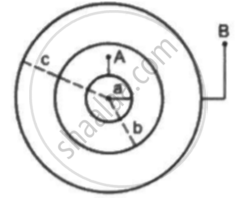
Consider an assembly of three conducting concentric spherical shell of radii a, b and c as shown in figure Find the capacitance of the assembly between the points Aand B.
An air-filled parallel-plate capacitor is to be constructed which can store 12 µC of charge when operated at 1200 V. What can be the minimum plate area of the capacitor? The dielectric strength of air is `3 xx 10^6 "Vm"^-1`
If the voltage applied on a capacitor is increased from V to 2V, choose the correct conclusion.
Define ‘capacitance’. Give its unit.
Obtain the expression for capacitance for a parallel plate capacitor.
During a thunder storm, the movement of water molecules within the clouds creates friction, partially causing the bottom part of the clouds to become negatively charged. This implies that the bottom of the cloud and the ground act as a parallel plate capacitor. If the electric field between the cloud and ground exceeds the dielectric breakdown of the air (3 × 10⁶ Vm–1), lightning will occur.
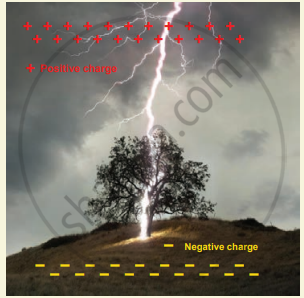
- If the bottom part of the cloud is 1000 m above the ground, determine the electric potential difference that exists between the cloud and ground.
- In a typical lightning phenomenon, around 25 C of electrons are transferred from cloud to ground. How much electrostatic potential energy is transferred to the ground?
The capacitance of a parallel plate capacitor is 60 µF. If the distance between the plates is tripled and area doubled then new capacitance will be ______.
The radius of a sphere of capacity 1 microfarad in the air is ______
A parallel plate capacitor is filled by a dielectric whose relative permittivity varies with the applied voltage (U) as ε = αU where α = 2V–1. A similar capacitor with no dielectric is charged to U0 = 78V. It is then connected to the uncharged capacitor with the dielectric. Find the final voltage on the capacitors.
The displacement current of 4.425 µA is developed in the space between the plates of the parallel plate capacitor when voltage is changing at a rate of 106 Vs-1. The area of each plate of the capacitor is 40 cm2. The distance between each plate of the capacitor is x × 10-3 m. The value of x is ______.
(Permittivity of free space, ε0 = 8.85 × 10⁻¹²C2N-1m-2).
Which set lists the factors on which capacitance depends?
For a given capacitor, what fixes its capacitance?
Which combination has charge as its constant quantity and potential difference as its variable quantity?
