Advertisements
Advertisements
प्रश्न
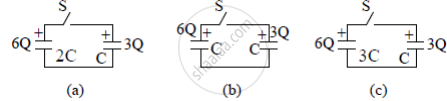
Three circuits, each consisting of a switch 'S' and two capacitors, are initially charged, as shown in the figure. After the switch has been closed, in which circuit will the charge on the left-hand capacitor
(i) increase,
(ii) decrease, and
(iii) remains the same? Give reasons.
Advertisements
उत्तर
When charged capacitors are connected to each other then the charge will flow from the capacitor with higher potential towards the capacitor with lower potential until a common potential is reached.
(a) In fig. (a) the potential of both the capacitor is same so the charge on left hand capacitor remains the same.
(b) In fig. (b) the potential of left hand capacitor is high so charge from 6Q to 3Q. Therefore charge on left hand capacitor will decrease. (c) In fig.
(c) the potential of left hand capacitor is low so charge will flow from 3Q to 6Q. Therefore charge on the left-hand capacitor will increase.
APPEARS IN
संबंधित प्रश्न
When an AC source is connected to an ideal capacitor, show that the average power supplied by the source over a complete cycle is zero
(i) Find equivalent capacitance between A and B in the combination given below. Each capacitor is of 2 µF capacitance.
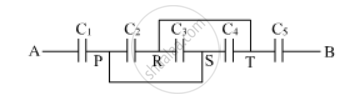
(ii) If a dc source of 7 V is connected across AB, how much charge is drawn from the source and what is the energy stored in the network?
A capacitor has capacitance C. Is this information sufficient to know what maximum charge the capacitor can contain? If yes, what is this charges? If no, what other information is needed?
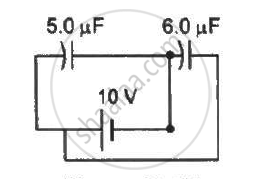
Find the charge supplied by the battery in the arrangement shown in figure.
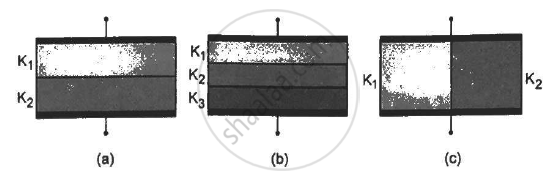
Find the capacitances of the capacitors shown in figure . The plate area is Aand the separation between the plates is d. Different dielectric slabs in a particular part of the figure are of the same thickness and the entire gap between the plates is filled with the dielectric slabs.
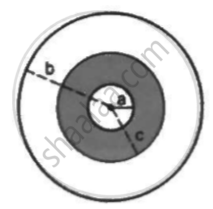
A sphercial capacitor is made of two conducting spherical shells of radii a and b. The space between the shells is filled with a dielectric of dielectric constant K up to a radius c as shown in figure . Calculate the capacitance.
Dielectric constant for a metal is ______.
Two plates A and B of a parallel plate capacitor are arranged in such a way, that the area of each plate is S = 5 × 10⁻³ m 2 and distance between them is d = 8.85 mm. Plate A has a positive charge q1 = 10-10 C and Plate B has charge q2 = + 2 × 10⁻¹⁰ C. Then the charge induced on the plate B due to the plate A be - (....... × 10-11 )C
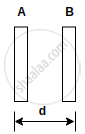
A capacitor with capacitance 5µF is charged to 5 µC. If the plates are pulled apart to reduce the capacitance to 2 µF, how much work is done?
In a parallel combination, which statement describes the charges on the capacitors?
