Advertisements
Advertisements
प्रश्न
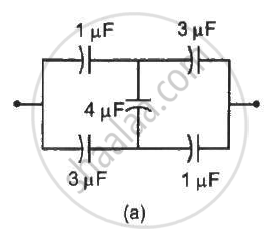
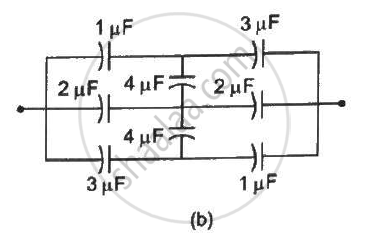
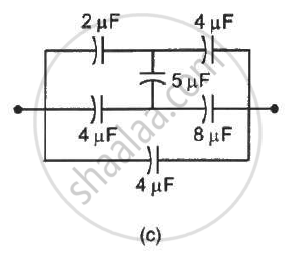
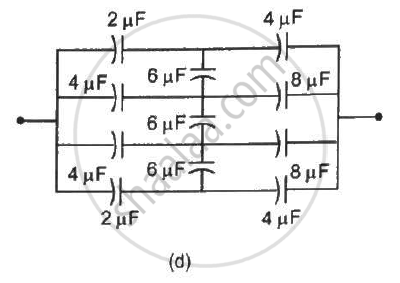
Find the equivalent capacitances of the combinations shown in figure between the indicated points.
Advertisements
उत्तर
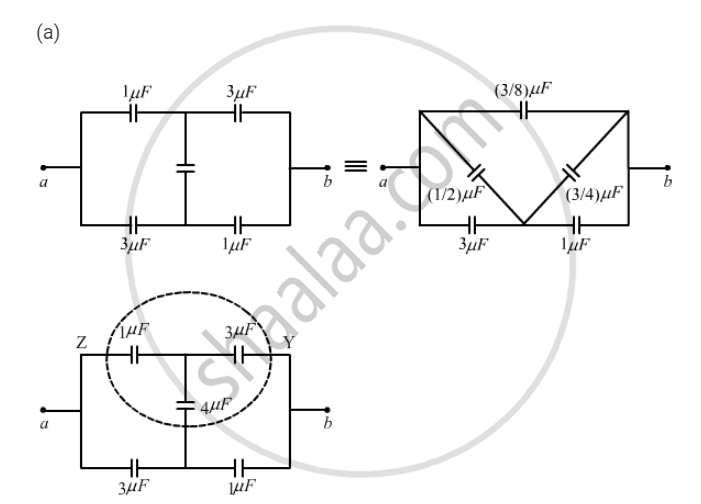
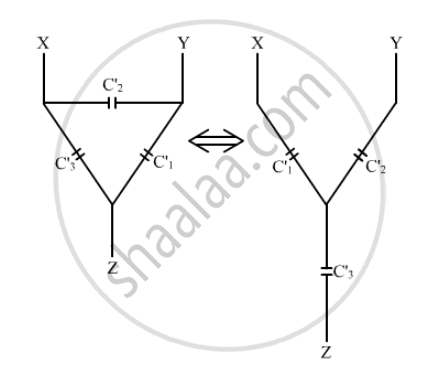
Applying star-delta conversion in the part indicated in the diagram.
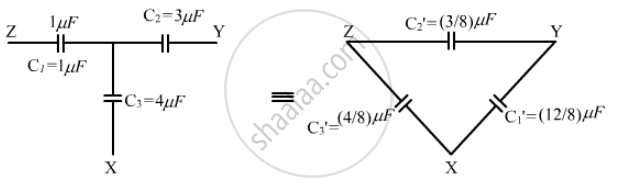
The Capacitance of the `C_1` is given by
`C_1^' = (C_2C_3)/(C_1+C_2+C_3)`
`C_2^' = (C_1C_3)/(C_1+C_2+C_3)`
`C_3^' = (C_1C_2)/(C_1+C_2+C_3)`
⇒ `C_1'^ = (3 xx 4)/(1+3+4) = 12/8 "uF"`
⇒ `C_2^' = (1 xx 3)/(1+3+4) = 3/8 "uF"`
⇒ `C_3^' = (1 xx 4)/(1+3+4) = 4/8 "uF"`
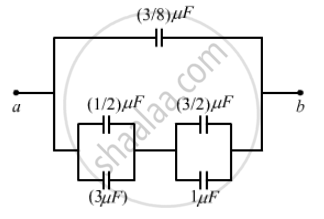
Thus, the equivalent circuit can be drawn as :
Therefore, the equivalent capacitance is given by
`C_(eq) = 3/8 + [((3+1/2) xx (3/2+1))/((3+1/2)+(3/2+1))]` = `3/8 + 35/24 = (9+35)/24 = 11/6 "uF"`
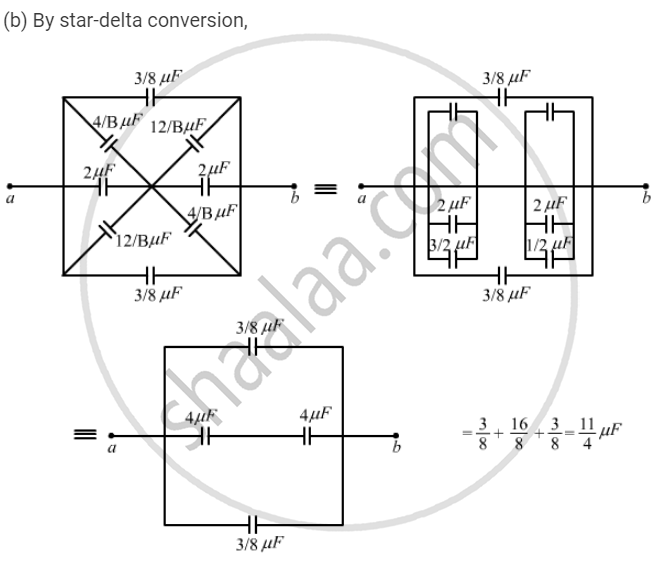
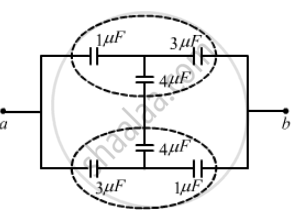
`1+1 = 2 "uF"`
(c)
It is a balanced bridge.
Therefore, the capacitor of capacitance 5 μF can be removed.
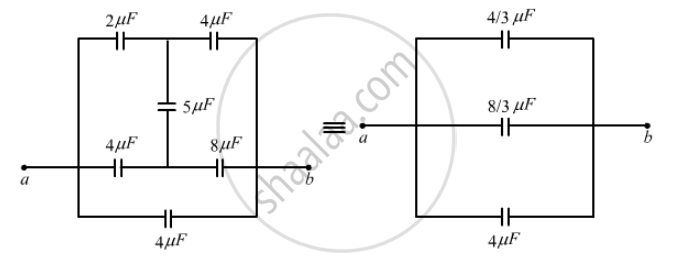
Cef = `4/3+8/3+4 = 8 "uF"`
The capacitance of the two branches are :
`C_1 = (2 xx 4)/(2+4) = 4/3 uF`
`C_2 = (4 xx 8)/(4+8) = 8/3 uF`
∴ Equivalent capacitance = `4/3 + 8/3 + 4 = 8 "uF"`
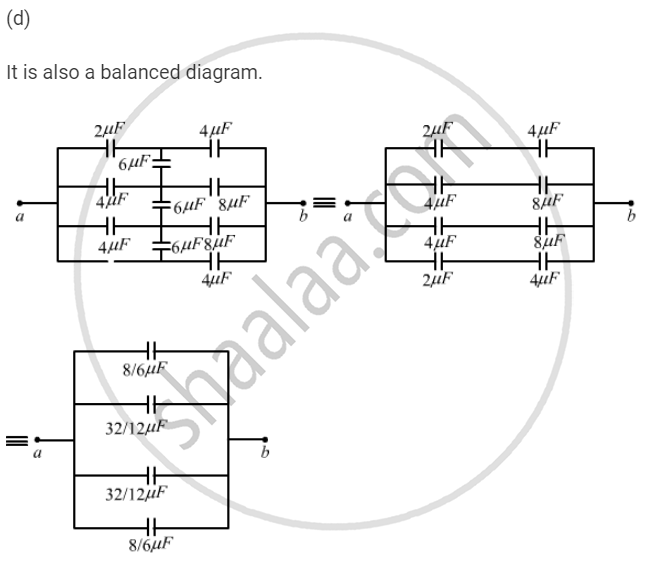
It can be observed that the bridges are balanced.
Therefore, the capacitors of capacitance 6 μF between the branches can be removed
The capacitances of the four branches are :
`C_1 = (2 xx 4)/(2+4) = 4/3 uF`
`C_2 = (4 xx 8)/(4+8) = 8/3 uF`
`C_3 = (4 xx 8)/(4+8) = 8/3 uF`
`C_4 = (2 xx 4)/(2+4) = 4/3 uF`
∴ Equivalent capacitance
= `4/3 + 8/3 + 8/3 + 4/3`
= ` 8 "uF"`
APPEARS IN
संबंधित प्रश्न
A spherical capacitor consists of two concentric spherical conductors, held in position by suitable insulating supports. Show that the capacitance of a spherical capacitor is given by
C = `(4piin_0"r"_1"r"_2)/("r"_1 - "r"_2)`
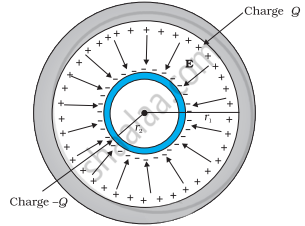
where r1 and r2 are the radii of outer and inner spheres, respectively.
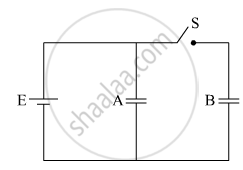
Two identical parallel plate capacitors A and B are connected to a battery of V volts with the switch S closed. The switch is now opened and the free space between the plates of the capacitors is filled with a dielectric of dielectric constant K. Find the ratio of the total electrostatic energy stored in both capacitors before and after the introduction of the dielectric.
A capacitor of unknown capacitance is connected across a battery of V volts. The charge stored in it is 360 μC. When potential across the capacitor is reduced by 120 V, the charge stored in it becomes 120 μC.
Calculate:
(i) The potential V and the unknown capacitance C.
(ii) What will be the charge stored in the capacitor, if the voltage applied had increased by 120 V?
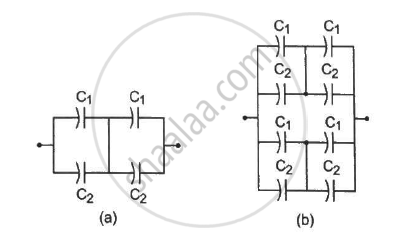
Take `C_1 = 4.0 "uF" and C_2 = 6.0 "uF"` in figure . Calculate the equivalent capacitance of the combination between the points indicated.
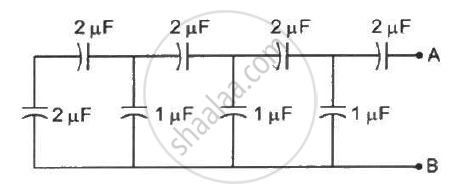
Find the capacitance of the combination shown in figure between A and B.
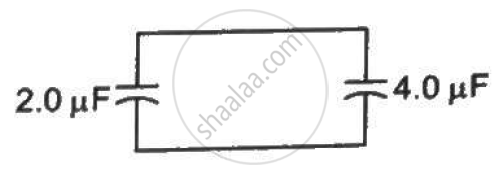
A capacitor of capacitance 2⋅0 µF is charged to a potential difference of 12 V. It is then connected to an uncharged capacitor of capacitance 4⋅0 µF as shown in figure . Find (a) the charge on each of the two capacitors after the connection, (b) the electrostatic energy stored in each of the two capacitors and (c) the heat produced during the charge transfer from one capacitor to the other.
The two square faces of a rectangular dielectric slab (dielectric constant 4⋅0) of dimensions 20 cm × 20 cm × 1⋅0 mm are metal-coated. Find the capacitance between the coated surfaces.
An air-filled parallel-plate capacitor is to be constructed which can store 12 µC of charge when operated at 1200 V. What can be the minimum plate area of the capacitor? The dielectric strength of air is `3 xx 10^6 "Vm"^-1`
Define ‘capacitance’. Give its unit.
Calculate equivalent capacitance of the circuit shown in the Figure given below:

Two spherical conductors of capacities 4 µF and 3 µF are charged to same potential having radii 4 cm and 3 cm respectively. If ‘σ1’ and ‘σ2’ represent surface density of charge on respective conductors then ______.
Which system is called a capacitor?
Which units are capacitors commonly measured in practice?
For a given capacitor, what fixes its capacitance?
In a series combination, which quantity is the same on each capacitor?
In a series combination, which statement describes the potential difference across each capacitor?
Which combination has charge as its constant quantity and potential difference as its variable quantity?
In a parallel combination, which quantity is the same across each capacitor?
