Advertisements
Advertisements
प्रश्न
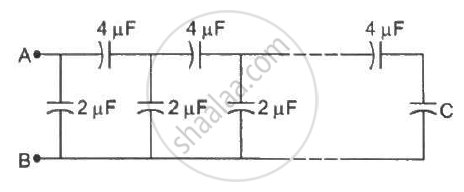
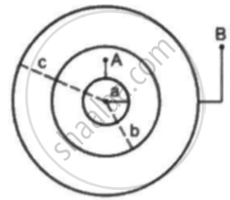
A finite ladder is constructed by connecting several sections of 2 µF, 4 µF capacitor combinations as shown in the figure. It is terminated by a capacitor of capacitance C. What value should be chosen for C, such that the equivalent capacitance of the ladder between the points A and B becomes independent of the number of sections in between?
Advertisements
उत्तर
The equivalent capacitance of the ladder between points A and B becomes independent of the number of sections in between when the capacitance between A and B is C.
The capacitors C and 4 µF are in series; their equivalent capacitance is given by `C_1 = (C xx 4) / (C+4)`
The capacitors C1 and 2 µF are in parallel; their equivalent capacitance is given by C = C1 + 2 µF
`⇒ C = (C xx 4) / (C+4) + 2`
⇒ 4C + 8 + 2 C = 4C + C2
⇒ C2 − 2C − 8 = 0
⇒ C = −2, C = 4
Capacitance cannot be negative.
∴ C = 4 µF
The value of C is 4 µF.
APPEARS IN
संबंधित प्रश्न
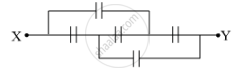
Find the equivalent capacitance of the network shown in the figure, when each capacitor is of 1 μF. When the ends X and Y are connected to a 6 V battery, find out (i) the charge and (ii) the energy stored in the network.
As `C = (1/V) Q` , can you say that the capacitance C is proportional to the charge Q?
The capacitance of a capacitor does not depend on
A parallel-plate capacitor has plate area 25⋅0 cm2 and a separation of 2⋅00 mm between the plates. The capacitor is connected to a battery of 12⋅0 V. (a) Find the charge on the capacitor. (b) The plate separation is decreased to 1⋅00 mm. Find the extra charge given by the battery to the positive plate.
Take `C_1 = 4.0 "uF" and C_2 = 6.0 "uF"` in figure . Calculate the equivalent capacitance of the combination between the points indicated.
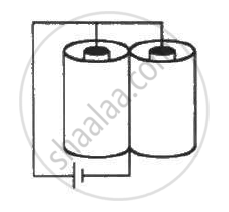
The outer cylinders of two cylindrical capacitors of capacitance 2⋅2 µF each, are kept in contact and the inner cylinders are connected through a wire. A battery of emf 10 V is connected as shown in figure . Find the total charge supplied by the battery to the inner cylinders.
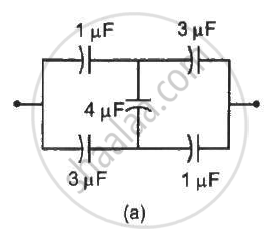
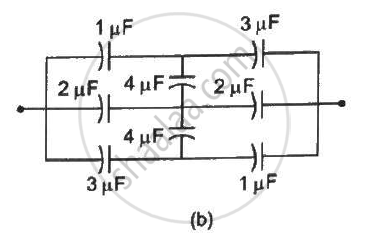
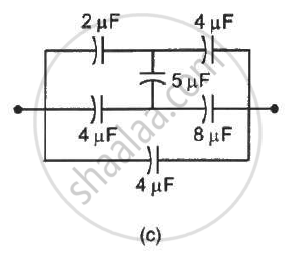
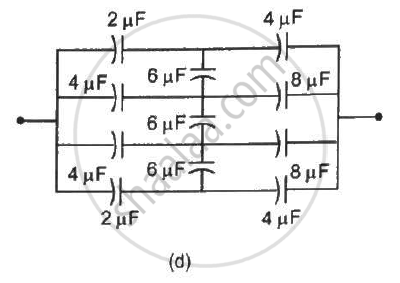
Find the equivalent capacitances of the combinations shown in figure between the indicated points.
Suppose the space between the two inner shells is filled with a dielectric of dielectric constant K. Find the capacitance of the system between A and B.
An air-filled parallel-plate capacitor is to be constructed which can store 12 µC of charge when operated at 1200 V. What can be the minimum plate area of the capacitor? The dielectric strength of air is `3 xx 10^6 "Vm"^-1`
You are provided with 8 μF capacitors. Show with the help of a diagram how you will arrange minimum number of them to get a resultant capacitance of 20 μF.
Obtain the expression for capacitance for a parallel plate capacitor.
Obtain the expression for energy stored in the parallel plate capacitor.
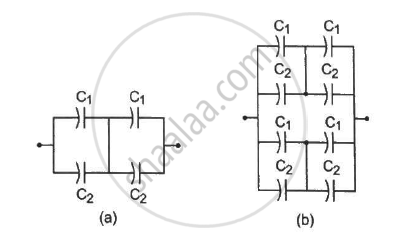
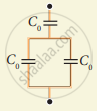
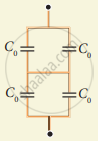
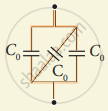
Calculate the resultant capacitances for each of the following combinations of capacitors.
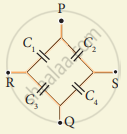
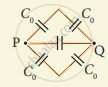
The radius of a sphere of capacity 1 microfarad in the air is ______
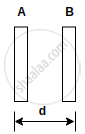
Two plates A and B of a parallel plate capacitor are arranged in such a way, that the area of each plate is S = 5 × 10⁻³ m 2 and distance between them is d = 8.85 mm. Plate A has a positive charge q1 = 10-10 C and Plate B has charge q2 = + 2 × 10⁻¹⁰ C. Then the charge induced on the plate B due to the plate A be - (....... × 10-11 )C
A leaky parallel plate capacitor is filled completely with a material having dielectric constant K = 5 and electric conductivity σ = 7.4 × 10⁻¹² Ω-1 m-1. If the charge on the plate at the instant t = 0 is q = 8.85 µC, then the leakage current at the instant t = 12 s is ______ × 10-1 µA.
Current versus time and voltage versus time graphs of a circuit element are shown in figure.
 |
 |
The type of the circuit element is ______.
The plates of a parallel plate capacitor are separated by d. Two slabs of different dielectric constant K1 and K2 with thickness `3/8 d and d/2`, respectively, are inserted in the capacitor. Due to this, the capacitance becomes two times larger than when there is nothing between the plates. If K1 = 1.25 K, the value of K1 is:
Which statement lists the factors on which capacitance depends?
