Advertisements
Advertisements
प्रश्न
Calculate the resultant capacitances for each of the following combinations of capacitors.
Advertisements
उत्तर
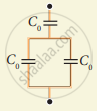
Parallel combination of capacitor 1 and 2
Cp = C0 + C0 = 2C0
Series combination of capacitor Cp and 3
`1/"C"_"s" = 1/"C"_"p" + 1/"C"_3 = 1/(2 "C"_0) + 1/"C"_0 = ("or") 1/"C"_"s" = 3/2 "C"_0 ("or") "C"_"s" = 2/3 "C"_0`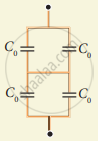
`1/"C"_("s"_1) = 1/"C"_1 + 1/"C"_2 = 1/"C"_0 + 1/"C"_0 = 1/"C"_0` (or)
`1/"C"_("s"_1) = 2/"C"_0 ("or") "C"_("S"_1) = "C"_0/2`
Similarly 3 and 4 are series combination
`1/"C"_("s"_1) = 1/"C"_3 + 1/"C"_4 = 1/"C"_0 + 1/"C"_0 = 2/"C"_0 ("or") "C"_("S"_2) = "C"_0/2`
`"C"_("S"_1) and "C"_("S"_2)` are in parallel combination
`"C"_"p" = "C"_("S"_1) + "C"_("S"_2) = "C"_0/2 + "C"_0/2 ("or") "C"_"p" = (2"C"_0)/2 "C"_"p" = "C"_0`- Capacitor 1, 2 and 3 are in parallel combination
Cp = C0 + C0 + C0 = 3C0
Cp = 3C0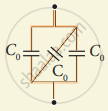
- Capacitar C1 and C2 are in combination
`1/"C"_("s"_1) = ("C"_1 + "C"_2)/("C"_1"C"_2)`
`"C"_("s"_1) = ("C"_1"C"_2)/("C"_1 + "C"_2)`
Similarly C3 and C4 are in series combination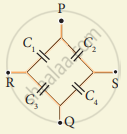
`1/"C"_("s"_2) = 1/"C"_3 + 1/"C"_4 = ("C"_3 + "C"_4)/("C"_3"C"_4)`
`"C"_("s"_2) = ("C"_3"C"_4)/("C"_3 + "C"_4)`
`"C"_("s"_1) and "C"_("s"_2)` are in parallel combination across RS:
CP = `"C"_("S"_1) + "C"_("S"_2)`
`= ("C"_1"C"_2)/("C"_1 + "C"_2) + ("C"_3"C"_4)/("C"_3 + "C"_4)`
`= ("C"_1"C"_2 ("C"_3 + "C"_4) + "C"_3"C"_4("C"_1 + "C"_2))/(("C"_1 + "C"_2)("C"_3 + "C"_4))`
`"C"_"P" = ("C"_1"C"_2"C"_3 + "C"_1"C"_2"C"_4 + "C"_3"C"_4"C"_1 + "C"_3"C"_4"C"_2)/(("C"_1 + "C"_2)("C"_3 + "C"_4))` - Capacitor 1 and 2 are series combination
`1/"C"_("s"_1) = 1/"C"_1 + 1/"C"_2 = 1/"C"_0 + 1/"C"_0 = 1/"C"_0`
`1/"C"_("s"_1) = 2/"C"_0` (or) `"C"_"s"_1 = "C"_0/2`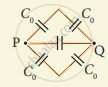
Similarly 3 and 4 are series combination
`1/"C"_("s"_1) = 2/"C"_0 ("or") "C"_("s"_2) = "C"_0/2`
Three capacitors are in parallel combination
`"C"_"P" = "C"_0/2 + "C"_0 + "C"_0/2 + (2"C"_0)/2 + "C"_0/2 = (4"C"_0)/2`
`"C"_"P" = 2 "C"_0`
APPEARS IN
संबंधित प्रश्न
A capacitor of capacitance ‘C’ is charged to ‘V’ volts by a battery. After some time the battery is disconnected and the distance between the plates is doubled. Now a slab of dielectric constant, 1 < k < 2, is introduced to fill the space between the plates. How will the following be affected? (b) The energy stored in the capacitor Justify your answer by writing the necessary expressions
A capacitor of capacitance C is charged to a potential V. The flux of the electric field through a closed surface enclosing the capacitor is
The plates of a parallel-plate capacitor are made of circular discs of radii 5⋅0 cm each. If the separation between the plates is 1⋅0 mm, what is the capacitance?
A capacitor of capacitance 10 μF is connected to a battery of emf 2 V. It is found that it takes 50 ms for the charge of the capacitor to become 12.6 μC. Find the resistance of the circuit.
The variation of inductive reactance (XL) of an inductor with the frequency (f) of the ac source of 100 V and variable frequency is shown in fig.
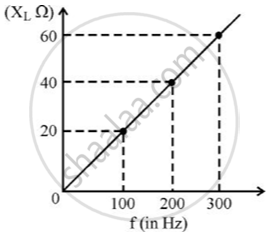
- Calculate the self-inductance of the inductor.
- When this inductor is used in series with a capacitor of unknown value and a resistor of 10 Ω at 300 s–1, maximum power dissipation occurs in the circuit. Calculate the capacitance of the capacitor.
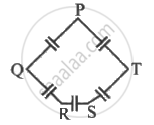
Five capacitor each of capacitance value C are connected as shown in the figure. The ratio of capacitance between P to R, and the capacitance between P and Q is ______.
Two spherical conductors of capacities 4 µF and 3 µF are charged to same potential having radii 4 cm and 3 cm respectively. If ‘σ1’ and ‘σ2’ represent surface density of charge on respective conductors then ______.
Which set lists the factors on which capacitance depends?
In a series combination, which quantity is the same on each capacitor?
