Advertisements
Advertisements
Question
Calculate the resultant capacitances for each of the following combinations of capacitors.
Advertisements
Solution
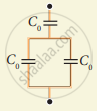
Parallel combination of capacitor 1 and 2
Cp = C0 + C0 = 2C0
Series combination of capacitor Cp and 3
`1/"C"_"s" = 1/"C"_"p" + 1/"C"_3 = 1/(2 "C"_0) + 1/"C"_0 = ("or") 1/"C"_"s" = 3/2 "C"_0 ("or") "C"_"s" = 2/3 "C"_0`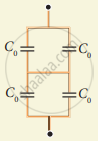
`1/"C"_("s"_1) = 1/"C"_1 + 1/"C"_2 = 1/"C"_0 + 1/"C"_0 = 1/"C"_0` (or)
`1/"C"_("s"_1) = 2/"C"_0 ("or") "C"_("S"_1) = "C"_0/2`
Similarly 3 and 4 are series combination
`1/"C"_("s"_1) = 1/"C"_3 + 1/"C"_4 = 1/"C"_0 + 1/"C"_0 = 2/"C"_0 ("or") "C"_("S"_2) = "C"_0/2`
`"C"_("S"_1) and "C"_("S"_2)` are in parallel combination
`"C"_"p" = "C"_("S"_1) + "C"_("S"_2) = "C"_0/2 + "C"_0/2 ("or") "C"_"p" = (2"C"_0)/2 "C"_"p" = "C"_0`- Capacitor 1, 2 and 3 are in parallel combination
Cp = C0 + C0 + C0 = 3C0
Cp = 3C0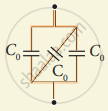
- Capacitar C1 and C2 are in combination
`1/"C"_("s"_1) = ("C"_1 + "C"_2)/("C"_1"C"_2)`
`"C"_("s"_1) = ("C"_1"C"_2)/("C"_1 + "C"_2)`
Similarly C3 and C4 are in series combination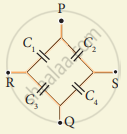
`1/"C"_("s"_2) = 1/"C"_3 + 1/"C"_4 = ("C"_3 + "C"_4)/("C"_3"C"_4)`
`"C"_("s"_2) = ("C"_3"C"_4)/("C"_3 + "C"_4)`
`"C"_("s"_1) and "C"_("s"_2)` are in parallel combination across RS:
CP = `"C"_("S"_1) + "C"_("S"_2)`
`= ("C"_1"C"_2)/("C"_1 + "C"_2) + ("C"_3"C"_4)/("C"_3 + "C"_4)`
`= ("C"_1"C"_2 ("C"_3 + "C"_4) + "C"_3"C"_4("C"_1 + "C"_2))/(("C"_1 + "C"_2)("C"_3 + "C"_4))`
`"C"_"P" = ("C"_1"C"_2"C"_3 + "C"_1"C"_2"C"_4 + "C"_3"C"_4"C"_1 + "C"_3"C"_4"C"_2)/(("C"_1 + "C"_2)("C"_3 + "C"_4))` - Capacitor 1 and 2 are series combination
`1/"C"_("s"_1) = 1/"C"_1 + 1/"C"_2 = 1/"C"_0 + 1/"C"_0 = 1/"C"_0`
`1/"C"_("s"_1) = 2/"C"_0` (or) `"C"_"s"_1 = "C"_0/2`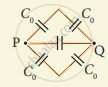
Similarly 3 and 4 are series combination
`1/"C"_("s"_1) = 2/"C"_0 ("or") "C"_("s"_2) = "C"_0/2`
Three capacitors are in parallel combination
`"C"_"P" = "C"_0/2 + "C"_0 + "C"_0/2 + (2"C"_0)/2 + "C"_0/2 = (4"C"_0)/2`
`"C"_"P" = 2 "C"_0`
APPEARS IN
RELATED QUESTIONS
When an AC source is connected to an ideal capacitor, show that the average power supplied by the source over a complete cycle is zero
A spherical capacitor consists of two concentric spherical conductors, held in position by suitable insulating supports. Show that the capacitance of a spherical capacitor is given by
C = `(4piin_0"r"_1"r"_2)/("r"_1 - "r"_2)`
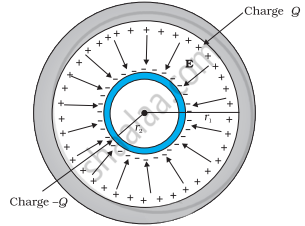
where r1 and r2 are the radii of outer and inner spheres, respectively.
The capacitance of a capacitor does not depend on
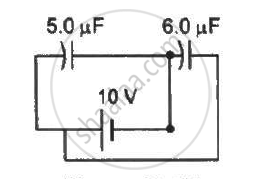
Find the charge supplied by the battery in the arrangement shown in figure.
Two conducting spheres of radii R1 and R2 are kept widely separated from each other. What are their individual capacitances? If the spheres are connected by a metal wire, what will be the capacitance of the combination? Think in terms of series−parallel connections.
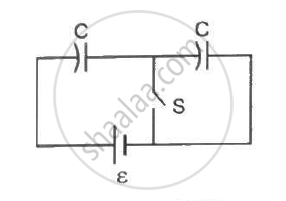
Consider the situation shown in the figure. The switch S is open for a long time and then closed. (a) Find the charge flown through the battery when the switch S is closed. (b) Find the work done by the battery.(c) Find the change in energy stored in the capacitors.(d) Find the heat developed in the system.
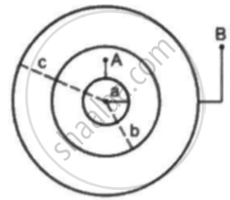
Suppose the space between the two inner shells is filled with a dielectric of dielectric constant K. Find the capacitance of the system between A and B.
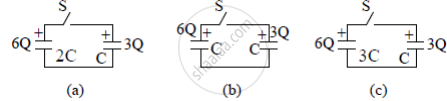
Three circuits, each consisting of a switch 'S' and two capacitors, are initially charged, as shown in the figure. After the switch has been closed, in which circuit will the charge on the left-hand capacitor
(i) increase,
(ii) decrease, and
(iii) remains the same? Give reasons.