Advertisements
Advertisements
Question
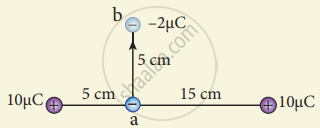
A point charge of +10 µC is placed at a distance of 20 cm from another identical point charge of +10 µC. A point charge of -2 µC is moved from point a to b as shown in the figure. Calculate the change in potential energy of the system? Interpret your result.
Advertisements
Solution
q1 = 10μC = 10 x 10-6 C
q2 = 2μC = -2 x 10⁻⁶ C
distance, r = 5cm = 5 x 10⁻² m
Change in potential energy,
`Delta "U" = (9 xx 10^9 xx 10 xx 10^-6 xx (- 2 xx 10^-6))/(5 xx 10^-2)`
= -36 × 1 × 109 × 10-12 × 102 = -36 × 10-1
∆ U = -3.6 J
Negative sign implies that to move the charge -2pC no external work is required. The system spends its stored energy to move the charge from point a to point b.
∆ U = -3.6 J, negative sign implies that to move the charge -2μC no external work is required. System spends its stored energy to move the charge from point a to point b.
APPEARS IN
RELATED QUESTIONS
An electric field `vec"E" = 10 xx hat"i"` exists in a certain region of space. Then the potential difference V = Vo – VA, where Vo is the potential at the origin and VA is the potential at x = 2 m is:
Two points A and B are maintained at a potential of 7 V and -4 V respectively. The work done in moving 50 electrons from A to B is ______.
Define electrostatic potential.
What is an equipotential surface?
What are the properties of an equipotential surface?
Derive an expression for electrostatic potential due to a point charge.
Obtain an expression for potential energy due to a collection of three point charges which are separated by finite distances.
Derive an expression for electrostatic potential energy of the dipole in a uniform electric field.
The electrostatic potential is given as a function of x in figure (a) and (b). Calculate the corresponding electric fields in regions A, B, C and D. Plot the electric field as a function of x for figure (b).
A spark plug in a bike or a car is used to ignite the air-fuel mixture in the engine. It consists of two electrodes separated by a gap of around 0.6 mm gap as shown in the figure.

To create the spark, an electric field of magnitude 3 x 10⁶Vm-1 is required,
- What potential difference must be applied to produce the spark?
- If the gap is increased, does the potential difference increase, decrease or remains the same?
- Find the potential difference if the gap is 1 mm.


