Advertisements
Advertisements
Question
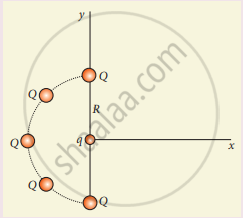
Five identical charges Q are placed equidistant on a semicircle as shown in the figure. Another point charge q is kept at the center of the circle of radius R. Calculate the electrostatic force experienced by the charge q.
Advertisements
Solution
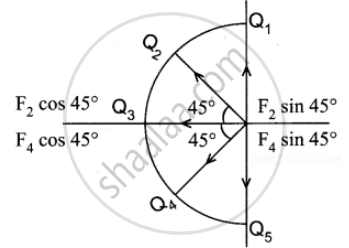
Force acting on q due to Q1 and Q5 are opposite direction, so cancel to each other.
Force acting on q due to Q3 is F3 = `1/(4pi epsilon_0) ("qQ"_3)/"R"^2`
Force acting on q due to Q2 and Q4
Resolving in two-component method:
- Vertical Component:
Q2 Sin θ and Q4 Sinθ are equal and opposite direction, so they are cancel to each other. - Horizontal Component:
Q2 Sin θ and Q4 cos θ are equal and same direction, so they can get added.
F24 = F2q + F4q = F2 cos 55° + F4 cos 45°
F24 = `1/(4pi epsilon_0) ("qQ"_3)/"R"^2 cos 45^circ + 1/(4pi epsilon_0) ("qQ"_4)/"R"^2 cos 45^circ`
Resultant net force F
F = F3 + F24 + F15
Q = Q1 = Q2 = Q3 = Q4 = Q5
cos 45° = `1/sqrt2`
F = `"qQ"/(4pi epsilon_0 "R"^2) [1 + 1/sqrt2 + 1/sqrt2]`
`= 1/(4pi epsilon_0) "qQ"/"R"^2 [1 + 2/sqrt2]`
F = `1/(4pi epsilon_0) "qQ"/"R"^2 [1 + sqrt2]`N
Vector form:
`vec"F" = 1/(4pi epsilon_0) "qQ"/"R"^2 (1 + sqrt2) "N"hat"i"`
APPEARS IN
RELATED QUESTIONS
Rank the electrostatic potential energies for the given system of charges in increasing order.

A thin conducting spherical shell of radius R has a charge Q which is uniformly distributed on its surface. The correct plot for electrostatic potential due to this spherical shell is
Give the relation between electric field and electric potential.
Define ‘electrostatic potential energy’.
Derive an expression for electrostatic potential due to a point charge.
Obtain an expression for potential energy due to a collection of three point charges which are separated by finite distances.
Derive an expression for electrostatic potential energy of the dipole in a uniform electric field.
Draw the free body diagram for the following charges as shown in the following figure.

The electrostatic potential is given as a function of x in figure (a) and (b). Calculate the corresponding electric fields in regions A, B, C and D. Plot the electric field as a function of x for figure (b).
A spark plug in a bike or a car is used to ignite the air-fuel mixture in the engine. It consists of two electrodes separated by a gap of around 0.6 mm gap as shown in the figure.

To create the spark, an electric field of magnitude 3 x 10⁶Vm-1 is required,
- What potential difference must be applied to produce the spark?
- If the gap is increased, does the potential difference increase, decrease or remains the same?
- Find the potential difference if the gap is 1 mm.


