Advertisements
Advertisements
प्रश्न
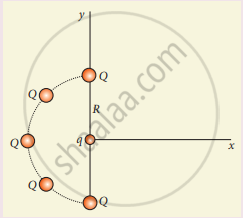
Five identical charges Q are placed equidistant on a semicircle as shown in the figure. Another point charge q is kept at the center of the circle of radius R. Calculate the electrostatic force experienced by the charge q.
संख्यात्मक
Advertisements
उत्तर
Force acting on q due to Q1 and Q5 are opposite direction, so cancel to each other.
Force acting on q due to Q3 is F3 = `1/(4pi epsilon_0) ("qQ"_3)/"R"^2`
Force acting on q due to Q2 and Q4
Resolving in two-component method:
- Vertical Component:
Q2 Sin θ and Q4 Sinθ are equal and opposite direction, so they are cancel to each other. - Horizontal Component:
Q2 Sin θ and Q4 cos θ are equal and same direction, so they can get added.
F24 = F2q + F4q = F2 cos 55° + F4 cos 45°
F24 = `1/(4pi epsilon_0) ("qQ"_3)/"R"^2 cos 45^circ + 1/(4pi epsilon_0) ("qQ"_4)/"R"^2 cos 45^circ`
Resultant net force F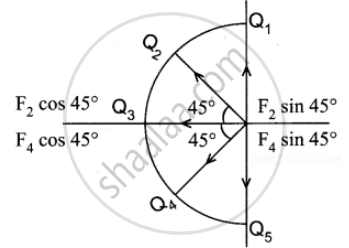
F = F3 + F24 + F15
Q = Q1 = Q2 = Q3 = Q4 = Q5
cos 45° = `1/sqrt2`
F = `"qQ"/(4pi epsilon_0 "R"^2) [1 + 1/sqrt2 + 1/sqrt2]`
`= 1/(4pi epsilon_0) "qQ"/"R"^2 [1 + 2/sqrt2]`
F = `1/(4pi epsilon_0) "qQ"/"R"^2 [1 + sqrt2]`N
Vector form:
`vec"F" = 1/(4pi epsilon_0) "qQ"/"R"^2 (1 + sqrt2) "N"hat"i"`
shaalaa.com
या प्रश्नात किंवा उत्तरात काही त्रुटी आहे का?
