Advertisements
Advertisements
प्रश्न
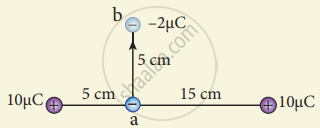
A point charge of +10 µC is placed at a distance of 20 cm from another identical point charge of +10 µC. A point charge of -2 µC is moved from point a to b as shown in the figure. Calculate the change in potential energy of the system? Interpret your result.
Advertisements
उत्तर
q1 = 10μC = 10 x 10-6 C
q2 = 2μC = -2 x 10⁻⁶ C
distance, r = 5cm = 5 x 10⁻² m
Change in potential energy,
`Delta "U" = (9 xx 10^9 xx 10 xx 10^-6 xx (- 2 xx 10^-6))/(5 xx 10^-2)`
= -36 × 1 × 109 × 10-12 × 102 = -36 × 10-1
∆ U = -3.6 J
Negative sign implies that to move the charge -2pC no external work is required. The system spends its stored energy to move the charge from point a to point b.
∆ U = -3.6 J, negative sign implies that to move the charge -2μC no external work is required. System spends its stored energy to move the charge from point a to point b.
APPEARS IN
संबंधित प्रश्न
Rank the electrostatic potential energies for the given system of charges in increasing order.

An electric field `vec"E" = 10 xx hat"i"` exists in a certain region of space. Then the potential difference V = Vo – VA, where Vo is the potential at the origin and VA is the potential at x = 2 m is:
Define electrostatic potential.
What is an equipotential surface?
Give the relation between electric field and electric potential.
What is meant by electrostatic energy density?
Obtain an expression for potential energy due to a collection of three point charges which are separated by finite distances.
Derive an expression for electrostatic potential energy of the dipole in a uniform electric field.
The total number of electrons in the human body is typically in the order of 1028. Suppose, due to some reason, you and your friend lost 1% of this number of electrons. Calculate the electrostatic force between you and your friend separated at a distance of lm. Compare this with your weight. Assume the mass of each person is 60kg and use point charge approximation.
Suppose a charge +q on Earth’s surface and another +q charge is placed on the surface of the Moon,
- Calculate the value of q required to balance the gravitational attraction between Earth and Moon
- Suppose the distance between the Moon and Earth is halved, would the charge q change?
(Take mE = 5.9 x 1024 kg, mM = 7.348 x 10²² kg)
