Advertisements
Advertisements
प्रश्न
A spark plug in a bike or a car is used to ignite the air-fuel mixture in the engine. It consists of two electrodes separated by a gap of around 0.6 mm gap as shown in the figure.
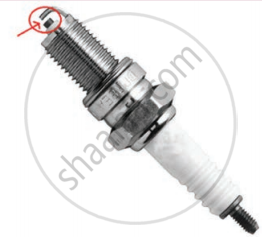
To create the spark, an electric field of magnitude 3 x 10⁶Vm-1 is required,
- What potential difference must be applied to produce the spark?
- If the gap is increased, does the potential difference increase, decrease or remains the same?
- Find the potential difference if the gap is 1 mm.
Advertisements
उत्तर
Separation gap between two electrodes, d = 0.6 mm
d = 0.6 × 10⁻³ m
Magnetude of electric field Electric field = E = 3 × 10⁶ V m-1
Electric field E = `"V"/"d"`
(a) Applied potential difference, V = E . d
= 3 × 106 × 0.6 10-13 = 1.8 × 10³
V = 1800 V
(b) From equation, V = E . d
If the gap (distance) between the electrodes increased, the potential difference also increases.
(c) Gap between the electrodes, d = 1mm = 1 x 10⁻³ m
Potential difference, V = E.d
= 3 × 106 × 1 × 10-3 = 3 × 10³
V = 3000 V
APPEARS IN
संबंधित प्रश्न
An electric field `vec"E" = 10 xx hat"i"` exists in a certain region of space. Then the potential difference V = Vo – VA, where Vo is the potential at the origin and VA is the potential at x = 2 m is:
Two points A and B are maintained at a potential of 7 V and -4 V respectively. The work done in moving 50 electrons from A to B is ______.
What is an equipotential surface?
Give the relation between electric field and electric potential.
What is meant by electrostatic energy density?
Derive an expression for electrostatic potential energy of the dipole in a uniform electric field.
Five identical charges Q are placed equidistant on a semicircle as shown in the figure. Another point charge q is kept at the center of the circle of radius R. Calculate the electrostatic force experienced by the charge q.

Suppose a charge +q on Earth’s surface and another +q charge is placed on the surface of the Moon,
- Calculate the value of q required to balance the gravitational attraction between Earth and Moon
- Suppose the distance between the Moon and Earth is halved, would the charge q change?
(Take mE = 5.9 x 1024 kg, mM = 7.348 x 10²² kg)
Draw the free body diagram for the following charges as shown in the following figure.

A point charge of +10 µC is placed at a distance of 20 cm from another identical point charge of +10 µC. A point charge of -2 µC is moved from point a to b as shown in the figure. Calculate the change in potential energy of the system? Interpret your result.

