Advertisements
Advertisements
प्रश्न
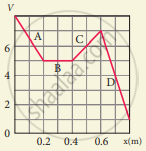
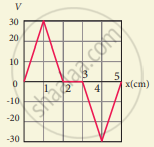
The electrostatic potential is given as a function of x in figure (a) and (b). Calculate the corresponding electric fields in regions A, B, C and D. Plot the electric field as a function of x for figure (b).
Advertisements
उत्तर
Figure a:
`vec"E" = - "dv"/"dx" hat"i"`
From 0 to 0.2 m,
`"E"_"x" = "dv"/"dx" = 3/0.2 = 30/2 = 15`Vm-1 (region A)
`"E"_"x" = "dv"/"dx"` = 0
Since the potential is constant (region B)
`"E"_"x" = "dv"/"dx" = (-2)/0.2 = (-20)/2` = - 10 Vm-1 (region c)
`"E"_"x" = "dv"/"dx" = 6/0.2 = 60/2` = 30 Vm-1 (region d)
Figure b:
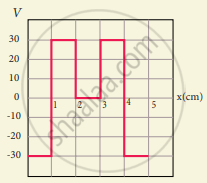
`"E"_"x" = "dv"/"dx"` = - 30 Vm-1 (region 0-1 cm)
`"E"_"x" = "dv"/"dx"` = 30 Vm-1 (region 1-2 cm)
`"E"_"x" = "dv"/"dx"` = 0 (region 2-3 cm)
`"E"_"x" = "dv"/"dx"` = 30 Vm-1 (region 3-4 cm)
`"E"_"x" = "dv"/"dx"` = - 30 Vm-1 (region 4-5 cm)
