Advertisements
Advertisements
प्रश्न
Calculate the resultant capacitances for each of the following combinations of capacitors.
Advertisements
उत्तर
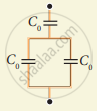
Parallel combination of capacitor 1 and 2
Cp = C0 + C0 = 2C0
Series combination of capacitor Cp and 3
`1/"C"_"s" = 1/"C"_"p" + 1/"C"_3 = 1/(2 "C"_0) + 1/"C"_0 = ("or") 1/"C"_"s" = 3/2 "C"_0 ("or") "C"_"s" = 2/3 "C"_0`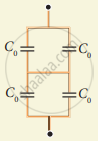
`1/"C"_("s"_1) = 1/"C"_1 + 1/"C"_2 = 1/"C"_0 + 1/"C"_0 = 1/"C"_0` (or)
`1/"C"_("s"_1) = 2/"C"_0 ("or") "C"_("S"_1) = "C"_0/2`
Similarly 3 and 4 are series combination
`1/"C"_("s"_1) = 1/"C"_3 + 1/"C"_4 = 1/"C"_0 + 1/"C"_0 = 2/"C"_0 ("or") "C"_("S"_2) = "C"_0/2`
`"C"_("S"_1) and "C"_("S"_2)` are in parallel combination
`"C"_"p" = "C"_("S"_1) + "C"_("S"_2) = "C"_0/2 + "C"_0/2 ("or") "C"_"p" = (2"C"_0)/2 "C"_"p" = "C"_0`- Capacitor 1, 2 and 3 are in parallel combination
Cp = C0 + C0 + C0 = 3C0
Cp = 3C0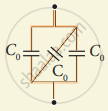
- Capacitar C1 and C2 are in combination
`1/"C"_("s"_1) = ("C"_1 + "C"_2)/("C"_1"C"_2)`
`"C"_("s"_1) = ("C"_1"C"_2)/("C"_1 + "C"_2)`
Similarly C3 and C4 are in series combination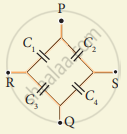
`1/"C"_("s"_2) = 1/"C"_3 + 1/"C"_4 = ("C"_3 + "C"_4)/("C"_3"C"_4)`
`"C"_("s"_2) = ("C"_3"C"_4)/("C"_3 + "C"_4)`
`"C"_("s"_1) and "C"_("s"_2)` are in parallel combination across RS:
CP = `"C"_("S"_1) + "C"_("S"_2)`
`= ("C"_1"C"_2)/("C"_1 + "C"_2) + ("C"_3"C"_4)/("C"_3 + "C"_4)`
`= ("C"_1"C"_2 ("C"_3 + "C"_4) + "C"_3"C"_4("C"_1 + "C"_2))/(("C"_1 + "C"_2)("C"_3 + "C"_4))`
`"C"_"P" = ("C"_1"C"_2"C"_3 + "C"_1"C"_2"C"_4 + "C"_3"C"_4"C"_1 + "C"_3"C"_4"C"_2)/(("C"_1 + "C"_2)("C"_3 + "C"_4))` - Capacitor 1 and 2 are series combination
`1/"C"_("s"_1) = 1/"C"_1 + 1/"C"_2 = 1/"C"_0 + 1/"C"_0 = 1/"C"_0`
`1/"C"_("s"_1) = 2/"C"_0` (or) `"C"_"s"_1 = "C"_0/2`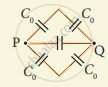
Similarly 3 and 4 are series combination
`1/"C"_("s"_1) = 2/"C"_0 ("or") "C"_("s"_2) = "C"_0/2`
Three capacitors are in parallel combination
`"C"_"P" = "C"_0/2 + "C"_0 + "C"_0/2 + (2"C"_0)/2 + "C"_0/2 = (4"C"_0)/2`
`"C"_"P" = 2 "C"_0`
APPEARS IN
संबंधित प्रश्न
When an AC source is connected to an ideal capacitor, show that the average power supplied by the source over a complete cycle is zero
A capacitor of capacitance C is charged to a potential V. The flux of the electric field through a closed surface enclosing the capacitor is
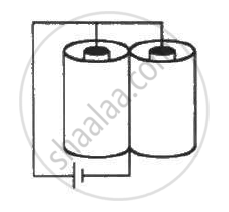
The outer cylinders of two cylindrical capacitors of capacitance 2⋅2 µF each, are kept in contact and the inner cylinders are connected through a wire. A battery of emf 10 V is connected as shown in figure . Find the total charge supplied by the battery to the inner cylinders.
A cylindrical capacitor is constructed using two coaxial cylinders of the same length 10 cm and of radii 2 mm and 4 mm. (a) Calculate the capacitance. (b) Another capacitor of the same length is constructed with cylinders of radii 4 mm and 8 mm. Calculate the capacitance.
A parallel-plate capacitor of capacitance 5 µF is connected to a battery of emf 6 V. The separation between the plates is 2 mm. (a) Find the charge on the positive plate. (b) Find the electric field between the plates. (c) A dielectric slab of thickness 1 mm and dielectric constant 5 is inserted into the gap to occupy the lower half of it. Find the capacitance of the new combination. (d) How much charge has flown through the battery after the slab is inserted?
Obtain an expression for equivalent capacitance when three capacitors C1, C2 and C3 are connected in series.
Derive the expression for resultant capacitance, when the capacitor is connected in series.
The work done in placing a charge of 8 × 10–18 coulomb on a condenser of capacity 100 micro-farad is ______.
Eight drops of mercury of equal radius and possessing equal charge combine to form a big drop. The capacitance of bigger drop as compared to each small drop is ______.
Which units are capacitors commonly measured in practice?
