Advertisements
Advertisements
प्रश्न
A parallel-plate capacitor of capacitance 5 µF is connected to a battery of emf 6 V. The separation between the plates is 2 mm. (a) Find the charge on the positive plate. (b) Find the electric field between the plates. (c) A dielectric slab of thickness 1 mm and dielectric constant 5 is inserted into the gap to occupy the lower half of it. Find the capacitance of the new combination. (d) How much charge has flown through the battery after the slab is inserted?
Advertisements
उत्तर
For the given capacitor,
`C = 5 "uF"`
V = 6 V
`d = 2 "mm" = 2 xx 10^-3 "m"`
(a) The charge on the positive plate is calculated using q = CV.
Thus,
`q = 5 "uF" xx 6 V = 30 "uC"`
(b) The electric field between the plates of the capacitor is given by
`E = V/d = 3 xx 10^3 "V/m"`
(c) Separation between the plates of the capacitor, d = `2 xx 10^-3 "m"`
Dielectric constant of the dielectric inserted, k = 5
Thickness of the dielectric inserted, t = `1 xx 10^-3 "m"`
Now ,
Area of the plates of the capacitor `C = (∈_0A)/d`
⇒ `5 xx 10^-6 = (8.85 xx 10^-12 xx A)/(2 xx 10^-3)`
⇒ `10^4 = 8.85 xx A`
⇒ `A = 10^4 xx 1/8.85`
When the dielectric placed in it, the capacitance becomes
⇒ `C_1 = (∈_0A)/(d-t+t/k)`
⇒ `C_1 = (8.85 xx 10^-12 xx 10^4/8.85)/(2 xx 10^-3-10^-3+(10-3)/5)`
⇒ `C_1 = (8.85 xx 10^-12 xx 10^4/8.85)/(10^-3+(10-3)/5)`
⇒ `C_1 = (10^-12 xx 10^4 xx 5)/(6 xx 10^-3) = 8.33 "uF"`
(d)
The charge stored in the capacitor initially is given by
`C = 5 xx 10^-6 "F"`
Also ,
V = 6 V
Now ,
`Q = CV = 3 xx 10^-5 "F"`
⇒`Q = 30 "uC"`
The charge on the capacitor after inserting the dielectric slab is given by
`C_1 = 8.3 xx 10^-6 "F"`
`therefore Q^' = C_1V = 8.3 xx 6 xx 10^-6`
⇒ `Q^' = 50 "uC"`
Now ,
Charge flown , `Q^' - Q = 20 "uC"`
APPEARS IN
संबंधित प्रश्न
A bulb is connected in series with a variable capacitor and an AC source as shown. What happens to the brightness of the bulb when the key is plugged in and capacitance of the capacitor is gradually reduced?
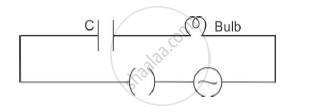
A capacitor of capacitance ‘C’ is charged to ‘V’ volts by a battery. After some time the battery is disconnected and the distance between the plates is doubled. Now a slab of dielectric constant, 1 < k < 2, is introduced to fill the space between the plates. How will the following be affected? (b) The energy stored in the capacitor Justify your answer by writing the necessary expressions
A spherical capacitor consists of two concentric spherical conductors, held in position by suitable insulating supports. Show that the capacitance of a spherical capacitor is given by
C = `(4piin_0"r"_1"r"_2)/("r"_1 - "r"_2)`
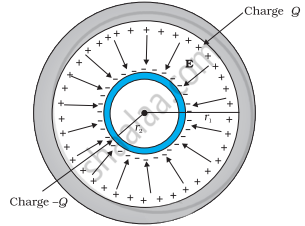
where r1 and r2 are the radii of outer and inner spheres, respectively.
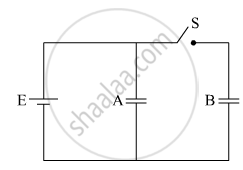
Two identical parallel plate capacitors A and B are connected to a battery of V volts with the switch S closed. The switch is now opened and the free space between the plates of the capacitors is filled with a dielectric of dielectric constant K. Find the ratio of the total electrostatic energy stored in both capacitors before and after the introduction of the dielectric.
A capacitor of capacitance ‘C’ is being charged by connecting it across a dc source along with an ammeter. Will the ammeter show a momentary deflection during the process of charging? If so, how would you explain this momentary deflection and the resulting continuity of current in the circuit? Write the expression for the current inside the capacitor.
Two capacitors each having capacitance C and breakdown voltage V are joined in series. The capacitance and the breakdown voltage of the combination will be
A capacitor of capacitance 10 μF is connected to a battery of emf 2 V. It is found that it takes 50 ms for the charge of the capacitor to become 12.6 μC. Find the resistance of the circuit.
The separation between the plates of a parallel-plate capacitor is 0⋅500 cm and its plate area is 100 cm2. A 0⋅400 cm thick metal plate is inserted into the gap with its faces parallel to the plates. Show that the capacitance of the assembly is independent of the position of the metal plate within the gap and find its value.
Obtain an expression for equivalent capacitance when three capacitors C1, C2 and C3 are connected in series.
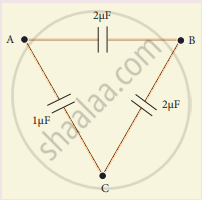
Three capacitors are connected in a triangle as shown in the figure. The equivalent capacitance between points A and C is ______.
Define ‘capacitance’. Give its unit.
- Charge on each capacitor remains same and equals to the main charge supplied by the battery.
- Potential difference and energy distribute in the reverse ratio of capacitance.
- Effective capacitance is even les than the least of teh individual capacitances.
A leaky parallel plate capacitor is filled completely with a material having dielectric constant K = 5 and electric conductivity σ = 7.4 × 10⁻¹² Ω-1 m-1. If the charge on the plate at the instant t = 0 is q = 8.85 µC, then the leakage current at the instant t = 12 s is ______ × 10-1 µA.
A capacitor of capacity 2 µF is charged to a potential difference of 12 V. It is then connected across an inductor of inductance 0.6 mH. The current in the circuit at a time when the potential difference across the capacitor is 6.0 V is ______ × 10-1A.
The plates of a parallel plate capacitor are separated by d. Two slabs of different dielectric constant K1 and K2 with thickness `3/8 d and d/2`, respectively, are inserted in the capacitor. Due to this, the capacitance becomes two times larger than when there is nothing between the plates. If K1 = 1.25 K, the value of K1 is:
For the same potential difference, what does a larger capacitance mean?
For a given capacitor, what fixes its capacitance?
What is the practical purpose of a parallel combination of capacitors?
