Advertisements
Advertisements
प्रश्न
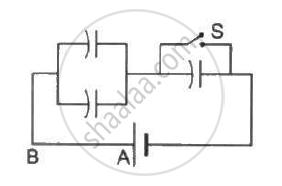
Each capacitor shown in figure has a capacitance of 5⋅0 µF. The emf of the battery is 50 V. How much charge will flow through AB if the switch S is closed?
Advertisements
उत्तर
Initially, when the switch S is open, the equivalent capacitance is given by
`C_(eq) = (2CxxC)/(3C)`
`⇒ C_("eq") = 2/3 C = 2/3 xx 5.0 "uF"`
The Charge supplied by the battery is given by
`Q = C_(eq) xx V`
`⇒ Q = 2/3 xx (5.0 "uF") xx (50 "V")`
`⇒Q = 500/3 "uC"`
When the switch S is closed, no charge goes to the capacitor connected in parallel with the switch.
Thus, the equivalent capacitance is given by `C_(eq) = 2C = 2 xx 5.0 xx 10 = uF`
The charge supplied by the battery is given by
`Q = 10 "uF" xx 50 = 500 "uC"`
The initial charge stored in the shorted capacitor starts discharging."?
Hence, the charge that flows from A to B is given by
`Q_"net" = 500 "uC" - 500/3 "uC"`
`⇒ Q_"net" = 3.3 xx 10^-4 C`
APPEARS IN
संबंधित प्रश्न
The capacitance of a capacitor does not depend on
Three capacitors having capacitances 20 µF, 30 µF and 40 µF are connected in series with a 12 V battery. Find the charge on each of the capacitors. How much work has been done by the battery in charging the capacitors?
A capacitor of capacitance 10 μF is connected to a battery of emf 2 V. It is found that it takes 50 ms for the charge of the capacitor to become 12.6 μC. Find the resistance of the circuit.
A 5⋅0 µF capacitor is charged to 12 V. The positive plate of this capacitor is now connected to the negative terminal of a 12 V battery and vice versa. Calculate the heat developed in the connecting wires.
The two square faces of a rectangular dielectric slab (dielectric constant 4⋅0) of dimensions 20 cm × 20 cm × 1⋅0 mm are metal-coated. Find the capacitance between the coated surfaces.
A parallel-plate capacitor has plate area 100 cm2 and plate separation 1⋅0 cm. A glass plate (dielectric constant 6⋅0) of thickness 6⋅0 mm and an ebonite plate (dielectric constant 4⋅0) are inserted one over the other to fill the space between the plates of the capacitor. Find the new capacitance.
Obtain an expression for equivalent capacitance when three capacitors C1, C2 and C3 are connected in series.
The variation of inductive reactance (XL) of an inductor with the frequency (f) of the ac source of 100 V and variable frequency is shown in fig.
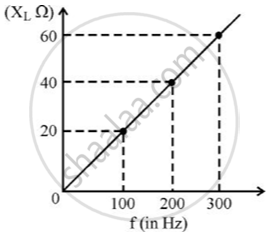
- Calculate the self-inductance of the inductor.
- When this inductor is used in series with a capacitor of unknown value and a resistor of 10 Ω at 300 s–1, maximum power dissipation occurs in the circuit. Calculate the capacitance of the capacitor.
Derive the expression for resultant capacitance, when the capacitor is connected in series.
Derive the expression for resultant capacitance, when the capacitor is connected in parallel.
A capacitor has charge 50 µC. When the gap between the plate is filled with glass wool, then 120 µC charge flows through the battery to capacitor. The dielectric constant of glass wool is ______.
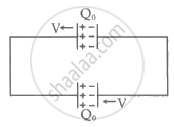
Two identical capacitors are connected as shown and have an initial charge of Q0. The separation between the plates of each capacitor is d0. Suddenly the left plate of the upper capacitor and right plate of the lower capacitor start moving with speed v towards the left while the other plate of each capacitor remains fixed. `("given" (Q_0V)/(2d_0) = 10 A)`. The value of current in the circuit is ______ A.
A parallel plate capacitor (A) of capacitance C is charged by a battery to voltage V. The battery is disconnected and an uncharged capacitor (B) of capacitance 2C is connected across A. Find the ratio of final charges on A and B.
Read the following paragraph and answer the questions.
| A capacitor is a system of two conductors separated by an insulator. The two conductors have equal and opposite charges with a potential difference between them. The capacitance of a capacitor depends on the geometrical configuration (shape, size and separation) of the system and also on the nature of the insulator separating the two conductors. They are used to store charges. Like resistors, capacitors can be arranged in series or parallel or a combination of both to obtain the desired value of capacitance. |
- Find the equivalent capacitance between points A and B in the given diagram.

- A dielectric slab is inserted between the plates of the parallel plate capacitor. The electric field between the plates decreases. Explain.
- A capacitor A of capacitance C, having charge Q is connected across another uncharged capacitor B of capacitance 2C. Find an expression for (a) the potential difference across the combination and (b) the charge lost by capacitor A.
OR
Two slabs of dielectric constants 2K and K fill the space between the plates of a parallel plate capacitor of plate area A and plate separation d as shown in the figure. Find an expression for the capacitance of the system.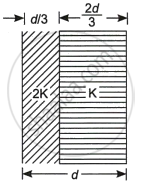
Eight drops of mercury of equal radius and possessing equal charge combine to form a big drop. The capacitance of bigger drop as compared to each small drop is ______.
Which expression gives the capacitance of a capacitor?
Which statement lists the factors on which capacitance depends?
In a series combination, which statement describes the potential difference across each capacitor?
