Advertisements
Advertisements
प्रश्न
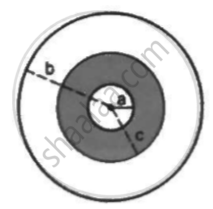
A sphercial capacitor is made of two conducting spherical shells of radii a and b. The space between the shells is filled with a dielectric of dielectric constant K up to a radius c as shown in figure . Calculate the capacitance.
Advertisements
उत्तर
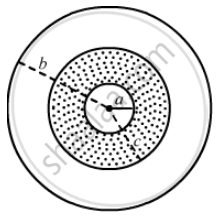
We have two capacitors: one made by the shells a and c and the other made by the shells b and c.
The capacitance of the capacitor `C_(ac)` is given by
`C_(ac) = (4pi∈_0acK)/((c-a))`
The capacitance of the capacitor `C_(cb)` is given by
`C_(cb) = (4pi∈_0bcK)/(K(b-c)`
The two capacitors are in series; thus, the equivalent capacitance is given by
`1/C = 1/C_(ac) + 1/C_(cb)`
⇒ `1/C = ((c-a))/(4pi∈_0acK) + ((b-c))/(4pi∈_0cb)`
⇒ `1/C = (b(c-a)+Ka(b-c))/(K4pi∈_0abc)`
⇒ `C = (K4pi∈_0abc)/(b(c-a)+Ka(b-c))`
APPEARS IN
संबंधित प्रश्न
A capacitor of capacitance ‘C’ is charged to ‘V’ volts by a battery. After some time the battery is disconnected and the distance between the plates is doubled. Now a slab of dielectric constant, 1 < k < 2, is introduced to fill the space between the plates. How will the following be affected? (a) The electric field between the plates of the capacitor Justify your answer by writing the necessary expressions.
A capacitor has capacitance C. Is this information sufficient to know what maximum charge the capacitor can contain? If yes, what is this charges? If no, what other information is needed?
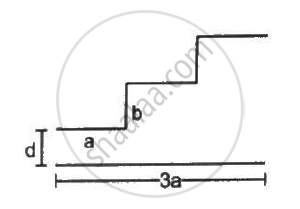
A capacitor is made of a flat plate of area A and a second plate having a stair-like structure as shown in figure . The width of each stair is a and the height is b. Find the capacitance of the assembly.
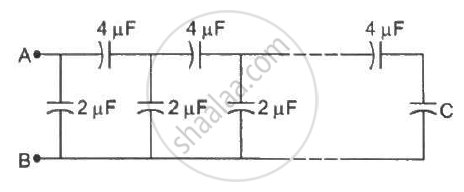
A finite ladder is constructed by connecting several sections of 2 µF, 4 µF capacitor combinations as shown in the figure. It is terminated by a capacitor of capacitance C. What value should be chosen for C, such that the equivalent capacitance of the ladder between the points A and B becomes independent of the number of sections in between?
The two square faces of a rectangular dielectric slab (dielectric constant 4⋅0) of dimensions 20 cm × 20 cm × 1⋅0 mm are metal-coated. Find the capacitance between the coated surfaces.
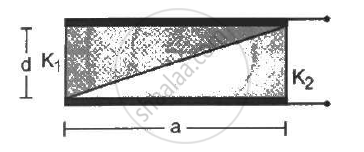
A capacitor is formed by two square metal-plates of edge a, separated by a distance d. Dielectrics of dielectric constant K1 and K2 are filled in the gap as shown in figure . Find the capacitance.
Explain in detail the effect of a dielectric placed in a parallel plate capacitor.
The positive terminal of 12 V battery is connected to the ground. Then the negative terminal will be at ______.
- Charge on each capacitor remains same and equals to the main charge supplied by the battery.
- Potential difference and energy distribute in the reverse ratio of capacitance.
- Effective capacitance is even les than the least of teh individual capacitances.
Three capacitors 2µF, 3µF, and 6µF are joined in series with each other. The equivalent capacitance is ____________.
The capacitance of a parallel plate capacitor is 60 µF. If the distance between the plates is tripled and area doubled then new capacitance will be ______.
A parallel plate capacitor is filled by a dielectric whose relative permittivity varies with the applied voltage (U) as ε = αU where α = 2V–1. A similar capacitor with no dielectric is charged to U0 = 78V. It is then connected to the uncharged capacitor with the dielectric. Find the final voltage on the capacitors.
The displacement current of 4.425 µA is developed in the space between the plates of the parallel plate capacitor when voltage is changing at a rate of 106 Vs-1. The area of each plate of the capacitor is 40 cm2. The distance between each plate of the capacitor is x × 10-3 m. The value of x is ______.
(Permittivity of free space, ε0 = 8.85 × 10⁻¹²C2N-1m-2).
The material filled between the plates of a parallel plate capacitor has a resistivity of 200Ωm. The value of the capacitance of the capacitor is 2 pF. If a potential difference of 40V is applied across the plates of the capacitor, then the value of leakage current flowing out of the capacitor is ______.
(given the value of relative permittivity of a material is 50.)
Calculate equivalent capacitance of the circuit shown in the Figure given below:

What is called the capacity of conductor?
Which expression gives the capacitance of a capacitor?
Which statement lists the factors on which capacitance depends?
In a parallel combination, which quantity is the same across each capacitor?
What is the practical purpose of a parallel combination of capacitors?
