Advertisements
Advertisements
प्रश्न
Obtain the expression for capacitance for a parallel plate capacitor.
Derive an expression for the capacitance of a parallel plate capacitor with air present between the two plates.
Advertisements
उत्तर १
Consider a capacitor with two parallel plates each of cross-sectional area A and separated by a distance d. The electric field between two infinite parallel plates is uniform and is given by E = `sigma/ε_0` where σ is the surface charge density on the plates σ = `"Q"/"A"`. If the separation distance d is very much smaller than the size of the plate (d2 << A), then the above result is used even for finite-sized
parallel plate capacitor.

Capacitance of a parallel plate capacitor
Capacitance of a parallel plate capacitor
The electric field between the plates is
E = `"Q"/("A"ε_0)` ....(1)
Since the electric field is unifonn, the electric potential between the plates having separation d is given by
V = Ed = `"Qd"/("A"ε_0)` ....(2)
Therefore the capacitance of the capacitor is given by
C = `"Q"/"V" = "Q"/(("Qd"/("A"ε_0))) = (ε_0"A")/"d"` ....(3)
From equation (3), it is evident that capacitance is directly proportional to the area of cross-section and is inversely proportional to the distance between the plates. This can be understood from the following.
- If the area of cross-section of the capacitor plates is increased, more charges can be distributed for the same potential difference. As a result, the capacitance is increased.
- If the distance d between the two plates is reduced, the potential difference between the plates (V = Ed) decreases with E constant.
उत्तर २
Derivation of the expression for the capacitance.
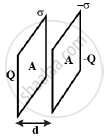
Let the two plates be kept parallel to each other separated by a distance d and the cross-sectional area of each plate is A. Electric field by a single thin plate E = `sigma/(2epsi_0)`
The total electric field between the plates E = `sigma/epsi_0` = `Q/(Aepsi_0)`
The potential difference between the plates V = Ed = `[Q/(Aε_0)]`d.
Capacitance C = `"Q"/"V" = (Aepsi_0)/d`
संबंधित प्रश्न
Define capacitor reactance. Write its S.I units.
The plates of a parallel-plate capacitor are made of circular discs of radii 5⋅0 cm each. If the separation between the plates is 1⋅0 mm, what is the capacitance?
A parallel-plate capacitor has plate area 25⋅0 cm2 and a separation of 2⋅00 mm between the plates. The capacitor is connected to a battery of 12⋅0 V. (a) Find the charge on the capacitor. (b) The plate separation is decreased to 1⋅00 mm. Find the extra charge given by the battery to the positive plate.
Find the equivalent capacitance of the system shown in figure between the points a and b.
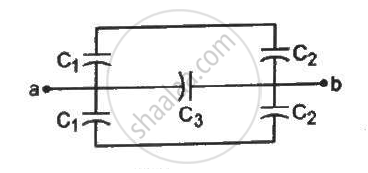
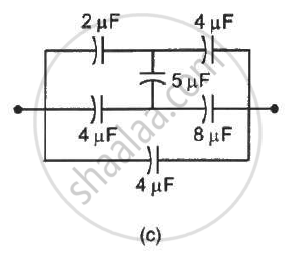
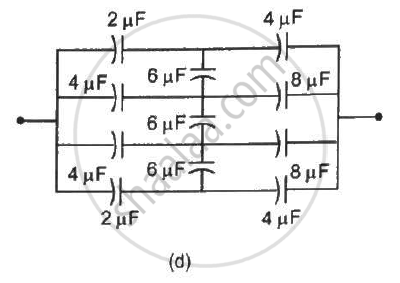
Find the equivalent capacitances of the combinations shown in figure between the indicated points.
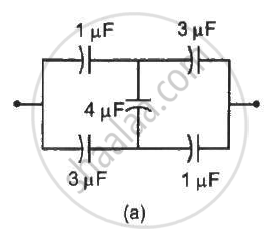
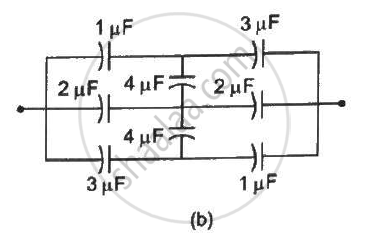
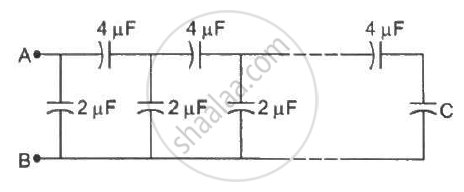
A finite ladder is constructed by connecting several sections of 2 µF, 4 µF capacitor combinations as shown in the figure. It is terminated by a capacitor of capacitance C. What value should be chosen for C, such that the equivalent capacitance of the ladder between the points A and B becomes independent of the number of sections in between?
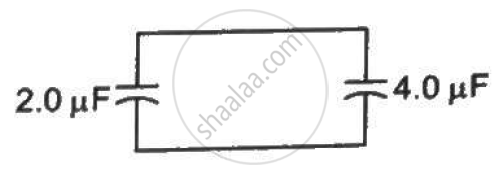
A capacitor of capacitance 2⋅0 µF is charged to a potential difference of 12 V. It is then connected to an uncharged capacitor of capacitance 4⋅0 µF as shown in figure . Find (a) the charge on each of the two capacitors after the connection, (b) the electrostatic energy stored in each of the two capacitors and (c) the heat produced during the charge transfer from one capacitor to the other.
A parallel-plate capacitor has plate area 100 cm2 and plate separation 1⋅0 cm. A glass plate (dielectric constant 6⋅0) of thickness 6⋅0 mm and an ebonite plate (dielectric constant 4⋅0) are inserted one over the other to fill the space between the plates of the capacitor. Find the new capacitance.
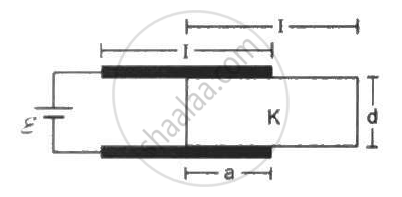
Consider the situation shown in figure. The plates of the capacitor have plate area A and are clamped in the laboratory. The dielectric slab is released from rest with a length a inside the capacitor. Neglecting any effect of friction or gravity, show that the slab will execute periodic motion and find its time period.
Dielectric constant for a metal is ______.
The radius of a sphere of capacity 1 microfarad in the air is ______
Consider two conducting spheres of radii R1 and R2 with R1 > R2. If the two are at the same potential, the larger sphere has more charge than the smaller sphere. State whether the charge density of the smaller sphere is more or less than that of the larger one.
The displacement current of 4.425 µA is developed in the space between the plates of the parallel plate capacitor when voltage is changing at a rate of 106 Vs-1. The area of each plate of the capacitor is 40 cm2. The distance between each plate of the capacitor is x × 10-3 m. The value of x is ______.
(Permittivity of free space, ε0 = 8.85 × 10⁻¹²C2N-1m-2).
Current versus time and voltage versus time graphs of a circuit element are shown in figure.
 |
 |
The type of the circuit element is ______.
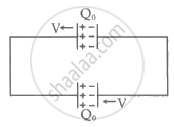
Two identical capacitors are connected as shown and have an initial charge of Q0. The separation between the plates of each capacitor is d0. Suddenly the left plate of the upper capacitor and right plate of the lower capacitor start moving with speed v towards the left while the other plate of each capacitor remains fixed. `("given" (Q_0V)/(2d_0) = 10 A)`. The value of current in the circuit is ______ A.
A parallel plate capacitor (A) of capacitance C is charged by a battery to voltage V. The battery is disconnected and an uncharged capacitor (B) of capacitance 2C is connected across A. Find the ratio of final charges on A and B.
If the plates of a parallel plate capacitor connected to a battery are moved close to each other, then:
- the charge stored in it. increases.
- the energy stored in it, decreases.
- its capacitance increases.
- the ratio of charge to its potential remains the same.
- the product of charge and voltage increases.
Choose the most appropriate answer from the options given below:
Which expression gives the capacitance of a capacitor?
