Advertisements
Advertisements
प्रश्न
A spherical capacitor has an inner sphere of radius 12 cm and an outer sphere of radius 13 cm. The outer sphere is earthed and the inner sphere is given a charge of 2.5 µC. The space between the concentric spheres is filled with a liquid of dielectric constant 32.
(a) Determine the capacitance of the capacitor.
(b) What is the potential of the inner sphere?
(c) Compare the capacitance of this capacitor with that of an isolated sphere of radius 12 cm. Explain why the latter is much smaller.
Advertisements
उत्तर
Radius of the inner sphere, r2 = 12 cm = 0.12 m
Radius of the outer sphere, r1 = 13 cm = 0.13 m
Charge on the inner sphere, q = 2.5 µC = `2.5 xx 10^-6 "C"`
Dielectric constant of a liquid, ` in_"r" = 32`
(a) Capacitance of the capacitor is given by the relation
C = `(4piin_0in_1"r"_1"r"_2)/("r"_1 - "r"_2)`
Where,
`in_0` = Permittivity of free space = `8.85 xx 10^-12 "C"^2 "N"^-1 "m"^-2`
`1/(4piin_0) = 9 xx 10^9 "Nm"^2 "C"^-2`
∴ C = `(32 xx 0.12 xx 0.13)/(9 xx 10^9 xx (0.13 - 0.12))`
`≈ 5.5 xx 10^-9 "F"`
Hence, the capacitance of the capacitor is approximate `5.5 xx 10^-9 "F"`.
(b) Potential of the inner sphere is given by,
`"V" = "q"/"C"`
= `(2.5 xx 10^-6)/(5.5 xx 10^-9) = 4.5 xx 10^2 "V"`
Hence, the potential of the inner sphere is `4.5 xx 10^2 "V"`.
(c) Radius of an isolated sphere, r = 12 × 10−2 m
Capacitance of the sphere is given by the relation,
`"C'" = 4piin_0"r"`
= `4pi xx 8.85 xx 10^-12 xx 12 xx 10^-12`
= `1.33 xx 10^-11 "F"`
The capacitance of the isolated sphere is less in comparison to the concentric spheres. This is because the outer sphere of the concentric spheres is earthed. Hence, the potential difference is less and the capacitance is more than the isolated sphere.
APPEARS IN
संबंधित प्रश्न
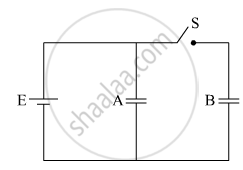
Two identical parallel plate capacitors A and B are connected to a battery of V volts with the switch S closed. The switch is now opened and the free space between the plates of the capacitors is filled with a dielectric of dielectric constant K. Find the ratio of the total electrostatic energy stored in both capacitors before and after the introduction of the dielectric.
(i) Find equivalent capacitance between A and B in the combination given below. Each capacitor is of 2 µF capacitance.
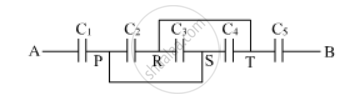
(ii) If a dc source of 7 V is connected across AB, how much charge is drawn from the source and what is the energy stored in the network?
Three identical capacitors C1, C2 and C3 of capacitance 6 μF each are connected to a 12 V battery as shown.
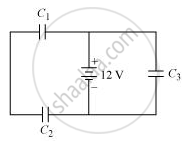
Find
(i) charge on each capacitor
(ii) equivalent capacitance of the network
(iii) energy stored in the network of capacitors
The plates of a parallel-plate capacitor are made of circular discs of radii 5⋅0 cm each. If the separation between the plates is 1⋅0 mm, what is the capacitance?
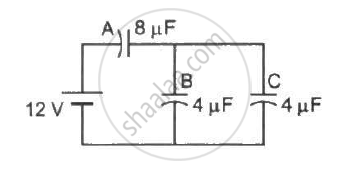
Find the charge appearing on each of the three capacitors shown in figure .
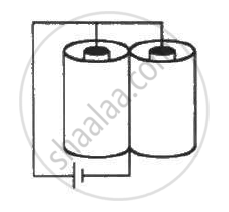
The outer cylinders of two cylindrical capacitors of capacitance 2⋅2 µF each, are kept in contact and the inner cylinders are connected through a wire. A battery of emf 10 V is connected as shown in figure . Find the total charge supplied by the battery to the inner cylinders.
A cylindrical capacitor is constructed using two coaxial cylinders of the same length 10 cm and of radii 2 mm and 4 mm. (a) Calculate the capacitance. (b) Another capacitor of the same length is constructed with cylinders of radii 4 mm and 8 mm. Calculate the capacitance.
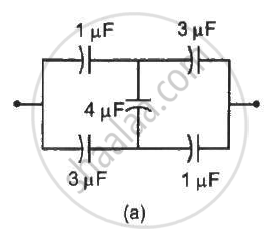
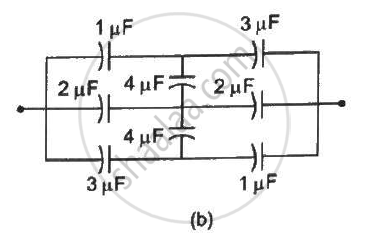
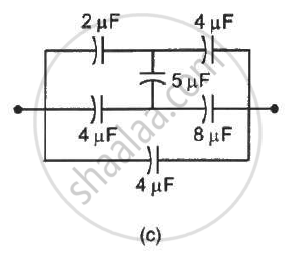
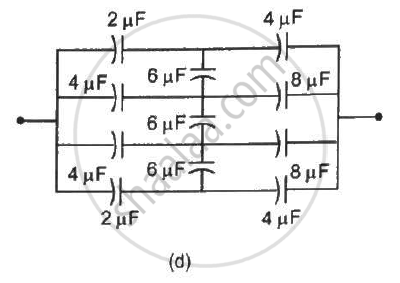
Find the equivalent capacitances of the combinations shown in figure between the indicated points.
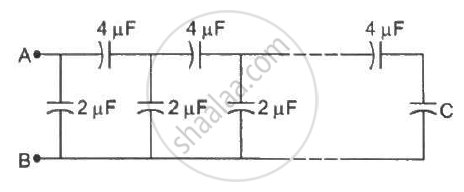
A finite ladder is constructed by connecting several sections of 2 µF, 4 µF capacitor combinations as shown in the figure. It is terminated by a capacitor of capacitance C. What value should be chosen for C, such that the equivalent capacitance of the ladder between the points A and B becomes independent of the number of sections in between?
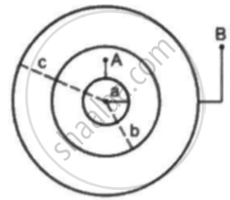
Suppose the space between the two inner shells is filled with a dielectric of dielectric constant K. Find the capacitance of the system between A and B.
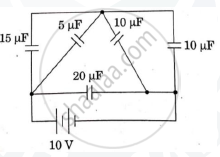
The figure show a network of five capacitors connected to a 10V battery. Calculate the charge acquired by the 5μF capacitor.
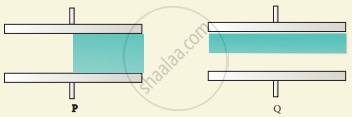
Capacitors P and Q have identical cross-sectional areas A and separation d. The space between the capacitors is filled with a dielectric of dielectric constant Er as shown in the figure. Calculate the capacitance of capacitors P and Q.
The work done in placing a charge of 8 × 10–18 coulomb on a condenser of capacity 100 micro-farad is ______.
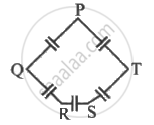
Five capacitor each of capacitance value C are connected as shown in the figure. The ratio of capacitance between P to R, and the capacitance between P and Q is ______.
The radius of a sphere of capacity 1 microfarad in the air is ______
A leaky parallel plate capacitor is filled completely with a material having dielectric constant K = 5 and electric conductivity σ = 7.4 × 10⁻¹² Ω-1 m-1. If the charge on the plate at the instant t = 0 is q = 8.85 µC, then the leakage current at the instant t = 12 s is ______ × 10-1 µA.
A parallel plate capacitor (A) of capacitance C is charged by a battery to voltage V. The battery is disconnected and an uncharged capacitor (B) of capacitance 2C is connected across A. Find the ratio of final charges on A and B.
Which set lists the factors on which capacitance depends?
In a series combination, which statement describes the potential difference across each capacitor?
