Advertisements
Advertisements
Question
A spherical capacitor has an inner sphere of radius 12 cm and an outer sphere of radius 13 cm. The outer sphere is earthed and the inner sphere is given a charge of 2.5 µC. The space between the concentric spheres is filled with a liquid of dielectric constant 32.
(a) Determine the capacitance of the capacitor.
(b) What is the potential of the inner sphere?
(c) Compare the capacitance of this capacitor with that of an isolated sphere of radius 12 cm. Explain why the latter is much smaller.
Advertisements
Solution
Radius of the inner sphere, r2 = 12 cm = 0.12 m
Radius of the outer sphere, r1 = 13 cm = 0.13 m
Charge on the inner sphere, q = 2.5 µC = `2.5 xx 10^-6 "C"`
Dielectric constant of a liquid, ` in_"r" = 32`
(a) Capacitance of the capacitor is given by the relation
C = `(4piin_0in_1"r"_1"r"_2)/("r"_1 - "r"_2)`
Where,
`in_0` = Permittivity of free space = `8.85 xx 10^-12 "C"^2 "N"^-1 "m"^-2`
`1/(4piin_0) = 9 xx 10^9 "Nm"^2 "C"^-2`
∴ C = `(32 xx 0.12 xx 0.13)/(9 xx 10^9 xx (0.13 - 0.12))`
`≈ 5.5 xx 10^-9 "F"`
Hence, the capacitance of the capacitor is approximate `5.5 xx 10^-9 "F"`.
(b) Potential of the inner sphere is given by,
`"V" = "q"/"C"`
= `(2.5 xx 10^-6)/(5.5 xx 10^-9) = 4.5 xx 10^2 "V"`
Hence, the potential of the inner sphere is `4.5 xx 10^2 "V"`.
(c) Radius of an isolated sphere, r = 12 × 10−2 m
Capacitance of the sphere is given by the relation,
`"C'" = 4piin_0"r"`
= `4pi xx 8.85 xx 10^-12 xx 12 xx 10^-12`
= `1.33 xx 10^-11 "F"`
The capacitance of the isolated sphere is less in comparison to the concentric spheres. This is because the outer sphere of the concentric spheres is earthed. Hence, the potential difference is less and the capacitance is more than the isolated sphere.
APPEARS IN
RELATED QUESTIONS
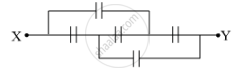
Find the equivalent capacitance of the network shown in the figure, when each capacitor is of 1 μF. When the ends X and Y are connected to a 6 V battery, find out (i) the charge and (ii) the energy stored in the network.
As `C = (1/V) Q` , can you say that the capacitance C is proportional to the charge Q?
Two capacitors each having capacitance C and breakdown voltage V are joined in series. The capacitance and the breakdown voltage of the combination will be
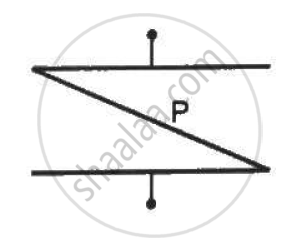
A thin metal plate P is inserted between the plates of a parallel-plate capacitor of capacitance C in such a way that its edges touch the two plates . The capacitance now becomes _________ .
The capacitance of a capacitor does not depend on
Take `C_1 = 4.0 "uF" and C_2 = 6.0 "uF"` in figure . Calculate the equivalent capacitance of the combination between the points indicated.
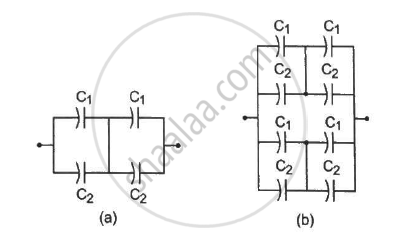
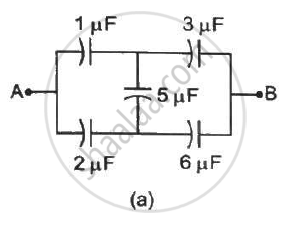
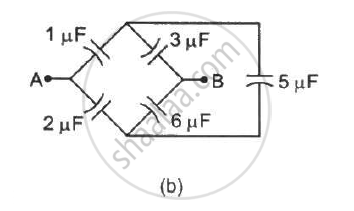
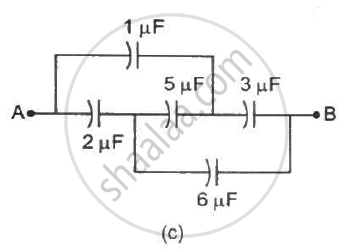
Convince yourself that parts (a), (b) and (c) figure are identical. Find the capacitance between the points A and B of the assembly.
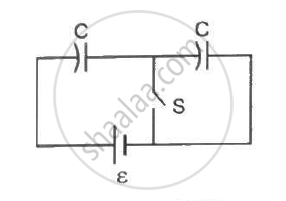
Consider the situation shown in the figure. The switch S is open for a long time and then closed. (a) Find the charge flown through the battery when the switch S is closed. (b) Find the work done by the battery.(c) Find the change in energy stored in the capacitors.(d) Find the heat developed in the system.
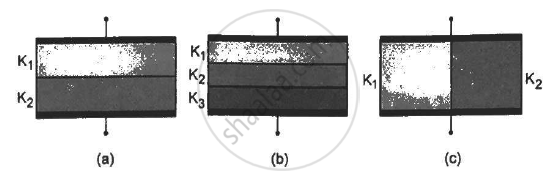
Find the capacitances of the capacitors shown in figure . The plate area is Aand the separation between the plates is d. Different dielectric slabs in a particular part of the figure are of the same thickness and the entire gap between the plates is filled with the dielectric slabs.
Explain in detail the effect of a dielectric placed in a parallel plate capacitor.
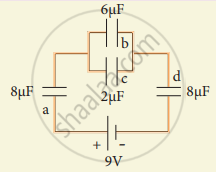
For the given capacitor configuration
- Find the charges on each capacitor
- potential difference across them
- energy stored in each capacitor.
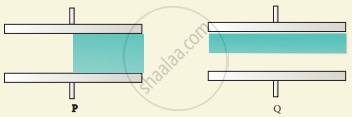
Capacitors P and Q have identical cross-sectional areas A and separation d. The space between the capacitors is filled with a dielectric of dielectric constant Er as shown in the figure. Calculate the capacitance of capacitors P and Q.
The displacement current of 4.425 µA is developed in the space between the plates of the parallel plate capacitor when voltage is changing at a rate of 106 Vs-1. The area of each plate of the capacitor is 40 cm2. The distance between each plate of the capacitor is x × 10-3 m. The value of x is ______.
(Permittivity of free space, ε0 = 8.85 × 10⁻¹²C2N-1m-2).
What is called the capacity of conductor?
For the same potential difference, what does a larger capacitance mean?
Which units are capacitors commonly measured in practice?
In a series combination, which quantity is the same on each capacitor?
What is the practical purpose of a series combination of capacitors?
