Advertisements
Advertisements
Question
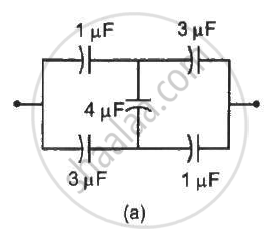
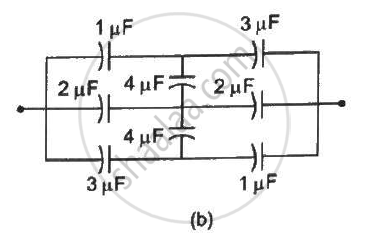
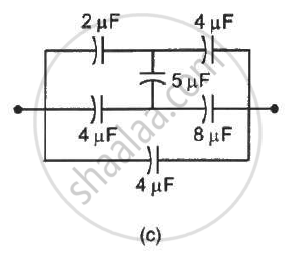
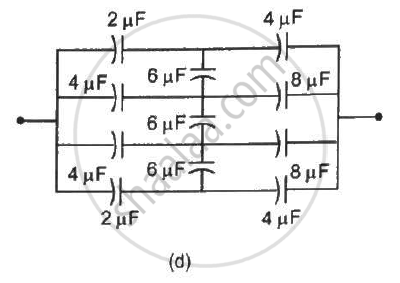
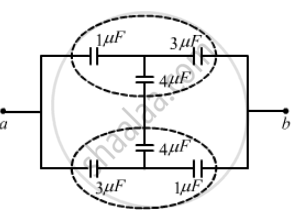
Find the equivalent capacitances of the combinations shown in figure between the indicated points.
Advertisements
Solution
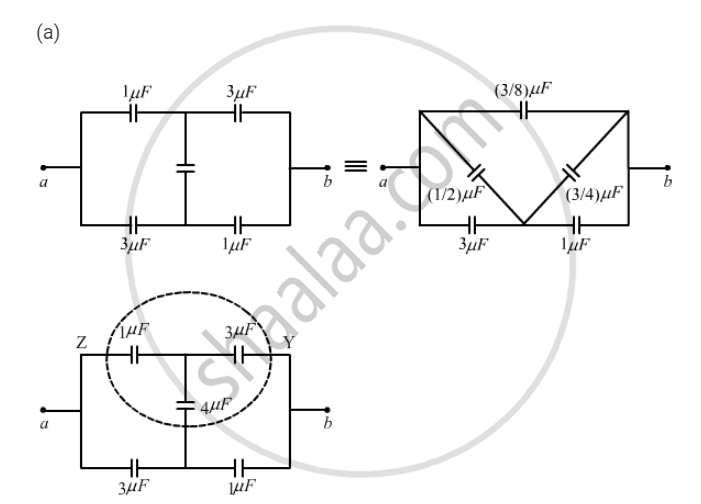
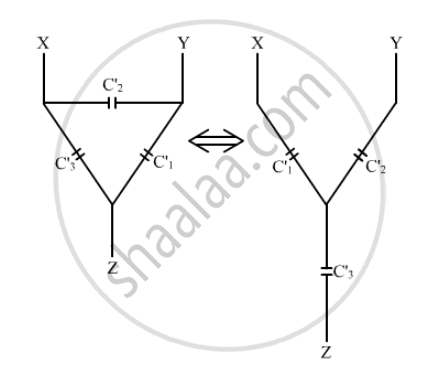
Applying star-delta conversion in the part indicated in the diagram.
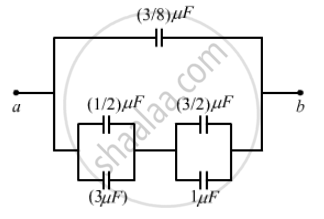
The Capacitance of the `C_1` is given by
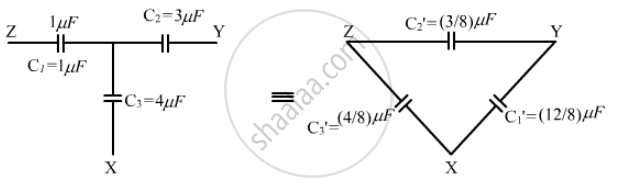
`C_1^' = (C_2C_3)/(C_1+C_2+C_3)`
`C_2^' = (C_1C_3)/(C_1+C_2+C_3)`
`C_3^' = (C_1C_2)/(C_1+C_2+C_3)`
⇒ `C_1'^ = (3 xx 4)/(1+3+4) = 12/8 "uF"`
⇒ `C_2^' = (1 xx 3)/(1+3+4) = 3/8 "uF"`
⇒ `C_3^' = (1 xx 4)/(1+3+4) = 4/8 "uF"`
Thus, the equivalent circuit can be drawn as :
Therefore, the equivalent capacitance is given by
`C_(eq) = 3/8 + [((3+1/2) xx (3/2+1))/((3+1/2)+(3/2+1))]` = `3/8 + 35/24 = (9+35)/24 = 11/6 "uF"`
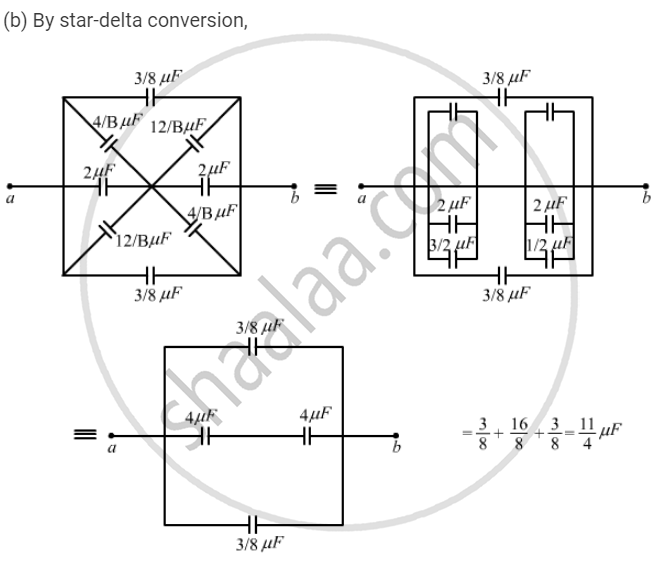
`1+1 = 2 "uF"`
(c)
It is a balanced bridge.
Therefore, the capacitor of capacitance 5 μF can be removed.
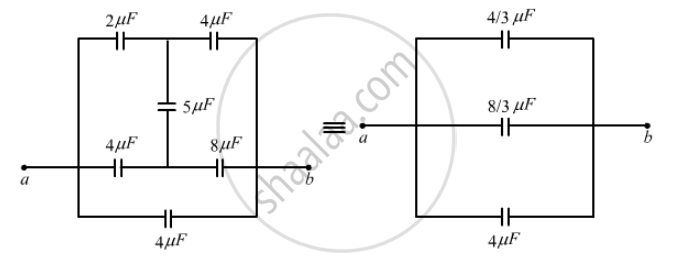
Cef = `4/3+8/3+4 = 8 "uF"`
The capacitance of the two branches are :
`C_1 = (2 xx 4)/(2+4) = 4/3 uF`
`C_2 = (4 xx 8)/(4+8) = 8/3 uF`
∴ Equivalent capacitance = `4/3 + 8/3 + 4 = 8 "uF"`
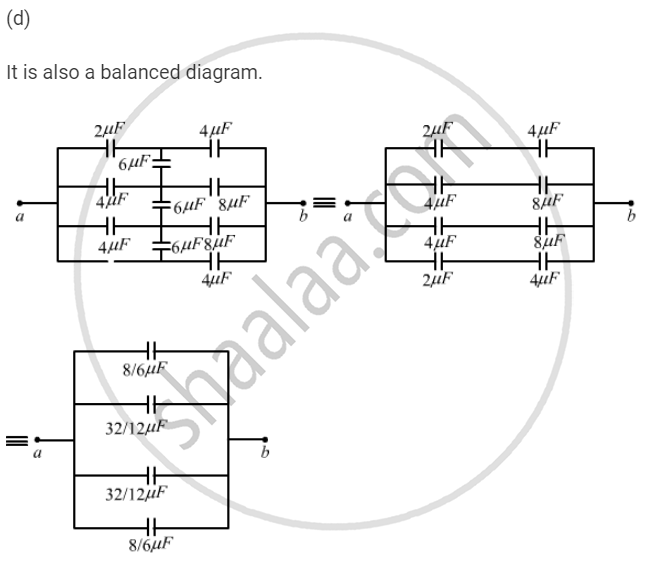
It can be observed that the bridges are balanced.
Therefore, the capacitors of capacitance 6 μF between the branches can be removed
The capacitances of the four branches are :
`C_1 = (2 xx 4)/(2+4) = 4/3 uF`
`C_2 = (4 xx 8)/(4+8) = 8/3 uF`
`C_3 = (4 xx 8)/(4+8) = 8/3 uF`
`C_4 = (2 xx 4)/(2+4) = 4/3 uF`
∴ Equivalent capacitance
= `4/3 + 8/3 + 8/3 + 4/3`
= ` 8 "uF"`
APPEARS IN
RELATED QUESTIONS
A parallel plate capacitor of capacitance C is charged to a potential V. It is then connected to another uncharged capacitor having the same capacitance. Find out the ratio of the energy stored in the combined system to that stored initially in the single capacitor.
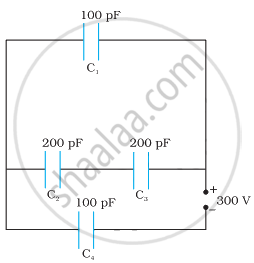
Obtain the equivalent capacitance of the network in Figure. For a 300 V supply, determine the charge and voltage across each capacitor.
A capacitor of capacitance ‘C’ is being charged by connecting it across a dc source along with an ammeter. Will the ammeter show a momentary deflection during the process of charging? If so, how would you explain this momentary deflection and the resulting continuity of current in the circuit? Write the expression for the current inside the capacitor.
Three capacitors of capacitances 6 µF each are available. The minimum and maximum capacitances, which may be obtained are
A cylindrical capacitor is constructed using two coaxial cylinders of the same length 10 cm and of radii 2 mm and 4 mm. (a) Calculate the capacitance. (b) Another capacitor of the same length is constructed with cylinders of radii 4 mm and 8 mm. Calculate the capacitance.
A capacitor of capacitance 10 μF is connected to a battery of emf 2 V. It is found that it takes 50 ms for the charge of the capacitor to become 12.6 μC. Find the resistance of the circuit.
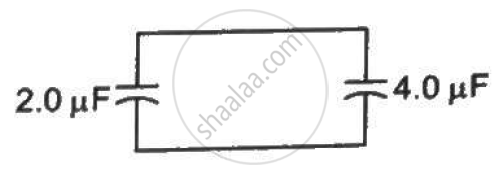
A capacitor of capacitance 2⋅0 µF is charged to a potential difference of 12 V. It is then connected to an uncharged capacitor of capacitance 4⋅0 µF as shown in figure . Find (a) the charge on each of the two capacitors after the connection, (b) the electrostatic energy stored in each of the two capacitors and (c) the heat produced during the charge transfer from one capacitor to the other.
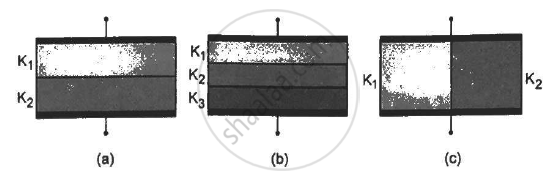
Find the capacitances of the capacitors shown in figure . The plate area is Aand the separation between the plates is d. Different dielectric slabs in a particular part of the figure are of the same thickness and the entire gap between the plates is filled with the dielectric slabs.
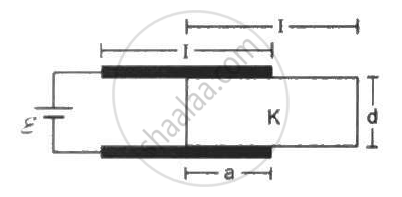
Consider the situation shown in figure. The plates of the capacitor have plate area A and are clamped in the laboratory. The dielectric slab is released from rest with a length a inside the capacitor. Neglecting any effect of friction or gravity, show that the slab will execute periodic motion and find its time period.
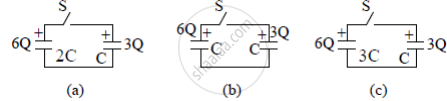
Three circuits, each consisting of a switch 'S' and two capacitors, are initially charged, as shown in the figure. After the switch has been closed, in which circuit will the charge on the left-hand capacitor
(i) increase,
(ii) decrease, and
(iii) remains the same? Give reasons.
- Charge on each capacitor remains same and equals to the main charge supplied by the battery.
- Potential difference and energy distribute in the reverse ratio of capacitance.
- Effective capacitance is even les than the least of teh individual capacitances.
Three capacitors 2µF, 3µF, and 6µF are joined in series with each other. The equivalent capacitance is ____________.
The displacement current of 4.425 µA is developed in the space between the plates of the parallel plate capacitor when voltage is changing at a rate of 106 Vs-1. The area of each plate of the capacitor is 40 cm2. The distance between each plate of the capacitor is x × 10-3 m. The value of x is ______.
(Permittivity of free space, ε0 = 8.85 × 10⁻¹²C2N-1m-2).
A capacitor with capacitance 5µF is charged to 5 µC. If the plates are pulled apart to reduce the capacitance to 2 µF, how much work is done?
Eight drops of mercury of equal radius and possessing equal charge combine to form a big drop. The capacitance of bigger drop as compared to each small drop is ______.
Two spherical conductors of capacities 4 µF and 3 µF are charged to same potential having radii 4 cm and 3 cm respectively. If ‘σ1’ and ‘σ2’ represent surface density of charge on respective conductors then ______.
Which units are capacitors commonly measured in practice?
In a series combination, which quantity is the same on each capacitor?
In a parallel combination, which quantity is the same across each capacitor?
