Advertisements
Advertisements
Question
A capacitor of unknown capacitance is connected across a battery of V volts. The charge stored in it is 300 μC. When potential across the capacitor is reduced by 100 V, the charge stored in it becomes 100 μC. Calculate The potential V and the unknown capacitance. What will be the charge stored in the capacitor if the voltage applied had increased by 100 V?
Advertisements
Solution
(i) Initial voltage, V1 = V volts, Charge stored,Q1 = 300 µC
Q1 = CV1 ..(1)
Changed potential, V2 = V-100 V
Q2 = 100 µC
Q2 = CV2 ..(2)
By dividing (2) from (1), we get `(Q_1)/(Q_2) = (CV_1)/(CV_2) => Q_1/Q_2 = V_1 /V_2`
`=> 300/100 = V/(V- 100) => V = 150 \text { volts }`
`∴ C = Q_1/V_1 = (300 xx 10^-6)/150 = 2 xx 10^-6 F = 2 μ F`
(ii) If the voltage applied had increased by 120 V, then V3 = 150+100 = 250 V
Hence, charge stored in the capacitor, Q3 = CV3 = 2×10-6×250 = 500 µC
(ii) If the voltage applied had increased by 120 V, then V3 = 150+100 = 250 V
Hence, charge stored in the capacitor, Q3 = CV3 = 2×10-6×250 = 500 µC
APPEARS IN
RELATED QUESTIONS
Two capacitors each having capacitance C and breakdown voltage V are joined in series. The capacitance and the breakdown voltage of the combination will be
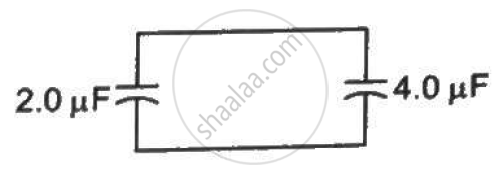
A capacitor of capacitance 2⋅0 µF is charged to a potential difference of 12 V. It is then connected to an uncharged capacitor of capacitance 4⋅0 µF as shown in figure . Find (a) the charge on each of the two capacitors after the connection, (b) the electrostatic energy stored in each of the two capacitors and (c) the heat produced during the charge transfer from one capacitor to the other.
A 5⋅0 µF capacitor is charged to 12 V. The positive plate of this capacitor is now connected to the negative terminal of a 12 V battery and vice versa. Calculate the heat developed in the connecting wires.
A parallel-plate capacitor of plate area A and plate separation d is charged to a potential difference V and then the battery is disconnected. A slab of dielectric constant K is then inserted between the plates of the capacitor so as to fill the space between the plates. Find the work done on the system in the process of inserting the slab.
The variation of inductive reactance (XL) of an inductor with the frequency (f) of the ac source of 100 V and variable frequency is shown in fig.
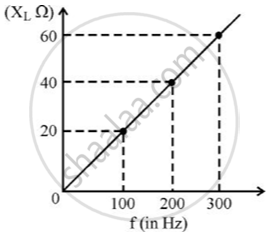
- Calculate the self-inductance of the inductor.
- When this inductor is used in series with a capacitor of unknown value and a resistor of 10 Ω at 300 s–1, maximum power dissipation occurs in the circuit. Calculate the capacitance of the capacitor.
Obtain the expression for capacitance for a parallel plate capacitor.
Derive the expression for resultant capacitance, when the capacitor is connected in series.
- Charge on each capacitor remains same and equals to the main charge supplied by the battery.
- Potential difference and energy distribute in the reverse ratio of capacitance.
- Effective capacitance is even les than the least of teh individual capacitances.
Current versus time and voltage versus time graphs of a circuit element are shown in figure.
 |
 |
The type of the circuit element is ______.
Which system is called a capacitor?
