Advertisements
Advertisements
प्रश्न
A capacitor of unknown capacitance is connected across a battery of V volts. The charge stored in it is 300 μC. When potential across the capacitor is reduced by 100 V, the charge stored in it becomes 100 μC. Calculate The potential V and the unknown capacitance. What will be the charge stored in the capacitor if the voltage applied had increased by 100 V?
Advertisements
उत्तर
(i) Initial voltage, V1 = V volts, Charge stored,Q1 = 300 µC
Q1 = CV1 ..(1)
Changed potential, V2 = V-100 V
Q2 = 100 µC
Q2 = CV2 ..(2)
By dividing (2) from (1), we get `(Q_1)/(Q_2) = (CV_1)/(CV_2) => Q_1/Q_2 = V_1 /V_2`
`=> 300/100 = V/(V- 100) => V = 150 \text { volts }`
`∴ C = Q_1/V_1 = (300 xx 10^-6)/150 = 2 xx 10^-6 F = 2 μ F`
(ii) If the voltage applied had increased by 120 V, then V3 = 150+100 = 250 V
Hence, charge stored in the capacitor, Q3 = CV3 = 2×10-6×250 = 500 µC
(ii) If the voltage applied had increased by 120 V, then V3 = 150+100 = 250 V
Hence, charge stored in the capacitor, Q3 = CV3 = 2×10-6×250 = 500 µC
APPEARS IN
संबंधित प्रश्न
As `C = (1/V) Q` , can you say that the capacitance C is proportional to the charge Q?
Three capacitors having capacitances 20 µF, 30 µF and 40 µF are connected in series with a 12 V battery. Find the charge on each of the capacitors. How much work has been done by the battery in charging the capacitors?
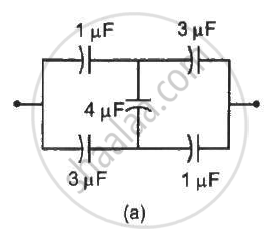
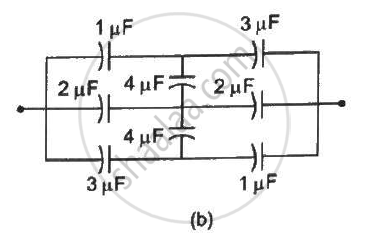
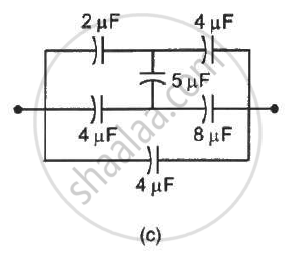
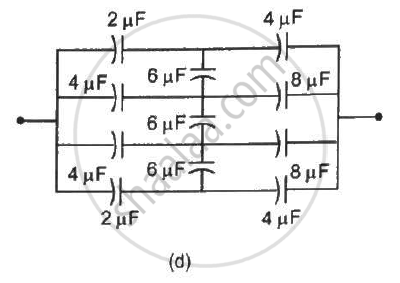
Find the equivalent capacitances of the combinations shown in figure between the indicated points.
Obtain an expression for equivalent capacitance when three capacitors C1, C2 and C3 are connected in series.
Obtain the expression for energy stored in the parallel plate capacitor.
- Charge on each capacitor remains same and equals to the main charge supplied by the battery.
- Potential difference and energy distribute in the reverse ratio of capacitance.
- Effective capacitance is even les than the least of teh individual capacitances.
The radius of a sphere of capacity 1 microfarad in the air is ______
Obtain the equivalent capacitance of the network shown in the figure. For a 300 V supply, determine the charge on each capacitor.

Which expression gives the capacitance of a capacitor?
In a series combination, which capacitor gets a larger potential difference?
