Advertisements
Advertisements
प्रश्न
A parallel plate capacitor (A) of capacitance C is charged by a battery to voltage V. The battery is disconnected and an uncharged capacitor (B) of capacitance 2C is connected across A. Find the ratio of final charges on A and B.
Advertisements
उत्तर
The electric field in the region between the plates depends on the change given to the conducting plates,

For capacitor 'A' of capacitance C, having voltage V, the charge on it is given by Q = CV.
On connecting this capacitor A with capacitor B changes get distributed.

Now, `q_1 + q_2 = Q`
`q_1 + q_2` = CV
`CV_1 + 2CV_1 = CV`
`V_1 = V/3`
∴ `q_1 = (CV)/3`
`q_2 = (2CV)/3`
∴ The ratio of final changes on A and B:
`q_1/q_2 = (CV"/"3)/(2CV"/"3) = 1/2`
APPEARS IN
संबंधित प्रश्न
Three capacitors of capacitances 6 µF each are available. The minimum and maximum capacitances, which may be obtained are
The plates of a parallel-plate capacitor are made of circular discs of radii 5⋅0 cm each. If the separation between the plates is 1⋅0 mm, what is the capacitance?
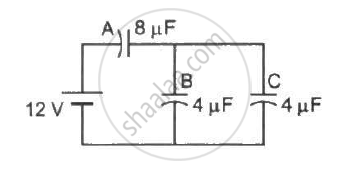
Find the charge appearing on each of the three capacitors shown in figure .
It is required to construct a 10 µF capacitor which can be connected across a 200 V battery. Capacitors of capacitance 10 µF are available but they can withstand only 50 V. Design a combination which can yield the desired result.
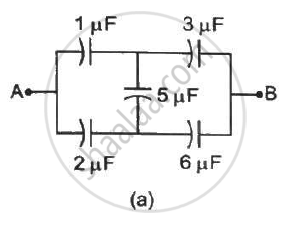
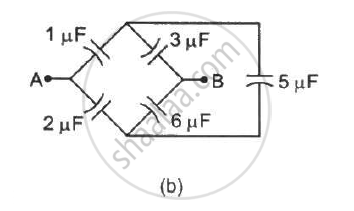
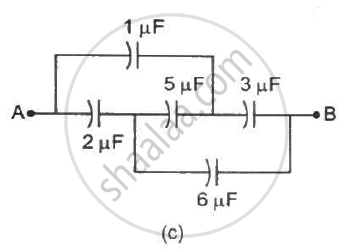
Convince yourself that parts (a), (b) and (c) figure are identical. Find the capacitance between the points A and B of the assembly.
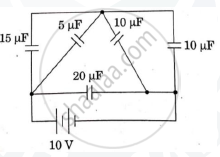
The figure show a network of five capacitors connected to a 10V battery. Calculate the charge acquired by the 5μF capacitor.
Obtain an expression for equivalent capacitance when three capacitors C1, C2 and C3 are connected in series.
A capacitor of capacity 2 µF is charged to a potential difference of 12 V. It is then connected across an inductor of inductance 0.6 mH. The current in the circuit at a time when the potential difference across the capacitor is 6.0 V is ______ × 10-1A.
A capacitor has charge 50 µC. When the gap between the plate is filled with glass wool, then 120 µC charge flows through the battery to capacitor. The dielectric constant of glass wool is ______.
What does a large capacitance mean in terms of charge storage and potential difference?
