Advertisements
Advertisements
प्रश्न
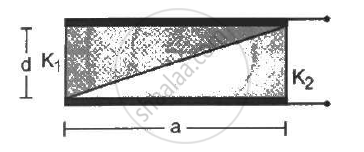
A capacitor is formed by two square metal-plates of edge a, separated by a distance d. Dielectrics of dielectric constant K1 and K2 are filled in the gap as shown in figure . Find the capacitance.
Advertisements
उत्तर
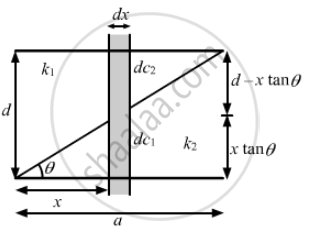
Let us consider an elemental capacitor of width dx at a distance x from the left end of the capacitor. It has two capacitive elements of dielectric constants K1 and K2 with plate separations (x tan θ) and (d − x tan θ) in series, respectively. The areas of the plates of the capacitors are adx.
The capacitances of the capacitive elements of the elemental capacitor are :
`dC_1 = (∈_0K_2(adx))/(x tan θ) , dC_2 = (∈_0K_1(adx))/(d - x tan θ)`
The net capacitance of the elemental capacitor is given by
`1/(dC)= 1/(dC_1) + 1/(dC_2)`
`1/(dC) = (x tanθ)/(∈_0K_2(adx)) + (d-x tanθ)/(∈_0K_1(adx))`
`⇒ dC = (∈_0K_1K_2(adx))/(K_1 x tanθ + K_2(d-x tanθ)`
Thus, integrating the above expression to calculate the net capacitance
`C = ∫_0^a dC = ∫_0^a (∈_0K_1K_2adx)/(K_1x tanθ+ K_2(d-x tanθ)`
`⇒ C = ∈_0K_1K_2a ∫_0^a (dx)/(K_2d + x tanθ(K_1 - K_2)`
`⇒ C = (∈_0K_1K_2a)/(tanθ(K_1 - K_2))[log_e[K_2d + x tanθ(K_1 - K_2) ]]_0^a`
`⇒ C = (∈_0K_1K_2a)/(tan θ(K_1 - K_2)) [ log_e[K_2d + a tan θ(K_1 - K_2)] - log_e K_2d]`
As we know that `tan θ = d/a` substituting in the expression for capacitance C.
Now,
`⇒ C = (∈_0K_1K_2a)/(d/a xx (K_1 - K_2) )[ log_e[K_2d + a xx d/a(K_1 - K_2)] - log_e K_2d]`
`⇒ C = (∈_0K_1K_2a)/(d/a xx (K_1 - K_2) )[ log_e K_1d - log_e K_2d ]`
`⇒ C = (∈_0K_1K_2a^2)/(d(K_1 - K_2)) [log_e (K_1/K_2)]`
APPEARS IN
संबंधित प्रश्न
A capacitor of capacitance ‘C’ is charged to ‘V’ volts by a battery. After some time the battery is disconnected and the distance between the plates is doubled. Now a slab of dielectric constant, 1 < k < 2, is introduced to fill the space between the plates. How will the following be affected? (a) The electric field between the plates of the capacitor Justify your answer by writing the necessary expressions.
As `C = (1/V) Q` , can you say that the capacitance C is proportional to the charge Q?
The capacitance of a capacitor does not depend on
The plates of a parallel-plate capacitor are made of circular discs of radii 5⋅0 cm each. If the separation between the plates is 1⋅0 mm, what is the capacitance?
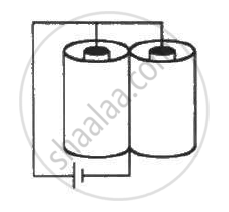
The outer cylinders of two cylindrical capacitors of capacitance 2⋅2 µF each, are kept in contact and the inner cylinders are connected through a wire. A battery of emf 10 V is connected as shown in figure . Find the total charge supplied by the battery to the inner cylinders.
Two conducting spheres of radii R1 and R2 are kept widely separated from each other. What are their individual capacitances? If the spheres are connected by a metal wire, what will be the capacitance of the combination? Think in terms of series−parallel connections.
A finite ladder is constructed by connecting several sections of 2 µF, 4 µF capacitor combinations as shown in the figure. It is terminated by a capacitor of capacitance C. What value should be chosen for C, such that the equivalent capacitance of the ladder between the points A and B becomes independent of the number of sections in between?
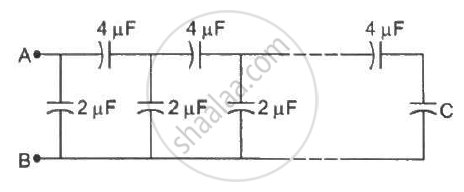
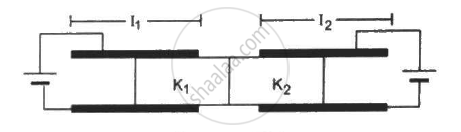
Figure shows two parallel plate capacitors with fixed plates and connected to two batteries. The separation between the plates is the same for the two capacitors. The plates are rectangular in shape with width b and lengths l1 and l2. The left half of the dielectric slab has a dielectric constant K1 and the right half K2. Neglecting any friction, find the ration of the emf of the left battery to that of the right battery for which the dielectric slab may remain in equilibrium.
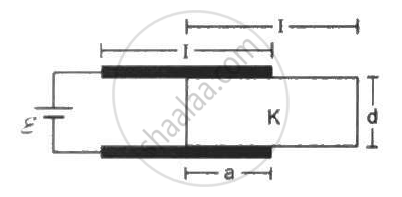
Consider the situation shown in figure. The plates of the capacitor have plate area A and are clamped in the laboratory. The dielectric slab is released from rest with a length a inside the capacitor. Neglecting any effect of friction or gravity, show that the slab will execute periodic motion and find its time period.
Obtain an expression for equivalent capacitance when three capacitors C1, C2 and C3 are connected in series.
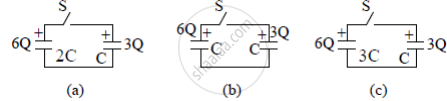
Three circuits, each consisting of a switch 'S' and two capacitors, are initially charged, as shown in the figure. After the switch has been closed, in which circuit will the charge on the left-hand capacitor
(i) increase,
(ii) decrease, and
(iii) remains the same? Give reasons.
When air is replaced by a dielectric medium of constant K, the maximum force of attraction between two charges separated by a distance ______.
Consider two conducting spheres of radii R1 and R2 with R1 > R2. If the two are at the same potential, the larger sphere has more charge than the smaller sphere. State whether the charge density of the smaller sphere is more or less than that of the larger one.
A parallel plate capacitor is filled by a dielectric whose relative permittivity varies with the applied voltage (U) as ε = αU where α = 2V–1. A similar capacitor with no dielectric is charged to U0 = 78V. It is then connected to the uncharged capacitor with the dielectric. Find the final voltage on the capacitors.
The material filled between the plates of a parallel plate capacitor has a resistivity of 200Ωm. The value of the capacitance of the capacitor is 2 pF. If a potential difference of 40V is applied across the plates of the capacitor, then the value of leakage current flowing out of the capacitor is ______.
(given the value of relative permittivity of a material is 50.)
Current versus time and voltage versus time graphs of a circuit element are shown in figure.
 |
 |
The type of the circuit element is ______.
Calculate equivalent capacitance of the circuit shown in the Figure given below:

What does a large capacitance mean in terms of charge storage and potential difference?
In a series combination, which statement describes the potential difference across each capacitor?
