Advertisements
Advertisements
प्रश्न
A parallel plate capacitor is filled by a dielectric whose relative permittivity varies with the applied voltage (U) as ε = αU where α = 2V–1. A similar capacitor with no dielectric is charged to U0 = 78V. It is then connected to the uncharged capacitor with the dielectric. Find the final voltage on the capacitors.
Advertisements
उत्तर
Let the final voltage be U: If C is the capacitance of the capacitor without the dielectric, then the charge on the capacitor is
Q1 = CU
The capacitor with the dielectric has a capacitance εC. Hence the charge on the capacitor is
Q2 = εU = α CU2
The initial charge on the capacitor that was charged is
Q0 = CU0
From the conservation of charges,
Q0 = Q1 + Q2
Or, CU0 = CU + α CU2
⇒ αU2 + U – u0 = 0
∴ U = `(-1 +- sqrt(1 + 4αU_0))/(2α)`
= `(-1 +- sqrt(1 + 624))/4`
= `(-1 +- sqrt(625))/4` volts
As U is positive
U = `(sqrt(625) - 1)/4 = 24/4` = 6V
APPEARS IN
संबंधित प्रश्न
When an AC source is connected to an ideal capacitor, show that the average power supplied by the source over a complete cycle is zero
Define capacitor reactance. Write its S.I units.
A spherical capacitor consists of two concentric spherical conductors, held in position by suitable insulating supports. Show that the capacitance of a spherical capacitor is given by
C = `(4piin_0"r"_1"r"_2)/("r"_1 - "r"_2)`
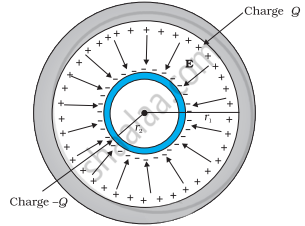
where r1 and r2 are the radii of outer and inner spheres, respectively.
A spherical capacitor has an inner sphere of radius 12 cm and an outer sphere of radius 13 cm. The outer sphere is earthed and the inner sphere is given a charge of 2.5 µC. The space between the concentric spheres is filled with a liquid of dielectric constant 32.
(a) Determine the capacitance of the capacitor.
(b) What is the potential of the inner sphere?
(c) Compare the capacitance of this capacitor with that of an isolated sphere of radius 12 cm. Explain why the latter is much smaller.
The capacitance of a capacitor does not depend on
When 1⋅0 × 1012 electrons are transferred from one conductor to another, a potential difference of 10 V appears between the conductors. Calculate the capacitance of the two-conductor system.
The plates of a parallel-plate capacitor are made of circular discs of radii 5⋅0 cm each. If the separation between the plates is 1⋅0 mm, what is the capacitance?
A parallel-plate capacitor has plate area 25⋅0 cm2 and a separation of 2⋅00 mm between the plates. The capacitor is connected to a battery of 12⋅0 V. (a) Find the charge on the capacitor. (b) The plate separation is decreased to 1⋅00 mm. Find the extra charge given by the battery to the positive plate.
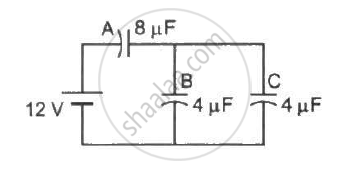
Find the charge appearing on each of the three capacitors shown in figure .
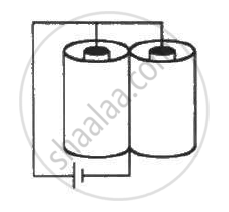
The outer cylinders of two cylindrical capacitors of capacitance 2⋅2 µF each, are kept in contact and the inner cylinders are connected through a wire. A battery of emf 10 V is connected as shown in figure . Find the total charge supplied by the battery to the inner cylinders.
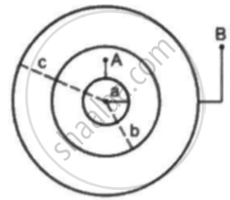
Suppose the space between the two inner shells is filled with a dielectric of dielectric constant K. Find the capacitance of the system between A and B.
The variation of inductive reactance (XL) of an inductor with the frequency (f) of the ac source of 100 V and variable frequency is shown in fig.
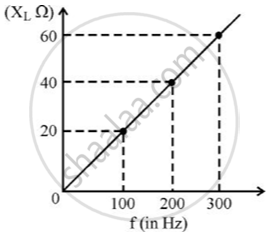
- Calculate the self-inductance of the inductor.
- When this inductor is used in series with a capacitor of unknown value and a resistor of 10 Ω at 300 s–1, maximum power dissipation occurs in the circuit. Calculate the capacitance of the capacitor.
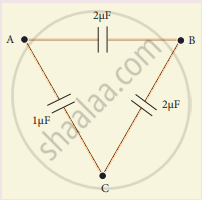
Three capacitors are connected in a triangle as shown in the figure. The equivalent capacitance between points A and C is ______.
During a thunder storm, the movement of water molecules within the clouds creates friction, partially causing the bottom part of the clouds to become negatively charged. This implies that the bottom of the cloud and the ground act as a parallel plate capacitor. If the electric field between the cloud and ground exceeds the dielectric breakdown of the air (3 × 10⁶ Vm–1), lightning will occur.
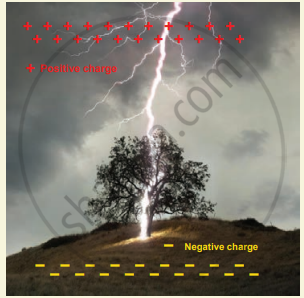
- If the bottom part of the cloud is 1000 m above the ground, determine the electric potential difference that exists between the cloud and ground.
- In a typical lightning phenomenon, around 25 C of electrons are transferred from cloud to ground. How much electrostatic potential energy is transferred to the ground?
Two similar conducting spheres having charge+ q and -q are placed at 'd' seperation from each other in air. The radius of each ball is r and the separation between their centre is d (d >> r). Calculate the capacitance of the two ball system ______.

The displacement current of 4.425 µA is developed in the space between the plates of the parallel plate capacitor when voltage is changing at a rate of 106 Vs-1. The area of each plate of the capacitor is 40 cm2. The distance between each plate of the capacitor is x × 10-3 m. The value of x is ______.
(Permittivity of free space, ε0 = 8.85 × 10⁻¹²C2N-1m-2).
If the plates of a parallel plate capacitor connected to a battery are moved close to each other, then:
- the charge stored in it. increases.
- the energy stored in it, decreases.
- its capacitance increases.
- the ratio of charge to its potential remains the same.
- the product of charge and voltage increases.
Choose the most appropriate answer from the options given below:
For the same potential difference, what does a larger capacitance mean?
In a series combination, which quantity is the same on each capacitor?
