Advertisements
Advertisements
प्रश्न
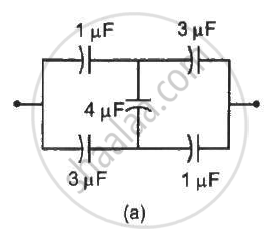
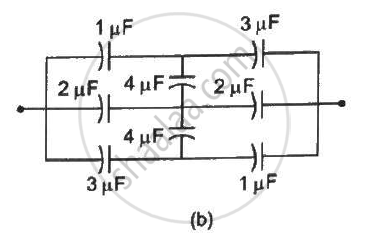
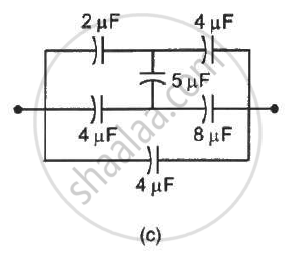
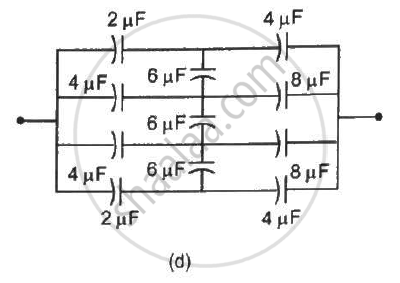
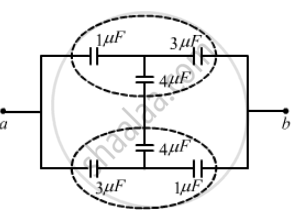
Find the equivalent capacitances of the combinations shown in figure between the indicated points.
Advertisements
उत्तर
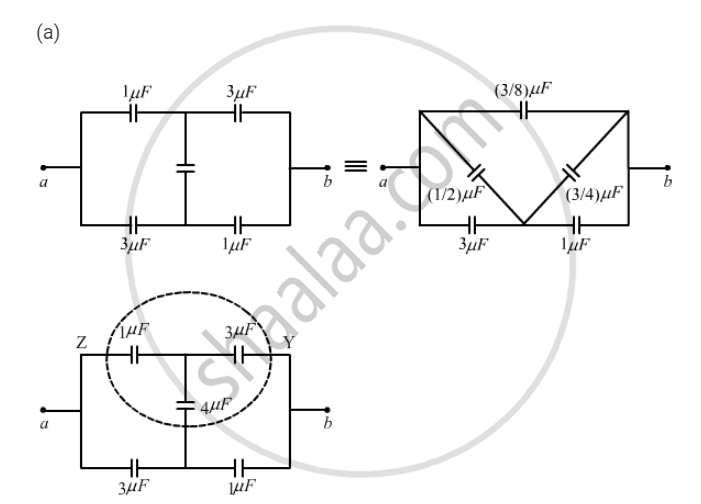
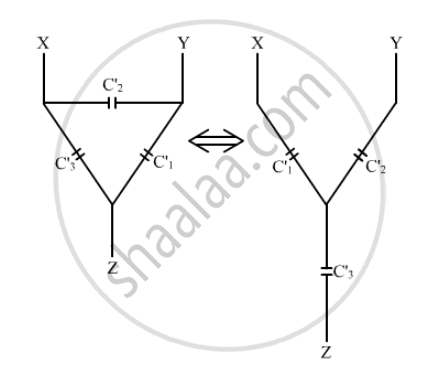
Applying star-delta conversion in the part indicated in the diagram.
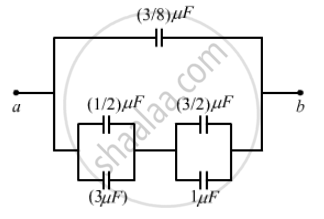
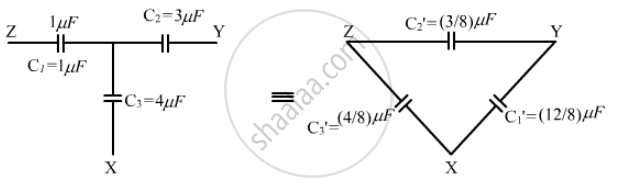
The Capacitance of the `C_1` is given by
`C_1^' = (C_2C_3)/(C_1+C_2+C_3)`
`C_2^' = (C_1C_3)/(C_1+C_2+C_3)`
`C_3^' = (C_1C_2)/(C_1+C_2+C_3)`
⇒ `C_1'^ = (3 xx 4)/(1+3+4) = 12/8 "uF"`
⇒ `C_2^' = (1 xx 3)/(1+3+4) = 3/8 "uF"`
⇒ `C_3^' = (1 xx 4)/(1+3+4) = 4/8 "uF"`
Thus, the equivalent circuit can be drawn as :
Therefore, the equivalent capacitance is given by
`C_(eq) = 3/8 + [((3+1/2) xx (3/2+1))/((3+1/2)+(3/2+1))]` = `3/8 + 35/24 = (9+35)/24 = 11/6 "uF"`
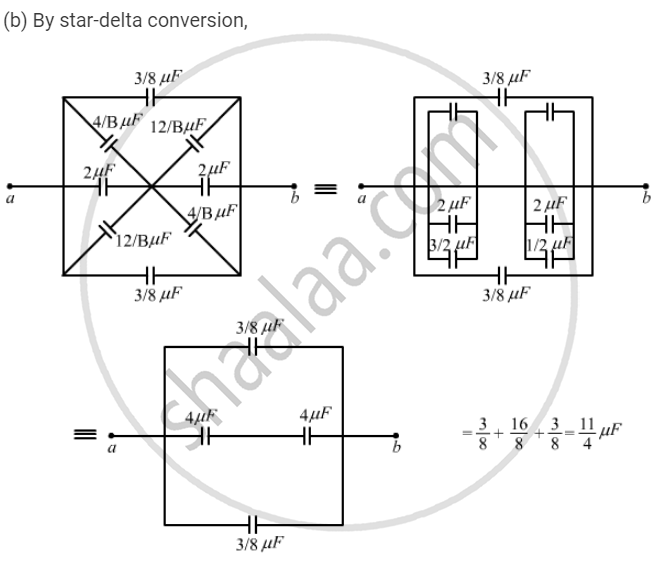
`1+1 = 2 "uF"`
(c)
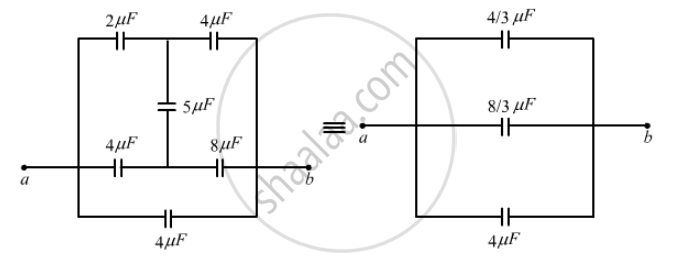
It is a balanced bridge.
Therefore, the capacitor of capacitance 5 μF can be removed.
Cef = `4/3+8/3+4 = 8 "uF"`
The capacitance of the two branches are :
`C_1 = (2 xx 4)/(2+4) = 4/3 uF`
`C_2 = (4 xx 8)/(4+8) = 8/3 uF`
∴ Equivalent capacitance = `4/3 + 8/3 + 4 = 8 "uF"`
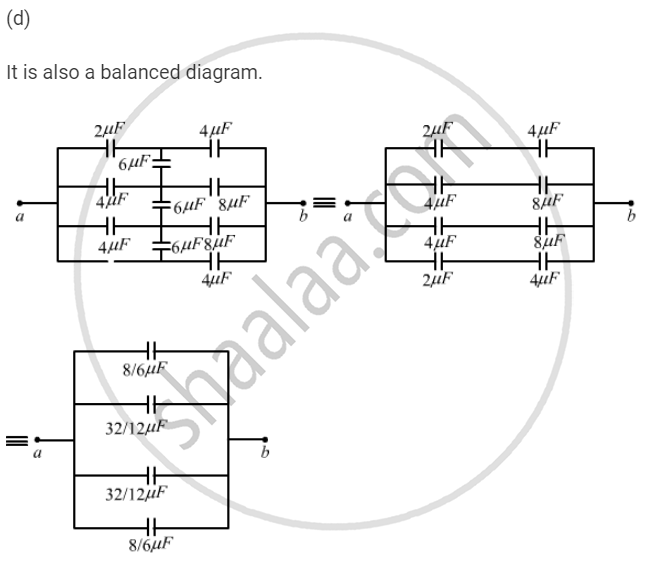
It can be observed that the bridges are balanced.
Therefore, the capacitors of capacitance 6 μF between the branches can be removed
The capacitances of the four branches are :
`C_1 = (2 xx 4)/(2+4) = 4/3 uF`
`C_2 = (4 xx 8)/(4+8) = 8/3 uF`
`C_3 = (4 xx 8)/(4+8) = 8/3 uF`
`C_4 = (2 xx 4)/(2+4) = 4/3 uF`
∴ Equivalent capacitance
= `4/3 + 8/3 + 8/3 + 4/3`
= ` 8 "uF"`
APPEARS IN
संबंधित प्रश्न
When an AC source is connected to an ideal capacitor, show that the average power supplied by the source over a complete cycle is zero
A capacitor has capacitance C. Is this information sufficient to know what maximum charge the capacitor can contain? If yes, what is this charges? If no, what other information is needed?
A capacitor of capacitance C is charged to a potential V. The flux of the electric field through a closed surface enclosing the capacitor is
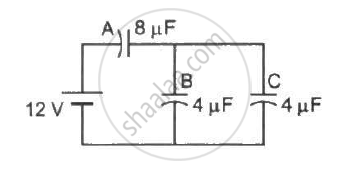
Find the charge appearing on each of the three capacitors shown in figure .
It is required to construct a 10 µF capacitor which can be connected across a 200 V battery. Capacitors of capacitance 10 µF are available but they can withstand only 50 V. Design a combination which can yield the desired result.
A capacitor of capacitance 10 μF is connected to a battery of emf 2 V. It is found that it takes 50 ms for the charge of the capacitor to become 12.6 μC. Find the resistance of the circuit.
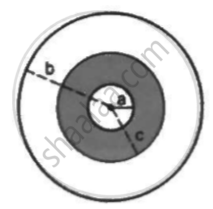
A sphercial capacitor is made of two conducting spherical shells of radii a and b. The space between the shells is filled with a dielectric of dielectric constant K up to a radius c as shown in figure . Calculate the capacitance.
An air-filled parallel-plate capacitor is to be constructed which can store 12 µC of charge when operated at 1200 V. What can be the minimum plate area of the capacitor? The dielectric strength of air is `3 xx 10^6 "Vm"^-1`
If the voltage applied on a capacitor is increased from V to 2V, choose the correct conclusion.
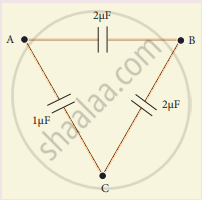
Three capacitors are connected in a triangle as shown in the figure. The equivalent capacitance between points A and C is ______.
Define ‘capacitance’. Give its unit.
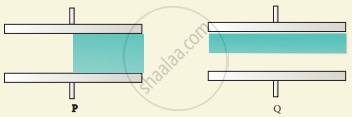
Capacitors P and Q have identical cross-sectional areas A and separation d. The space between the capacitors is filled with a dielectric of dielectric constant Er as shown in the figure. Calculate the capacitance of capacitors P and Q.
Two similar conducting spheres having charge+ q and -q are placed at 'd' seperation from each other in air. The radius of each ball is r and the separation between their centre is d (d >> r). Calculate the capacitance of the two ball system ______.

A 5µF capacitor is charged fully by a 220 V supply. It is then disconnected from the supply and is connected in series to another uncharged 2.5 µF capacitor If the energy change during the charge redistribution is `"X"/100`J then value of X to the 100 nearest integer is ______.
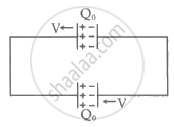
Two identical capacitors are connected as shown and have an initial charge of Q0. The separation between the plates of each capacitor is d0. Suddenly the left plate of the upper capacitor and right plate of the lower capacitor start moving with speed v towards the left while the other plate of each capacitor remains fixed. `("given" (Q_0V)/(2d_0) = 10 A)`. The value of current in the circuit is ______ A.
A capacitor with capacitance 5µF is charged to 5 µC. If the plates are pulled apart to reduce the capacitance to 2 µF, how much work is done?
Eight drops of mercury of equal radius and possessing equal charge combine to form a big drop. The capacitance of bigger drop as compared to each small drop is ______.
In a series combination, which capacitor gets a larger potential difference?
