Advertisements
Advertisements
प्रश्न
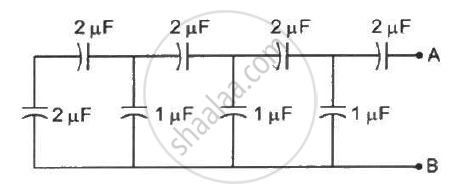
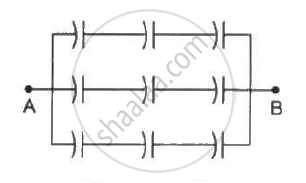
Find the capacitance of the combination shown in figure between A and B.
Advertisements
उत्तर
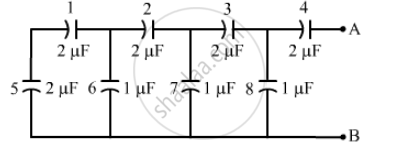
Capacitors 5 and 1 are in series.
Their equivalent capacitance, `C_(eq) = (C_1C_5)/(C_1+C_5)` =`(2 xx 2)/(2+2)` = `1 "uF"`
`therefore` `C_(eq) = 1`
Now, this capacitor system is parallel to capacitor 6. Thus, the equivalent capacitance becomes 1 + 1 = 2 μF
The above capacitor system is in series with capacitor 2. Thus, the equivalent capacitance become `(2 xx 2)/(2+2) = 1 "uF"`
The above capacitor system is in parallel with capacitor 7. Thus, the equivalent capacitance becomes 1 + 1 = 2 μF
The above capacitor system is in series with capacitor 3. Thus, the equivalent capacitance becomes `(2 xx 2)/(2+2) = 1 "uF"`
The above capacitor system is in parallel with capacitor 8. Thus, the equivalent capacitance becomes
1 + 1 = 2 μF
The above capacitor system is in series with capacitor 4. Thus, the equivalent capacitance becomes `(2 xx 2)/(2+2) = 1 "uF"`
Hence, the equivalent capacitance between points A and B of the given capacitor system is 1 μF.
APPEARS IN
संबंधित प्रश्न
(i) Find equivalent capacitance between A and B in the combination given below. Each capacitor is of 2 µF capacitance.
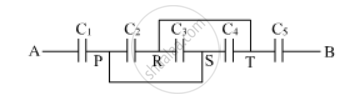
(ii) If a dc source of 7 V is connected across AB, how much charge is drawn from the source and what is the energy stored in the network?
Two capacitors each having capacitance C and breakdown voltage V are joined in series. The capacitance and the breakdown voltage of the combination will be
Find the charges on the three capacitors connected to a battery as shown in figure.
Take `C_1 = 2.0 uF , C_2 = 4.0 uF , C_3 = 6.0 uF and V` = 12 volts.
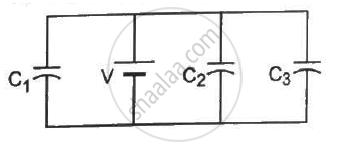
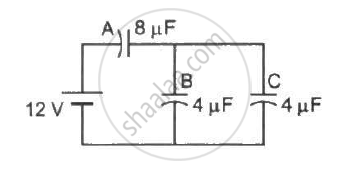
Find the charge appearing on each of the three capacitors shown in figure .
Each of the capacitors shown in figure has a capacitance of 2 µF. find the equivalent capacitance of the assembly between the points A and B. Suppose, a battery of emf 60 volts is connected between A and B. Find the potential difference appearing on the individual capacitors.
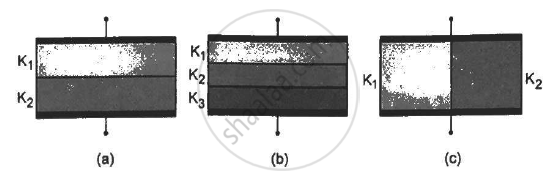
Find the capacitances of the capacitors shown in figure . The plate area is Aand the separation between the plates is d. Different dielectric slabs in a particular part of the figure are of the same thickness and the entire gap between the plates is filled with the dielectric slabs.
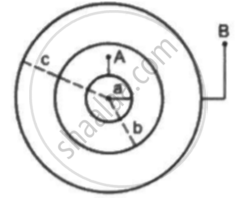
Consider an assembly of three conducting concentric spherical shell of radii a, b and c as shown in figure Find the capacitance of the assembly between the points Aand B.
If the voltage applied on a capacitor is increased from V to 2V, choose the correct conclusion.
Explain in detail the effect of a dielectric placed in a parallel plate capacitor.
During a thunder storm, the movement of water molecules within the clouds creates friction, partially causing the bottom part of the clouds to become negatively charged. This implies that the bottom of the cloud and the ground act as a parallel plate capacitor. If the electric field between the cloud and ground exceeds the dielectric breakdown of the air (3 × 10⁶ Vm–1), lightning will occur.
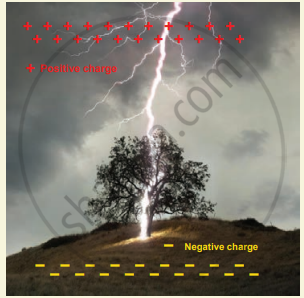
- If the bottom part of the cloud is 1000 m above the ground, determine the electric potential difference that exists between the cloud and ground.
- In a typical lightning phenomenon, around 25 C of electrons are transferred from cloud to ground. How much electrostatic potential energy is transferred to the ground?
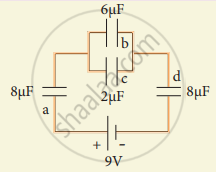
For the given capacitor configuration
- Find the charges on each capacitor
- potential difference across them
- energy stored in each capacitor.
Dielectric constant for a metal is ______.
Obtain the equivalent capacitance of the network shown in the figure. For a 300 V supply, determine the charge on each capacitor.

Which system is called a capacitor?
For the same potential difference, what does a larger capacitance mean?
For a given capacitor, what fixes its capacitance?
In a series combination, which capacitor gets a larger potential difference?
