Advertisements
Advertisements
Question
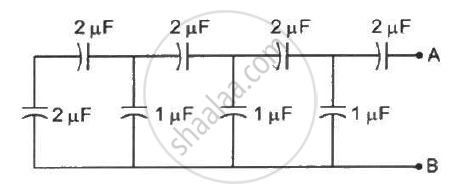
Find the capacitance of the combination shown in figure between A and B.
Advertisements
Solution
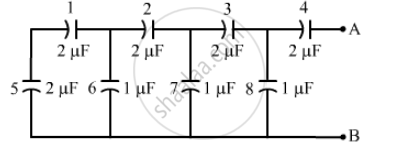
Capacitors 5 and 1 are in series.
Their equivalent capacitance, `C_(eq) = (C_1C_5)/(C_1+C_5)` =`(2 xx 2)/(2+2)` = `1 "uF"`
`therefore` `C_(eq) = 1`
Now, this capacitor system is parallel to capacitor 6. Thus, the equivalent capacitance becomes 1 + 1 = 2 μF
The above capacitor system is in series with capacitor 2. Thus, the equivalent capacitance become `(2 xx 2)/(2+2) = 1 "uF"`
The above capacitor system is in parallel with capacitor 7. Thus, the equivalent capacitance becomes 1 + 1 = 2 μF
The above capacitor system is in series with capacitor 3. Thus, the equivalent capacitance becomes `(2 xx 2)/(2+2) = 1 "uF"`
The above capacitor system is in parallel with capacitor 8. Thus, the equivalent capacitance becomes
1 + 1 = 2 μF
The above capacitor system is in series with capacitor 4. Thus, the equivalent capacitance becomes `(2 xx 2)/(2+2) = 1 "uF"`
Hence, the equivalent capacitance between points A and B of the given capacitor system is 1 μF.
APPEARS IN
RELATED QUESTIONS
The plates of a parallel-plate capacitor are made of circular discs of radii 5⋅0 cm each. If the separation between the plates is 1⋅0 mm, what is the capacitance?
Three capacitors having capacitances 20 µF, 30 µF and 40 µF are connected in series with a 12 V battery. Find the charge on each of the capacitors. How much work has been done by the battery in charging the capacitors?
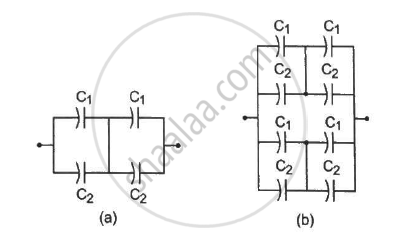
Take `C_1 = 4.0 "uF" and C_2 = 6.0 "uF"` in figure . Calculate the equivalent capacitance of the combination between the points indicated.
Two conducting spheres of radii R1 and R2 are kept widely separated from each other. What are their individual capacitances? If the spheres are connected by a metal wire, what will be the capacitance of the combination? Think in terms of series−parallel connections.
It is required to construct a 10 µF capacitor which can be connected across a 200 V battery. Capacitors of capacitance 10 µF are available but they can withstand only 50 V. Design a combination which can yield the desired result.
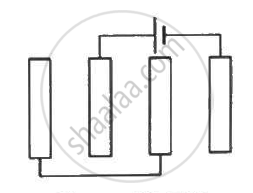
Each of the plates shown in figure has surface area `(96/∈_0) xx 10^-12` Fm on one side and the separation between the consecutive plates is 4⋅0 mm. The emf of the battery connected is 10 volts. Find the magnitude of the charge supplied by the battery to each of the plates connected to it.
The two square faces of a rectangular dielectric slab (dielectric constant 4⋅0) of dimensions 20 cm × 20 cm × 1⋅0 mm are metal-coated. Find the capacitance between the coated surfaces.
A parallel-plate capacitor of plate area A and plate separation d is charged to a potential difference V and then the battery is disconnected. A slab of dielectric constant K is then inserted between the plates of the capacitor so as to fill the space between the plates. Find the work done on the system in the process of inserting the slab.
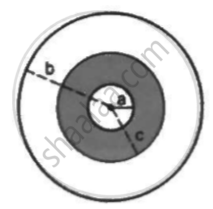
A sphercial capacitor is made of two conducting spherical shells of radii a and b. The space between the shells is filled with a dielectric of dielectric constant K up to a radius c as shown in figure . Calculate the capacitance.
A parallel plate capacitor stores a charge Q at a voltage V. Suppose the area of the parallel plate capacitor and the distance between the plates are each doubled then which is the quantity that will change?
Define ‘capacitance’. Give its unit.
Obtain the expression for energy stored in the parallel plate capacitor.
The work done in placing a charge of 8 × 10–18 coulomb on a condenser of capacity 100 micro-farad is ______.
When air is replaced by a dielectric medium of constant K, the maximum force of attraction between two charges separated by a distance ______.
The capacitance of a parallel plate capacitor is 60 µF. If the distance between the plates is tripled and area doubled then new capacitance will be ______.
A capacitor has charge 50 µC. When the gap between the plate is filled with glass wool, then 120 µC charge flows through the battery to capacitor. The dielectric constant of glass wool is ______.
Current versus time and voltage versus time graphs of a circuit element are shown in figure.
 |
 |
The type of the circuit element is ______.
For the same potential difference, what does a larger capacitance mean?
What is the practical purpose of a parallel combination of capacitors?
