Advertisements
Advertisements
Question
Obtain the expression for energy stored in the parallel plate capacitor.
Advertisements
Solution
- Capacitor not only stores the charge but also stores energy.
- When a battery is connected to the capacitor, electrons of total charge -Q are transferred from one plate to the other plate.
- To transfer the charge, work is done by the battery. This work done is stored as electrostatic potential energy in the capacitor.
- To transfer an infinitesimal charge dQ for a potential difference V, the work done is given by
dW = V dQ ………….(1)
where V = `"Q"/"C"`
The total work done to charge a capacitor is
W = `int_0^"Q" "Q"/"C" "dQ" = "Q"^2/"2C"` .....(2)
This work done is stored as electrostatic potential energy (UB) in the capacitor.
`"U"_"E" = "Q"^2/"2C" = 1/2 "CV"^2` ....(3)
where Q = CV is used. - This stored energy is thus directly proportional to the capacitance of the capacitor and the square of the voltage between the plates of the capacitor.
`"U"_"E" = 1/2 ((ε_0"A")/"d")("Ed")^2 = 1/2 ε_0 ("Ad")"E"^2` ....(4)
where Ad = volume of the space between the capacitor plates. The energy stored per unit volume of space is defined `"U"_"E" = 1/2ε_0 "E"^2` .....(5) - Energy is stored in the electric field existing between the plates of the capacitor. 0nce the capacitor is allowed to discharge, the energy is retrieved.
- The energy density depends only on the electric field and not on the size of the plates of the capacitor.
APPEARS IN
RELATED QUESTIONS
A cylindrical capacitor is constructed using two coaxial cylinders of the same length 10 cm and of radii 2 mm and 4 mm. (a) Calculate the capacitance. (b) Another capacitor of the same length is constructed with cylinders of radii 4 mm and 8 mm. Calculate the capacitance.
Find the equivalent capacitances of the combinations shown in figure between the indicated points.
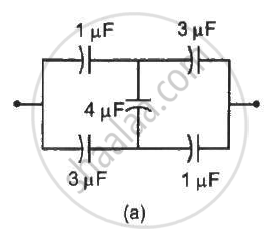
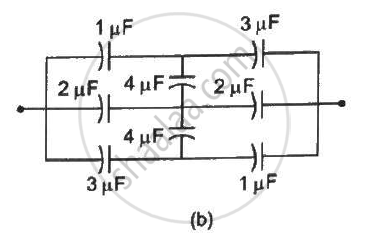
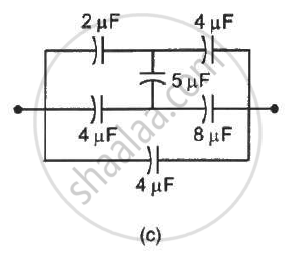
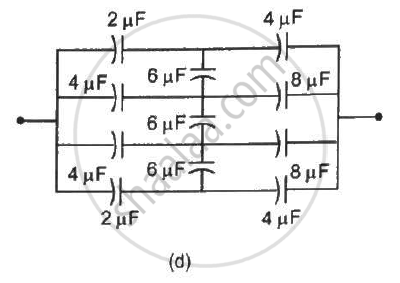
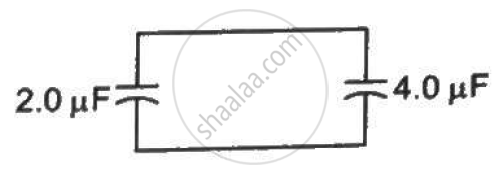
A capacitor of capacitance 2⋅0 µF is charged to a potential difference of 12 V. It is then connected to an uncharged capacitor of capacitance 4⋅0 µF as shown in figure . Find (a) the charge on each of the two capacitors after the connection, (b) the electrostatic energy stored in each of the two capacitors and (c) the heat produced during the charge transfer from one capacitor to the other.
The two square faces of a rectangular dielectric slab (dielectric constant 4⋅0) of dimensions 20 cm × 20 cm × 1⋅0 mm are metal-coated. Find the capacitance between the coated surfaces.
- Charge on each capacitor remains same and equals to the main charge supplied by the battery.
- Potential difference and energy distribute in the reverse ratio of capacitance.
- Effective capacitance is even les than the least of teh individual capacitances.
The capacitance of a parallel plate capacitor is 60 µF. If the distance between the plates is tripled and area doubled then new capacitance will be ______.
Two similar conducting spheres having charge+ q and -q are placed at 'd' seperation from each other in air. The radius of each ball is r and the separation between their centre is d (d >> r). Calculate the capacitance of the two ball system ______.

The material filled between the plates of a parallel plate capacitor has a resistivity of 200Ωm. The value of the capacitance of the capacitor is 2 pF. If a potential difference of 40V is applied across the plates of the capacitor, then the value of leakage current flowing out of the capacitor is ______.
(given the value of relative permittivity of a material is 50.)
Current versus time and voltage versus time graphs of a circuit element are shown in figure.
 |
 |
The type of the circuit element is ______.
A capacitor with capacitance 5µF is charged to 5 µC. If the plates are pulled apart to reduce the capacitance to 2 µF, how much work is done?
