Advertisements
Advertisements
Question
Explain in detail the effect of a dielectric placed in a parallel plate capacitor.
Advertisements
Solution
- When the capacitor is disconnected from the battery:
Consider a capacitor with two parallel plates each of cross-sectional area A and are separated by a distance d. The capacitor is charged by a battery of voltage V0 and the charge stored is Q0. The capacitance of the capacitor without the dielectric is
`"C"_0 = "Q"_0/"V"_0` .....(1)
The battery is then disconnected from the capacitor and the dielectric is inserted between the plates. The introduction of dielectric between the plates will decrease the electric field. Experimentally it is found that the modified electric field is given by
(a) Capacitor is charged with a battery
(b) Dielectric is inserted after the battery is disconnected
E = `"E"_0/ε_"r"` .....(2)
Here E0 is the electric field inside the capacitors when there is no dielectric and εr is the relative permeability of the dielectric or simply known as the dielectric constant. Since εr > 1, the electric field E < E0. As a result, the electrostatic potential difference between the plates (V = Ed) is also reduced. But at the same time, the charge Q0 will remain constant once the battery is disconnected. Hence the new potential difference is
V = Ed = `"E"_0/ε_"r" "d" = "V"_0/ε_"r"` ....(3)
We know that capacitance is inversely proportional to the potential difference. Therefore as V decreases, C increases. Thus new capacitance in the presence of a dielectric is
C = `"Q"_0/"V" = ε_"r" "Q"_0/"V"_0 = ε_"r" "C"_0` .....(4)
Since εr > 1, we have C > C0. Thus insertion of the dielectric constant εr increases the capacitance. Using equation,
C = `(ε_0"A")/"d"`
C = `(ε_"r"ε_0"A")/"d" = (ε"A")/"d"`......(5)
where ε = εrε0 is the permittivity of the dielectric medium. The energy stored in the capacitor before the insertion of a dielectric is given by U0 = `1/2 "Q"_0^2/"C"_0` .....(6)
After the dielectric is inserted, the charge Q0 remains constant but the capacitance is increased. As a result, the stored energy is decreased.
U = `1/2 "Q"_0^2/(2"C") = 1/2 "Q"_0^2/(2 ε_"r""C"_0) = "U"_0/ε_"r"`
Since εr> 1 we get U < U0. There is a decrease in energy because, when the dielectric is inserted, the capacitor spends some energy in pulling the dielectric inside.
- When the battery remains connected to the capacitor:
Let us now consider what happens when the battery of voltage V0 remains connected to the capacitor when the dielectric is inserted into the capacitor.
The potential difference V0 across the plates remains constant. But it is found experimentally (first shown by Faraday) that when dielectric is inserted, the charge stored in the capacitor is increased by a factor εr.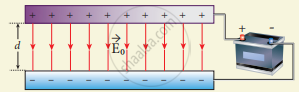
(a) Capacitor is charged through a battery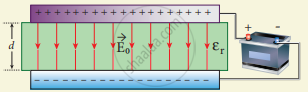
(b) Dielectric is inserted when the battery is connected.
Q = εrQ0 ….. (1)
Due to this increased charge, the capacitance is also increased. The new capacitance is
C = `"Q"_0/"V" = ε_"r" "Q"_0/"V"_0 = ε_"r" "C"_0` ....(2)
However the reason for the increase in capacitance in this case when the battery remains connected is different from the case when the battery is disconnected before introducing the dielectric.
Now, C0 = `(ε_0"A")/"d"` and, C = `(ε"A")/"d"` .....(3)
`"U"_0 = 1/2 "C"_0 "V"_0^2` ....(4)
Note that here we have not used the expression
`"U"_0 = 1/2 "V"_0^2 "C"_0`
because here, both charge and capacitance are changed, whereas in equation 4, V0 remains constant. After the dielectric is inserted, the capacitance is increased; hence the stored energy is also increased.
U = `1/2 "CV"_0^2 = 1/2 ε_"r" "CV"_0^2 = ε_"r" "U"_0`
Since er > 1 we have U > U0
It may be noted here that since voltage between the capacitor V0 is constant, the electric field between the plates also remains constant.
APPEARS IN
RELATED QUESTIONS
A spherical capacitor has an inner sphere of radius 12 cm and an outer sphere of radius 13 cm. The outer sphere is earthed and the inner sphere is given a charge of 2.5 µC. The space between the concentric spheres is filled with a liquid of dielectric constant 32.
(a) Determine the capacitance of the capacitor.
(b) What is the potential of the inner sphere?
(c) Compare the capacitance of this capacitor with that of an isolated sphere of radius 12 cm. Explain why the latter is much smaller.
A capacitor of unknown capacitance is connected across a battery of V volts. The charge stored in it is 300 μC. When potential across the capacitor is reduced by 100 V, the charge stored in it becomes 100 μC. Calculate The potential V and the unknown capacitance. What will be the charge stored in the capacitor if the voltage applied had increased by 100 V?
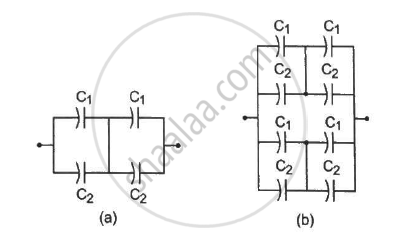
Take `C_1 = 4.0 "uF" and C_2 = 6.0 "uF"` in figure . Calculate the equivalent capacitance of the combination between the points indicated.
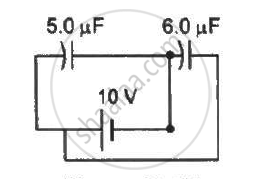
Find the charge supplied by the battery in the arrangement shown in figure.
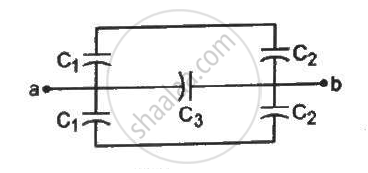
Find the equivalent capacitance of the system shown in figure between the points a and b.
A parallel-plate capacitor has plate area 100 cm2 and plate separation 1⋅0 cm. A glass plate (dielectric constant 6⋅0) of thickness 6⋅0 mm and an ebonite plate (dielectric constant 4⋅0) are inserted one over the other to fill the space between the plates of the capacitor. Find the new capacitance.
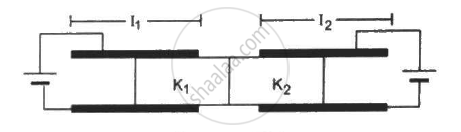
Figure shows two parallel plate capacitors with fixed plates and connected to two batteries. The separation between the plates is the same for the two capacitors. The plates are rectangular in shape with width b and lengths l1 and l2. The left half of the dielectric slab has a dielectric constant K1 and the right half K2. Neglecting any friction, find the ration of the emf of the left battery to that of the right battery for which the dielectric slab may remain in equilibrium.
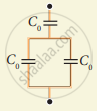
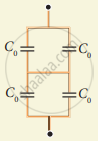
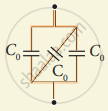
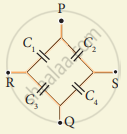
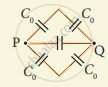
Calculate the resultant capacitances for each of the following combinations of capacitors.
A capacitor has charge 50 µC. When the gap between the plate is filled with glass wool, then 120 µC charge flows through the battery to capacitor. The dielectric constant of glass wool is ______.
If the plates of a parallel plate capacitor connected to a battery are moved close to each other, then:
- the charge stored in it. increases.
- the energy stored in it, decreases.
- its capacitance increases.
- the ratio of charge to its potential remains the same.
- the product of charge and voltage increases.
Choose the most appropriate answer from the options given below:
