Advertisements
Advertisements
Question
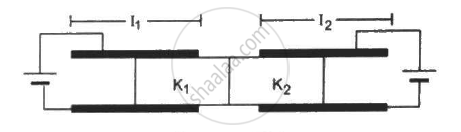
Figure shows two parallel plate capacitors with fixed plates and connected to two batteries. The separation between the plates is the same for the two capacitors. The plates are rectangular in shape with width b and lengths l1 and l2. The left half of the dielectric slab has a dielectric constant K1 and the right half K2. Neglecting any friction, find the ration of the emf of the left battery to that of the right battery for which the dielectric slab may remain in equilibrium.
Advertisements
Solution
Let the potential of the battery connected to the left capacitor be V1 and that of the battery connected to the right capacitor be V2.
Considering the left capacitor,
Let the length of the part of the slab inside the capacitor be x.
The left capacitor can be considered to be two capacitors in parallel.
The capacitances of the two capacitors in parallel are :-
`C_1 = (K_1∈_0bx)/d` , `C_2 = (∈_0b(l_1 - x))/d`
C1 is the part of the capacitor having the dielectric inserted in it and C2 is the capacitance of the part of the capacitor without dielectric.
As, C1 and C2 are in parallel.
Therefore, the net capacitance is given by
`C = C_1 + C_2`
`C = (K_1∈_0bx)/d + (∈_0b(l_1 - x))/d`
`C = (∈_0b)/d [l_1 + x(K_1 - 1)]`
Therefore, the potential energy stored in the left capacitor will be
`U = 1/2CV_1^2`
`U = (∈_0bV_1^2)/(2d)[l_1 + x(K_1 - 1)] ..........(1)`
The dielectric slab is attracted by the electric field of the capacitor and applies a force in left direction.
Let us consider electric force of magnitude F pulls the slab in left direction.
Let there be an infinitesimal displacement dx in left direction by the force F.
The work done by the force = F.dx
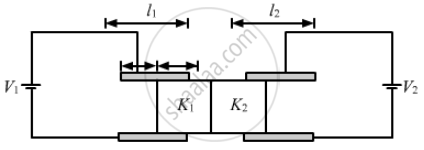
Let us consider a small displacement dx of the slab in the inward direction. The capacitance will increase, therefore the energy of the capacitor will also increase. In order to maintain constant voltage, the battery will supply extra charges, therefore the battery will do work.
Work done by the battery = change in energy of capacitor + work done by the force F on the capacitor
`dW_B = dU + dW_F`
Let the charge dq is supplied by the battery, and the change in the capacitor be dC
`dW_B = (dq).V = (dC). V^2`
`dU = 1/2(dC).V^2`
`(dC).V^2 = 1/2(dC).V^2 + F.dx`
`1/2(dC).V^2 = F.dx`
`⇒ F = 1/2 (dC)/dxV_1^2`
`⇒ F = 1/2d/dx ((∈_0b)/d[l_1 + x(K_1 - 1)])V_1^2`
`⇒ F = (∈_0bV_1^2(K_1 - 1))/(2d)`
`⇒ V_1^2 = (F xx 2d)/(∈_0b(K_1 - 1)) ⇒ V_1 = sqrt ((F xx 2d)/(∈_0b(K_1 - 1)))`
Similarly, for the right side the voltage of the battery is given by
`V_2 = sqrt ((F xx 2d)/(∈_0b(K_2 - 1)))`
Thus , the ratio of the voltages is given by
`V_1/V_2 = sqrt ((F xx 2d)/(∈_0b(K_1 - 1)))/sqrt ((F xx 2d)/(∈_0b(K_2 - 1))`
`⇒ V_1/V_2 = (sqrt(K_2 -1))/(sqrt(K_1 - 1))`
Thus, the ratio of the emfs of the left battery to the right battery is `V_1/V_2 = (sqrt(K_2 -1))/(sqrt(K_1 - 1))`
APPEARS IN
RELATED QUESTIONS
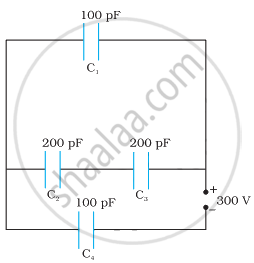
Obtain the equivalent capacitance of the network in Figure. For a 300 V supply, determine the charge and voltage across each capacitor.
As `C = (1/V) Q` , can you say that the capacitance C is proportional to the charge Q?
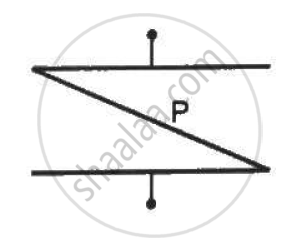
A thin metal plate P is inserted between the plates of a parallel-plate capacitor of capacitance C in such a way that its edges touch the two plates . The capacitance now becomes _________ .
The plates of a parallel-plate capacitor are made of circular discs of radii 5⋅0 cm each. If the separation between the plates is 1⋅0 mm, what is the capacitance?
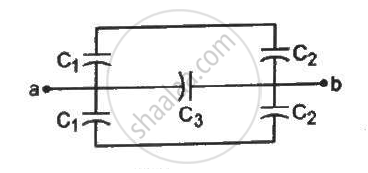
Find the equivalent capacitance of the system shown in figure between the points a and b.
A parallel-plate capacitor with the plate area 100 cm2 and the separation between the plates 1⋅0 cm is connected across a battery of emf 24 volts. Find the force of attraction between the plates.
Obtain the expression for capacitance for a parallel plate capacitor.
Explain in detail the effect of a dielectric placed in a parallel plate capacitor.
Derive the expression for resultant capacitance, when the capacitor is connected in parallel.
During a thunder storm, the movement of water molecules within the clouds creates friction, partially causing the bottom part of the clouds to become negatively charged. This implies that the bottom of the cloud and the ground act as a parallel plate capacitor. If the electric field between the cloud and ground exceeds the dielectric breakdown of the air (3 × 10⁶ Vm–1), lightning will occur.
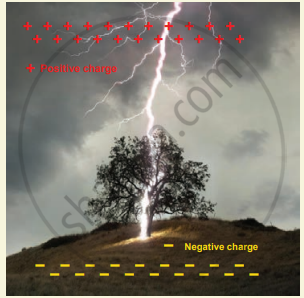
- If the bottom part of the cloud is 1000 m above the ground, determine the electric potential difference that exists between the cloud and ground.
- In a typical lightning phenomenon, around 25 C of electrons are transferred from cloud to ground. How much electrostatic potential energy is transferred to the ground?
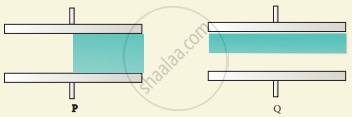
Capacitors P and Q have identical cross-sectional areas A and separation d. The space between the capacitors is filled with a dielectric of dielectric constant Er as shown in the figure. Calculate the capacitance of capacitors P and Q.
- Charge on each capacitor remains same and equals to the main charge supplied by the battery.
- Potential difference and energy distribute in the reverse ratio of capacitance.
- Effective capacitance is even les than the least of teh individual capacitances.
The capacitance of a parallel plate capacitor is 60 µF. If the distance between the plates is tripled and area doubled then new capacitance will be ______.
A parallel plate capacitor (A) of capacitance C is charged by a battery to voltage V. The battery is disconnected and an uncharged capacitor (B) of capacitance 2C is connected across A. Find the ratio of final charges on A and B.
In a series combination, which quantity is the same on each capacitor?
In a series combination, which capacitor gets a larger potential difference?
In a parallel combination, which statement describes the charges on the capacitors?
