Advertisements
Advertisements
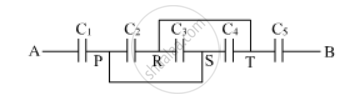
Question
Advertisements
Solution
(i)
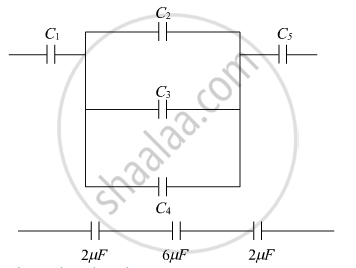
`1/C_(eqv)=1/2+1/6+1/2=7/6`
`C_(eqv)=6/7 μF`
(ii) `Q=C_(eqv)V`
`Q=6/7×7`
`Q=6 " μC"`
`E=1/2CV^2`
`E=1/2×6/7×(49)`
`E=21 J`
APPEARS IN
RELATED QUESTIONS
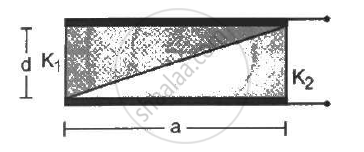
A capacitor is formed by two square metal-plates of edge a, separated by a distance d. Dielectrics of dielectric constant K1 and K2 are filled in the gap as shown in figure . Find the capacitance.
You are provided with 8 μF capacitors. Show with the help of a diagram how you will arrange minimum number of them to get a resultant capacitance of 20 μF.
Obtain the expression for capacitance for a parallel plate capacitor.
Three capacitors 2µF, 3µF, and 6µF are joined in series with each other. The equivalent capacitance is ____________.
The capacitance of a parallel plate capacitor is 60 µF. If the distance between the plates is tripled and area doubled then new capacitance will be ______.
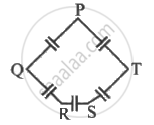
Five capacitor each of capacitance value C are connected as shown in the figure. The ratio of capacitance between P to R, and the capacitance between P and Q is ______.
Can the potential function have a maximum or minimum in free space?
The plates of a parallel plate capacitor are separated by d. Two slabs of different dielectric constant K1 and K2 with thickness `3/8 d and d/2`, respectively, are inserted in the capacitor. Due to this, the capacitance becomes two times larger than when there is nothing between the plates. If K1 = 1.25 K, the value of K1 is:
What is called the capacity of conductor?
