Advertisements
Advertisements
Question
Drive the expression for electric field at a point on the equatorial line of an electric dipole.
Advertisements
Solution
Electric Field for Points on the Equatorial Plane:

The magnitudes of the electric field due to the two charges +q and −q are given by,
`E_(+q)=q/(4piepsilon_0)1/(r^2+a^2)` .....(i)
`E_(-q)=q/(4piepsilon_0)1/(r^2-a^2)` .....(ii)
The directions of E+q and E−q are as shown in the figure. The components normal to the dipole axis cancel away. The components along the dipole axis add up.
∴ Total electric field
`E=-(E_(+q)+E_(-q))cos theta.hatp`[Negative sign shows that field is opposite to `hatp`]
`E=-(2qa)/(4piepsilon_0(r^2+a^2)^(3/2))hatp` .....(iii)
At large distances (r >> a), this reduces to
`E=-(2qa)/(4piepsilon_0(r^3))hatp` .....(iv)
`because vecp=qxxvec(2a)hatp`
`therefore E=(-vecp)/(4piepsilon_0(r^3))` (r >> a)
APPEARS IN
RELATED QUESTIONS
An electric dipole is placed at the centre of a sphere. Mark the correct options.
(a) The flux of the electric field through the sphere is zero.
(b) The electric field is zero at every point of the sphere.
(c) The electric field is not zero anywhere on the sphere.
(d) The electric field is zero on a circle on the sphere.
Two-point charges Q1 = 400 μC and Q2 = 100 μC are kept fixed, 60 cm apart in a vacuum. Find the intensity of the electric field at the midpoint of the line joining Q1 and Q2.
A uniform electric field is prevailing in X - direction in certain region. The coordinates of points P, Q, and R are (0, 0), (2, 0) and (0, 2) respectively. Which of the following alternatives is true for the potentials at these points?
When an electric dipole p is placed in a uniform electric field E then at what angle the value of torque will be maximum?
An electric dipole is placed at an angle of 30° to a non-uniform electric field. The dipole will experience ________.
A conic surface is placed in a uniform electric field E as shown in the figure such that the field is perpendicular to the surface on the side AB. The base of the cone is of radius R, and the height of the cone is h. The angle of the cone is θ.
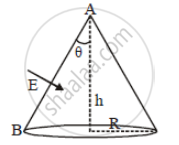
Find the magnitude of the flux that enters the cone's curved surface from the left side. Do not count the outgoing flux (θ < 45°)
Electric dipole consists of two charges of magnitude 0.1 µC separated by a distance of 2 cm. The dipole is in 5 an external field of 105 N/C. What maximum torque does the field exert on the dipole?
In an electric dipole, what is the locus of a point having zero potential?
An electric dipole consists of charges +q and −q separated by a distance 2a. Which of the following statements about the dipole is correct?
