Advertisements
Advertisements
Questions
Show that intensity of electric field at a point in broadside position of an electric dipole is given by:
E = `(1/(4 pi epsilon_0)) p/((r^2 + l^2)^(3//2))`
Where the terms have their usual meaning.
Show that intensity of electric field E at a point in broadside on position is given by:
E = `(1/(4 pi epsilon_0)) p/((r^2 + l^2)^(3//2))`,
where the terms have their usual meaning.
Advertisements
Solution
Consider a dipole of length 2l and moment `vec p`.
From the figure, resultant electric field intensity at C:
`vec E = vec E_A + vec E_B`
`|vec E_A| = 1/(4 pi epsilon_0) q/(r^2 + l^2)`
`|vec E_B| = 1/(4 pi epsilon_0) q/(r^2 + l^2)`
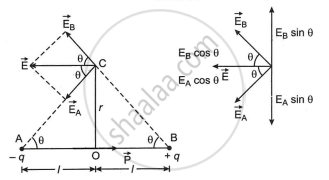
Sine components of `vec E_A` and `vec E_B` get cancelled each other as `|vec E_A| = |vec E_B|`.
The cosine components get added up to give the resultant field.
i.e., E = EA cos θ + EB cos θ
= `1/(4 pi epsilon_0) * q/(r^2 + l^2) cos theta + 1/(4 pi epsilon_0) * q/(r^2 + l^2) cos theta`
= `2 * 1/(4 pi epsilon_0) * q/(r^2 + l^2) cos theta`
= `2 xx 1/(4 pi epsilon_0) * q/(r^2 + l^2) xx l/(r^2 + l^2)^(1//2)`
= `1/(4 pi epsilon_0) (q(2 l))/((r^2 + l^2)^(3//2))`
E = `1/(4 pi epsilon_0) p/((r^2 + l^2)^(3//2))` ...[as p = q(2l)]
The above expression gives the magnitude of the field. The direction of the electric field E at C is opposite to the direction of the dipole moment `vec p`.
RELATED QUESTIONS
Define electric dipole moment.
An electric dipole consists of two opposite charges each 0.05 µC separated by 30 mm. The dipole is placed in an unifom1 external electric field of 106 NC-1. The maximum torque exerted by the field on the dipole is ______
A uniform electric field is prevailing in X - direction in certain region. The coordinates of points P, Q, and R are (0, 0), (2, 0) and (0, 2) respectively. Which of the following alternatives is true for the potentials at these points?
A short electric dipole bas a dipole moment of 16 x 10-9 C m. The electric potential due to the dipole at a point at a distance of 0.6 m from the centre of the dipole, situated on a line making an angle of 60° with the dipole axis is: ____________. `(1/(4piepsilon_0) = 9 xx 10^9 "Nm"^2// "C"^2)`
The electric intensity due to a dipole of length 10 cm and having a charge of 500 µC, at a point on the axis at a distance 20 cm from one of the charges in air, is:
The region surrounding a stationary electric dipole has ______
Polar molecules are the molecules ______.
A square surface of side l (m) in the plane of the paper. A uniform electric field E(V/m) also in the plane of the paper is limited only to the lower half of the square surface, the electric flux (in SI units) associated with the surface is ______.
The electric dipole moment \[\vec{p}\] is defined mathematically as:
For a short dipole, the ratio of the electric field on the axial line to that on the equatorial line (at the same distance r) is:
