Advertisements
Advertisements
प्रश्न
Show that intensity of electric field at a point in broadside position of an electric dipole is given by:
E = `(1/(4 pi epsilon_0)) p/((r^2 + l^2)^(3//2))`
Where the terms have their usual meaning.
Show that intensity of electric field E at a point in broadside on position is given by:
E = `(1/(4 pi epsilon_0)) p/((r^2 + l^2)^(3//2))`,
where the terms have their usual meaning.
Advertisements
उत्तर
Consider a dipole of length 2l and moment `vec p`.
From the figure, resultant electric field intensity at C:
`vec E = vec E_A + vec E_B`
`|vec E_A| = 1/(4 pi epsilon_0) q/(r^2 + l^2)`
`|vec E_B| = 1/(4 pi epsilon_0) q/(r^2 + l^2)`
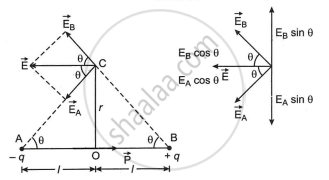
Sine components of `vec E_A` and `vec E_B` get cancelled each other as `|vec E_A| = |vec E_B|`.
The cosine components get added up to give the resultant field.
i.e., E = EA cos θ + EB cos θ
= `1/(4 pi epsilon_0) * q/(r^2 + l^2) cos theta + 1/(4 pi epsilon_0) * q/(r^2 + l^2) cos theta`
= `2 * 1/(4 pi epsilon_0) * q/(r^2 + l^2) cos theta`
= `2 xx 1/(4 pi epsilon_0) * q/(r^2 + l^2) xx l/(r^2 + l^2)^(1//2)`
= `1/(4 pi epsilon_0) (q(2 l))/((r^2 + l^2)^(3//2))`
E = `1/(4 pi epsilon_0) p/((r^2 + l^2)^(3//2))` ...[as p = q(2l)]
The above expression gives the magnitude of the field. The direction of the electric field E at C is opposite to the direction of the dipole moment `vec p`.
संबंधित प्रश्न
An electric dipole of length 2 cm, when placed with its axis making an angle of 60° with a uniform electric field, experiences a torque of \[8\sqrt{3}\] Nm. Calculate the potential energy of the dipole, if it has a charge \[\pm\] 4 nC.
An electric dipole is placed in an electric field generated by a point charge.
Two particles, carrying charges −q and +q and and of mass m each, are fixed at the ends of a light rod of length a to form a dipole. The rod is clamped at an end and is placed in a uniform electric field E with the axis of the dipole along the electric field. The rod is slightly tilted and then released. Neglecting gravity, find the time period of small oscillations.
When an electric dipole p is placed in a uniform electric field E then at what angle the value of torque will be maximum?
The electric field at a point on the equatorial plane at a distance r from the centre of a dipole having dipole moment `vec "p"` is given by, (r >> separation of two charges forming the dipole, `epsilon_0 - ` permittivity of free space) ____________.
An electric dipole of moment p is placed parallel to the uniform electric field. The amount of work done in rotating the dipole by 90° is ____________.
In the derivation of the electric field at the equatorial line, why do the components perpendicular to the dipole axis cancel out?
When a dipole is anti-aligned with the external electric field (θ = 180°), the potential energy is:
On the axial line of a dipole (θ = 0°), the electric potential is:
Carbon dioxide (CO₂) has zero net dipole moment even though it contains polar C=O bonds. Why?
